
Skip to content
The Encyclopedia of Horology

Tool · German horizontal dial

Horizontal Dial by Ulrich Schniep

Partially verified

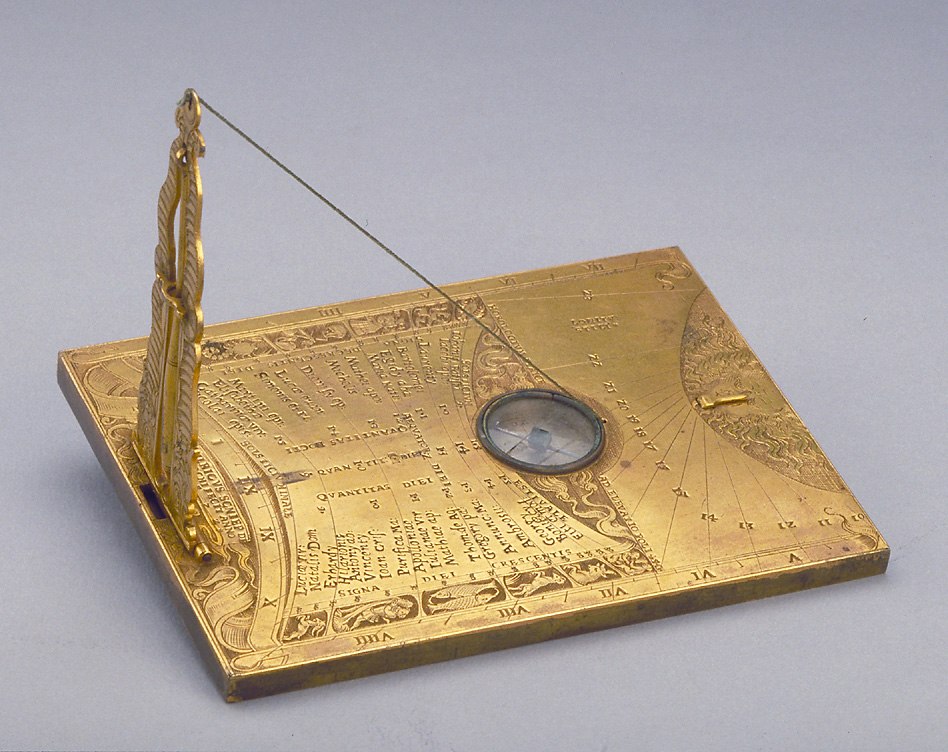
This horizontal dial, crafted from gilt brass, was made by Ulrich Schniep in Munich in 1572. Measuring 108 x 145 x 8 mm, the instrument features a central compass with cardinal points and magnetic deviation markings. It incorporates a pin gnomon dial designed for a 45-degree latitude, featuring Italian hours and a sun effigy. Additionally, it contains a string gnomon dial adjustable for three unspecified latitudes via holes in the folding plummet-holder, which is decorated with engraved twin dragons. The dial plate includes a comprehensive calendar marked with zodiacal signs, saint’s days, holy days, and equinoctial and solstitial inscriptions. A bead on the string allows for reading the length of the day and night using scales engraved at the centre of the calendar. The maker's signature and date are inscribed at the bottom edge. The object is part of the collection at the British Museum, formerly held by Octavius Morgan.

Horizontal dial in gilt brass by Ulrich Schniep, 1572.
Horizontal dial in gilt brass by Ulrich Schniep, 1572. — British Museum, London. Rights pending — permission not yet requested. Original source

Catalogue identity

Source
www.mhs.ox.ac.uk
Category
Tool · German horizontal dial
Maker / attribution
Ulrich Schniep
Reference
Not recorded
Catalogue / lot identifier
MLA 1888, 12-1.300
Source-reported date
1572
Source-reported place
Germany

Source-reported attribution and specifications are not independent authentication. A listing does not establish present ownership, current display, availability or permission to reproduce.

Object description

Construction and Design

The horizontal dial is constructed from a rectangular gilt brass plate. It features a central compass that identifies cardinal points and indicates magnetic deviation. The folding plummet-holder, which supports the string gnomon, is detailed with engravings of twin dragons on both sides and contains three distinct holes for adjusting the string to varying latitudes.

The dial plate surface accommodates two distinct timekeeping systems. A pin gnomon dial with a folding pin indicates Italian hours, while a string gnomon dial marks common hours. The instrument also integrates a calendar section displaying zodiacal signs, saint's days, and seasonal markers, including solstices and equinoxes, surrounded by engraved scrollwork.

Evidence for this section
  • “This horizontal dial consists of a gilt brass plate and a folding plummet-holder.”
  • “The plate has a compass at the centre, inscribed with the cardinal points 'S', 'OR', 'M', 'OC' and with magnetic deviation indicated”
  • “The string can be adjusted for three latitudes because there are three holes for the string in the plummet holder”
  • “The plummet-holder is engraved on both sides with twin dragons.”

Calendar and Timekeeping Functions

The calendar display is centrally located on the plate and features engraved figures of the zodiacal signs. It includes two sets of saint's and holy days to aid in date identification. Additionally, there are scales designated for 'QVANTITAS NOCTI' and 'QVANTITAS DIEI', which function in conjunction with a bead on the string gnomon to indicate the changing lengths of day and night throughout the year.

The length-of-day indications have been re-engraved, though original markings remain visible. The dial also features specific inscriptions related to the sun's position, including 'SOLSTICIVM ESTIVALE', 'SOLSTICIVM HI{E}MALE', and 'AEQVATOR DIEI', alongside the signature and date of the maker at the base of the plate.

Evidence for this section
  • “At the bottom of the dial is the indication 'HOROLOGIVM ITA{L}ICE AD ELEVATIO POLI 45 G'.”
  • “The indication of the length of the day has been re-engraved for ease of reading, but the first engraving has not been deleted.”
  • “By means of a bead, fixed on the string, it was also possible to read the length of the day and night, engraved at the centre of the calendar”

Provenance and Condition

The instrument was formerly in the collection of Octavius Morgan before being bequeathed to the British Museum. It is documented in F. A. B. Ward's catalogue of European scientific instruments held within the Department of Medieval and Later Antiquities.

Regarding the physical state of the dial, the museum reports that the glass covering the compass is cracked. The dial plate preserves its original engraving, including the signature and date, although secondary markings are present on the length-of-day scales.

Evidence for this section
  • “The instrument was bequeathed by Octavius Morgan and is described in F. A. B. Ward, A Catalogue of European Scientific Instruments in the Department of Medieval and Later Antiquities of the British Museum (London, 1981), p. 22, no.10.”
  • “the glass is cracked”

Open research questions

  • What are the three specific latitudes intended for the string gnomon holes?
  • What is the technical significance of the re-engraved length-of-day scales compared to the original markings?

Source evidence

Recorded claims and source quotations for Horizontal Dial by Ulrich Schniep
FieldSource-reported valueSource quotation
MakerUlrich Schniep“Ulrich Schniep”
Place of manufactureMunich“Munich”
Dimensions108 x 145 x 8 mm“108 x 145 x 8 mm”
MaterialGilt brass“Gilt brass”
Inventory numberMLA 1888, 12-1.300“MLA 1888, 12-1.300”
SignatureVLRICUS SC{H}NIEP DE MONACHI FECIT ANNO [star] 1572 [star]“VLRICUS SC{H}NIEP DE MONACHI FECIT ANNO [star] 1572 [star]”

Visible details

  • Folding plummet-holder engraved with twin dragons
  • Compass with marked cardinal points and magnetic deviation
  • Calendar displaying zodiacal signs and list of saints' days
  • Bead on the string for indicating day and night duration

Research qualifications

  • The glass over the compass is described as cracked.
  • The exact latitudes for the three-hole adjustment on the plummet-holder are not specified.

Photograph identity and source facts were screened before import; rights clearance remains pending.

Consulted source

Horizontal Dial

Reviewed 2026-10-26 · Record 24b77ea49a

Terms in this record

Glossary explanations for terms named in this object’s record.