
Skip to content
The Encyclopedia of Horology

Tool · German horizontal dial

Horizontal Sundial by Ulrich Schniep

Partially verified

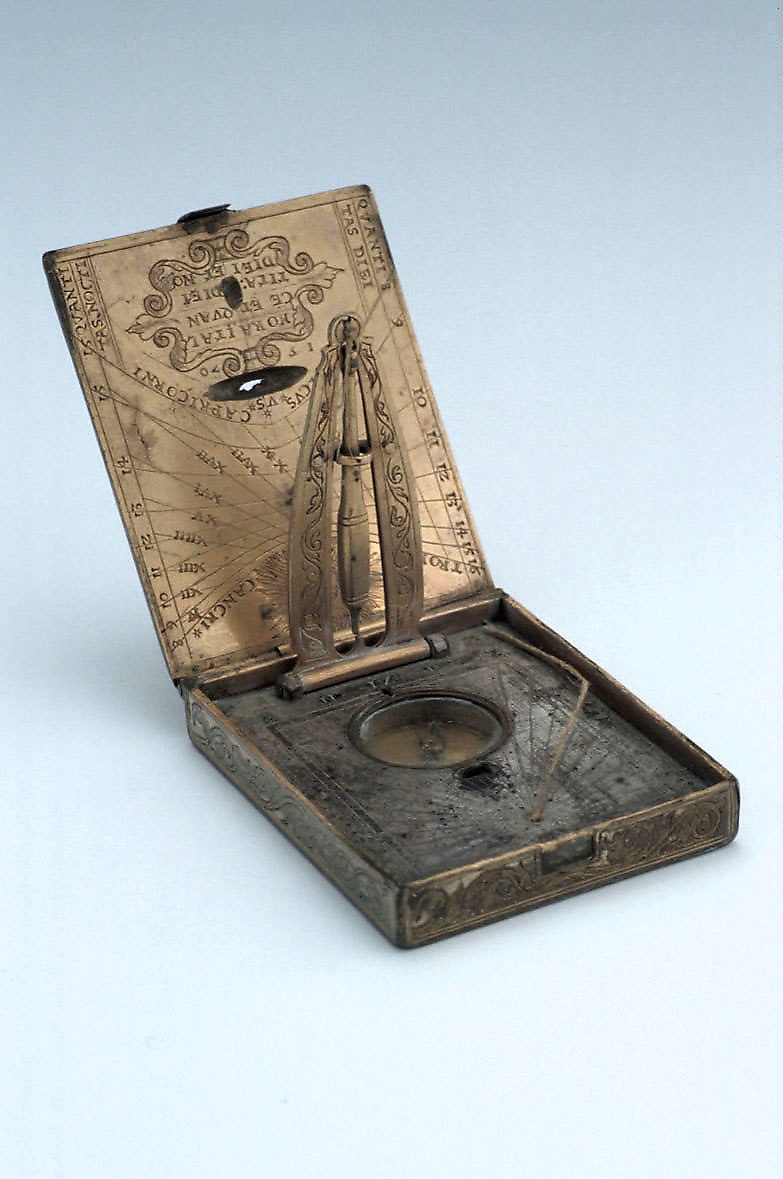
This 1570 horizontal sundial is signed by Ulrich Schniep and produced in Munich. Constructed from gilt and silvered brass, it measures 63 x 50 x 11 mm. The instrument takes the form of a box with a friction-clasped lid. The exterior surfaces are finished with engraved decoration, including the god Mercury between columns on the cover, foliage on the sides, and strapwork and foliage on the base. The interior houses two distinct timekeeping mechanisms: a horizontal pin-gnomon dial for Italian hours and length-of-day indications, and a horizontal string-gnomon dial for ordinary equal hours. The latter incorporates a decorated folding gnomon support with a plummet. An inset compass, 20 mm in diameter, is integrated into the dial plate. The instrument reflects the multi-functional approach of Schniep’s work, combining practical timekeeping and calendrical calculation within a portable, highly decorated format.

Horizontal sundial by Ulrich Schniep, 1570, viewed with the lid open to show the pin-gnomon and string-gnomon dial plates.
Horizontal sundial by Ulrich Schniep, 1570, viewed with the lid open to show the pin-gnomon and string-gnomon dial plates. — Museum of the History of Science, Oxford. Rights pending — permission not yet requested. Original source

Catalogue identity

Source
www.mhs.ox.ac.uk
Category
Tool · German horizontal dial
Maker / attribution
Ulrich Schniep
Reference
Not recorded
Catalogue / lot identifier
42561
Source-reported date
1570
Source-reported place
Germany

Source-reported attribution and specifications are not independent authentication. A listing does not establish present ownership, current display, availability or permission to reproduce.

Object description

External Decoration and Form

The instrument is constructed as a compact box finished in gilt and silvered brass, measuring 63 by 50 by 11 mm. It features a friction-clasped lid designed to protect the internal dial components. The external surfaces are used for extensive ornamental engraving, which is consistent with the design approach found in other instruments by Ulrich Schniep.

The cover lid depicts an engraving of the god Mercury positioned between two architectural columns. The perimeter of the box displays foliage engravings, while the base is finished with strapwork and foliage patterns. The overall design prioritizes decorative elements on the exterior, relegating the operational timekeeping components to the inner surfaces of the box and lid.

Evidence for this section
  • “The instrument is in the form of a box with a friction-clasped lid.”
  • “The outer faces are purely decorative: the outer face of the lid has an engraving of Mercury between two columns; the sides have foliage engraving; and the base carries strapwork and foliage.”

Internal Dials and Instrumentation

The interior of the box features two distinct sundials. The underside of the lid contains a horizontal pin-gnomon dial marked for Italian hours ranging from XI to XXII. This section also serves a calendrical function, with numerical lines from 8 to 16 indicating the length of the day and night between the Tropic of Cancer and the Tropic of Capricorn.

The main body of the box contains a horizontal string-gnomon dial for determining equal hours. This dial is silvered and numbered from 5 to 12 to 7, including half-hour marks. The gnomon support is designed to fold and incorporates a plummet for levelling. Additionally, a 20 mm compass is inset into the plate, featuring a cross of direction marked S, OR, M, and OC, and is calibrated for magnetic variation.

Evidence for this section
  • “The inner face of the cover carries a horizontal pin-gnomon dial marked for Italian hours XI to XXII.”
  • “The main box contains a horizontal string-gnomon dial with a decorated folding gnomon support sprung to the vertical and incorporating a plummet.”
  • “The inset compass is 20 mm in diameter; its bowl has a cross of direction labelled 'S', 'OR', 'M' and 'OC' and is marked for variation.”

Signatures and Provenance

The dial bears signatures attributed to Ulrich Schniep in two locations. On the pin-gnomon dial plate, the signature represented as [star] VS [star] and the date 1570 are located above a cartouche containing an inscription relating to Italian hours and the length of the day. A secondary signature, also marked [star] VS [star], appears near the southern end of the string-gnomon dial, adjacent to a latitude marking of 46 degrees.

The instrument is currently held by the Museum of the History of Science, Oxford, under inventory number 42561. Its provenance is identified as the Lewis Evans Collection, specifically piece G. 381.

Evidence for this section
  • “The pin is placed within a sun and the signature '[star] VS [star]' and date 1570 are placed above a cartouche with the inscription 'HORA ITALICE ET QVANTITA: DIEI DIEI [sic] ET NO'.”
  • “At the southern end is the latitude for which the instrument was to be used '[star] POLVS 46 GRAD ' and another signature '[star] VS [star]'.”
  • “Provenance: Lewis Evans Collection G. 381.”

Open research questions

  • What specific interpretation explains the '[star] VS [star]' signature attributed to Ulrich Schniep?
  • Does the latitude marking '46 GRAD' correspond to a specific city or region intended for the instrument's use, such as Salzburg?

Source evidence

Recorded claims and source quotations for Horizontal Sundial by Ulrich Schniep
FieldSource-reported valueSource quotation
MakerUlrich Schniep“Signed by Ulrich Schniep”
Date1570“Dated 1570”
MaterialGilt and silvered brass“Gilt and silvered brass”
Dimensions63 x 50 x 11 mm“63 x 50 x 11 mm”
Place of manufactureMunich“Munich”
ProvenanceLewis Evans Collection G. 381“Provenance: Lewis Evans Collection G. 381”
Inventory Number42561“Inventory number: 42561”

Visible details

  • The folding gnomon support contains an integrated plummet.
  • The compass bowl is labelled with directions S, OR, M, and OC.
  • The base of the sundial is decorated with foliage and strapwork engravings.
  • The pin-gnomon dial face includes markings for Tropicus Cancri and Tropicus Capricorni.

Research qualifications

  • The provenance is stated as the Lewis Evans Collection, but the source does not provide a comprehensive ownership history.
  • The source identifies the signature as '[star] VS [star]', attributed to Ulrich Schniep, without explaining the abbreviation.

Photograph identity and source facts were screened before import; rights clearance remains pending.

Consulted source

Horizontal Dial

Reviewed 2026-10-26 · Record 515dc350ea

Terms in this record

Glossary explanations for terms named in this object’s record.