
Skip to content
The Encyclopedia of Horology

Tool · German horizontal dial

Horizontal Dial

Partially verified

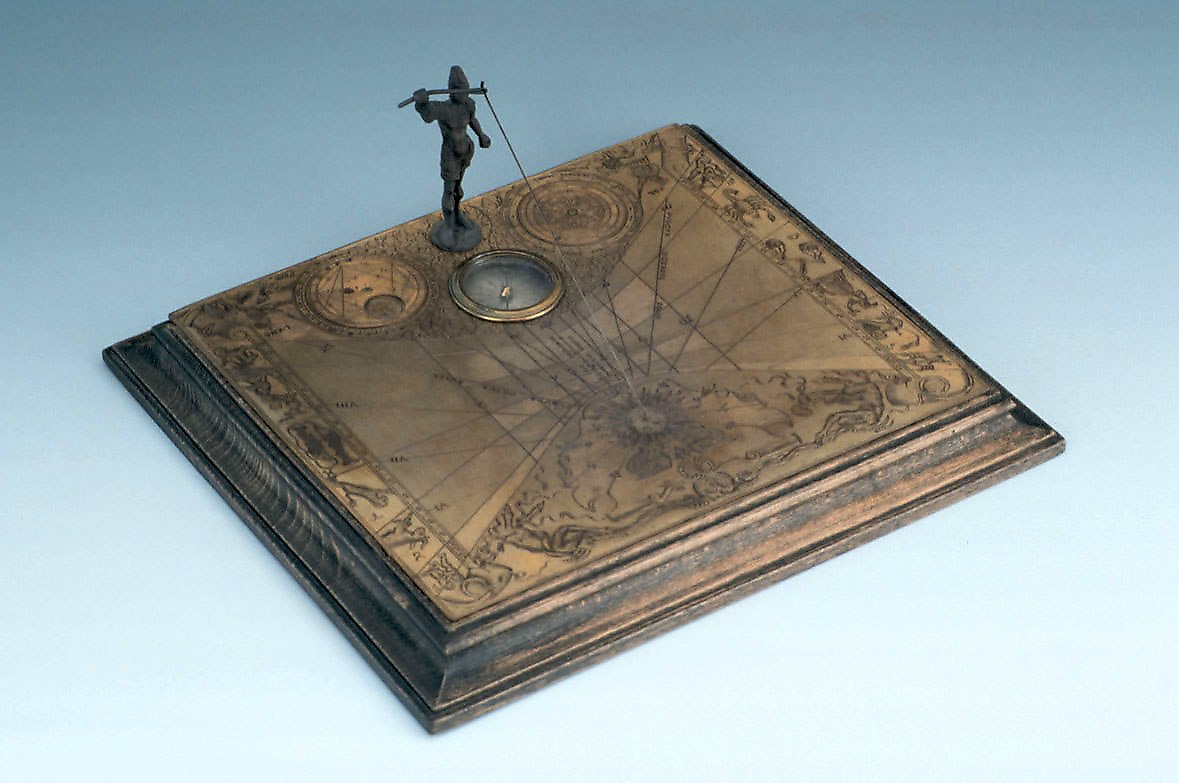
This 16th-century German horizontal sundial is crafted from gilt copper and silver and measures 213 by 185 mm. The instrument functions as a string-gnomon dial featuring dual sets of hour lines and solar declination markers accompanied by a zodiacal scale. It is distinguished by a silver figure, interpreted as a Roman soldier, which supports the gnomon rod. Integrated within the main plate are two volvelles: one for lunar tracking and aspectarium, and a second serving as an astrological planetary table for determining planetary hours. The instrument includes an inset glazed compass with a silvered base marked with sixteen directional points. The dial plate exhibits extensive decorative engraving featuring allegorical sun and moon motifs, foliage, and animals. The device is presently mounted on a modern wooden base. The maker is unsigned.

Horizontal sundial with a silver soldier figure supporting the gnomon and two integrated astrological volvelles.
Horizontal sundial with a silver soldier figure supporting the gnomon and two integrated astrological volvelles. — Museum of the History of Science, Oxford. Rights pending — permission not yet requested. Original source

Catalogue identity

Source
www.mhs.ox.ac.uk
Category
Tool · German horizontal dial
Maker / attribution
Not established
Reference
Not recorded
Catalogue / lot identifier
42534
Source-reported date
16th century
Source-reported place
Germany

Source-reported attribution and specifications are not independent authentication. A listing does not establish present ownership, current display, availability or permission to reproduce.

Object description

Dial Construction and Gnomon

The primary timekeeping surface is a horizontal string-gnomon dial. It displays two distinct sets of hour markings: one indicated by Roman numerals VI to XII to VI, and another marked between 4 to 8 and 4 to 8. The string gnomon is anchored centrally to the plate at a decorative sun emblem.

Beyond basic timekeeping, the plate contains lines for solar declination and zodiacal scales divided from 0 to 30. A meridian line facilitates the measurement of daylight and darkness duration, with markings labeled 'QVANTITAS DIEI' and 'QVANTITAS NOCTIS'. The instrument also includes parallel lines specifically designated for planetary hours.

Evidence for this section
  • “The basic dial is a horizontal string-gnomon dial, with two sets of hour-lines”
  • “The lower end of the string gnomon is secured to the plate at the centre of an elaborate emblem of the sun”
  • “The meridian line indicates the length of day and night by the numbers 9 to 16, marked ''QVANTITAS DIEI' and 'QVANTITAS NOCTIS'”

Astrological and Lunar Functions

The dial incorporates two complex volvelles situated on either side of the support figure. The first serves as a lunar volvelle and aspectarium, equipped with a fixed scale for hours and a movable disc displaying planetary aspects. An aperture and supplementary scale provide information regarding the age of the moon, which is read against the fixed plate beneath.

The second volvelle acts as an astrological planetary table. It identifies the planetary rulers for each hour of the day across the different days of the week. The days are inscribed on the base plate using Latin terminology. The moving disc contains a spiral scale designated for planetary hours, while the center features seven personifications representing the planets or days of the week.

Evidence for this section
  • “One is a lunar volvelle and aspectarium, with a fixed scale of hours 0 to XII twice”
  • “The second volvelle is a form of astrological planetary table, indicating the planets ruling the hours of the day”
  • “The moving disc has a spiral scale of planetary hours 1 to 12”

Decorative Elements and Compass

A glazed compass is inset into the plate in front of the soldier figure. The base is silvered and features sixteen directional points labeled with compass directions such as 'NORD' and 'NORD OST'. The compass provides necessary orientation for the sundial in the field.

The remaining surface of the plate is filled with dense, elaborate engraving. These decorations include a variety of animals, scrollwork, and foliage. Allegorical representations of the sun and the moon are integrated into the overall design scheme. The entire assembly is supported on a modern wooden base.

Evidence for this section
  • “In front of the figure is an inset glazed compass, with a silvered base with 16 named points”
  • “The spare surface of the plate has elaborate decorative engraving, including animals, scrolls and foliage”
  • “Modern wooden base.”

Open research questions

  • What was the identity or specific function of the object originally held in the silver figure's left hand?
  • Does the engraving style suggest a specific region within Germany for the instrument's manufacture?

Source evidence

Recorded claims and source quotations for Horizontal Dial
FieldSource-reported valueSource quotation
Inventory number42534“Inventory number: 42534”
Dimensions213 x 185 mm“213 x 185 mm”
MaterialGilt copper and silver“Gilt copper and silver”
CompassInset glazed compass with silvered base“inset glazed compass, with a silvered base”
Origin16th century German“16th century; German”
SignatureUnsigned“Unsigned”

Visible details

  • Silver figure of a soldier supporting the gnomon
  • Inset glazed compass with 16 cardinal points
  • Two integrated circular volvelles for astrological calculations
  • Extensive engraved decorative motifs including zodiac symbols

Research qualifications

  • The figure is missing an object formerly held in its left hand
  • The maker is unknown

Photograph identity and source facts were screened before import; rights clearance remains pending.

Consulted source

Horizontal Dial

Reviewed 2026-10-26 · Record d3753cec3e

Terms in this record

Glossary explanations for terms named in this object’s record.