
Skip to content
The Encyclopedia of Horology

Tool · German horizontal dial

Horizontal Dial

Partially verified

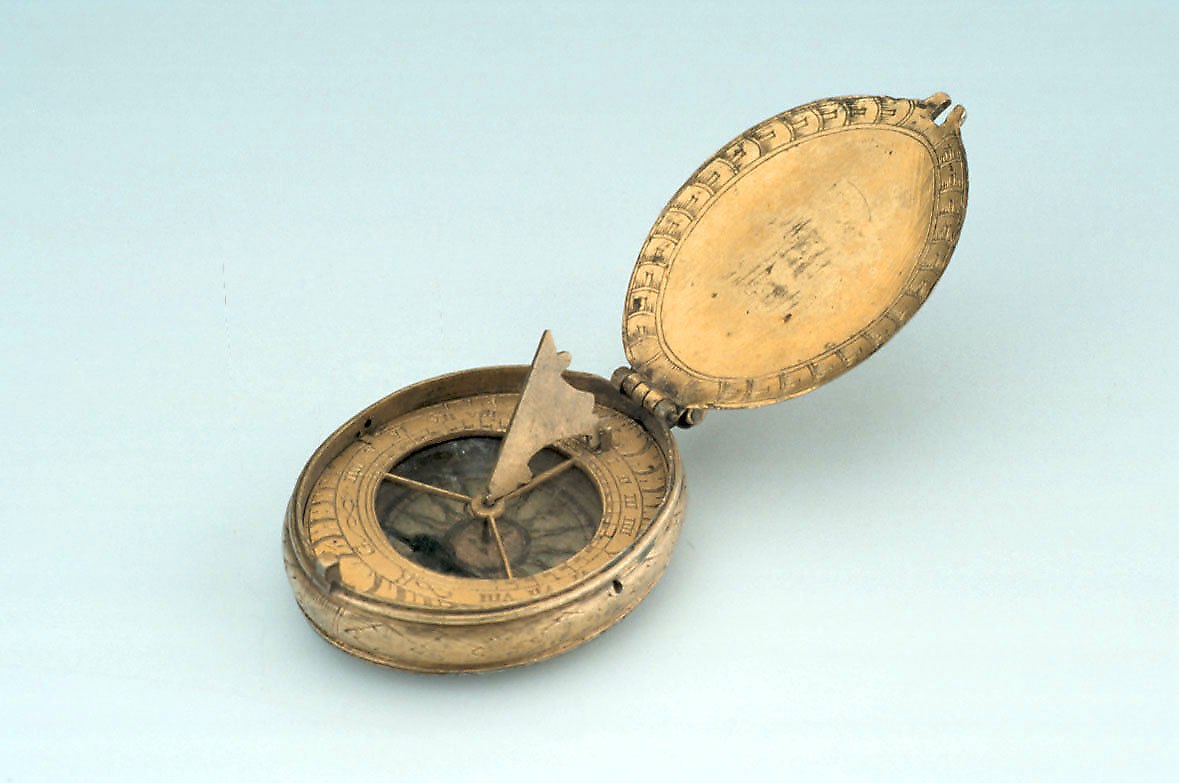
This circa 1600 horizontal dial is a portable German instrument constructed from gilt brass. Measuring 37 mm in diameter when closed, the object takes the form of an oval box equipped with a hinged lid. The exterior surfaces of the cover feature engravings of mythological figures, while the case edges display geometric ornamentation. Internally, the instrument contains a compass with a hand-painted card featuring a sun effigy in blue and pink, produced from an engraved plate. The hour ring is engraved with numerical markings from IIII to XII to VIII, accompanied by the initials 'R G'. A gnomon is positioned over the compass. The inclusion of a suspension ring indicates the object may have functioned as a wearable medallion. The maker is unidentified, and the initials 'R G' are interpreted by current scholarship as representing the owner or commissioner rather than the craftsman.

A portable German horizontal dial, circa 1600, featuring a hinged lid, integrated compass, and gnomon.
A portable German horizontal dial, circa 1600, featuring a hinged lid, integrated compass, and gnomon. — Museum of the History of Science, Oxford. Rights pending — permission not yet requested. Original source

Catalogue identity

Source
www.mhs.ox.ac.uk
Category
Tool · German horizontal dial
Maker / attribution
Not established
Reference
Not recorded
Catalogue / lot identifier
39983
Source-reported date
circa 1600
Source-reported place
Germany

Source-reported attribution and specifications are not independent authentication. A listing does not establish present ownership, current display, availability or permission to reproduce.

Object description

Case and Exterior Construction

The instrument is housed within an oval brass box finished in gilt. The exterior of the lid and the underside of the base are both engraved with mythological figures. The peripheral edge of the oval container is further decorated with geometric patterns. The box is designed to be portable and compact, measuring 37 mm in diameter.

A small metal ring is affixed to the side of the casing, facilitating its suspension. This feature leads researchers to suggest that the dial may have been worn as a piece of jewellery, specifically a medallion, rather than remaining strictly stationary on a surface.

Evidence for this section
  • “The oval-shaped dial consists of a brass box with its lid.”
  • “On the top and the bottom of the cover are engraved two mythological figures.”
  • “Around the edge of the oval box is geometrical decoration.”
  • “The dial also has a ring for suspension that suggests its possible use as a medallion.”

Dial and Compass Assembly

Internally, the instrument comprises a horizontal sundial integrated with a magnetic compass. The hour lines are engraved directly onto the base plate, surrounding the compass well, with the sequence labeled from IIII to XII to VIII. A triangular gnomon is present to cast the necessary shadow for timekeeping.

The compass card itself is distinct, having been printed from an engraved metal plate. It is finished with hand-painted details, specifically a sun effigy rendered in blue and pink tones. The inner rim of the lid is also engraved with geometric border motifs to match the exterior aesthetic.

Evidence for this section
  • “Inside the brass case itself is a compass with a card, printed from an engraved plate and hand painted with a sun effigy in blue and pink.”
  • “The hour lines are engraved around the compass and numbered from IIII to XII to VIII”

Signatures and Documentation

The instrument bears no maker's signature, remaining anonymous. The only personal mark found on the piece is the set of initials 'R G', which are engraved on the hour ring.

The item is currently held by the Museum of the History of Science in Oxford, recorded under inventory number 39983. Documentation characterizes it as a product of German craft from approximately 1600.

Evidence for this section
  • “Unsigned”
  • “On the hour ring are engraved the initials 'R G', probably belonging to the owner or the commissioner rather than the maker”

Open research questions

  • Can the mythological figures be identified to provide insight into the patron 'R G'?
  • Is there archival evidence to confirm the provenance of the object before its acquisition by the museum?

Source evidence

Recorded claims and source quotations for Horizontal Dial
FieldSource-reported valueSource quotation
Inventory number39983“Inventory number: 39983”
Dimensions37 mm“37 mm in diameter (closed)”
MaterialGilt brass“Gilt brass”
OriginGerman“circa 1600; German”
MarkingsR G“On the hour ring are engraved the initials 'R G'”
DecorationMythological figures and geometric patterns“On the top and the bottom of the cover are engraved two mythological figures.”
FunctionHorizontal sundial with compass“Horizontal Dial”

Visible details

  • Oval gilt brass box construction
  • Gnomon folds inward to allow the lid to close
  • Hand-painted compass card with sun motif
  • Suspension loop attached to the box casing

Research qualifications

  • The initials 'R G' remain unattributed to a specific individual
  • The specific identity of the mythological figures is not documented

Photograph identity and source facts were screened before import; rights clearance remains pending.

Consulted source

Horizontal Dial

Reviewed 2026-10-26 · Record 0673d24da9

Terms in this record

Glossary explanations for terms named in this object’s record.