
Skip to content
The Encyclopedia of Horology

Pocket watch · Quarter-repeating musical watch

Henry Capt Quarter Repeating Musical Watch with Automatons

Partially verified

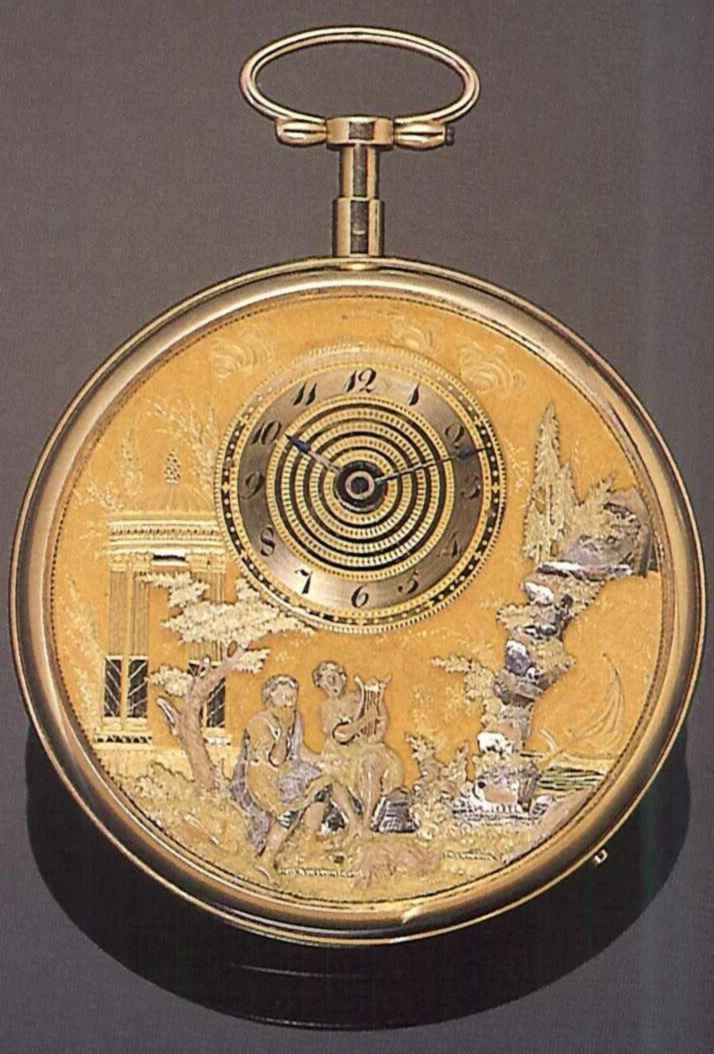
This 18-carat gold quarter-repeating musical watch is attributed to the maker Henry Capt of Geneva, circa 1800. The watch features an 'Empire' double-body case with a reeded band and an engine-turned back. The dial plate is decorated with an engraved classical landscape and displays an off-set gold dial with Breguet numerals and an engine-turned center, complemented by steel spade hands. An applied three-colored chiselled gold automaton scene located below the dial depicts a lady playing a lyre and a shepherd playing pan pipes. The watch is powered by a gilt brass full plate double-train movement equipped with cylindrical pillars, a cylinder escapement, a plain three-armed balance with a diamond endstone, and an English-type cock. A musical train consisting of six piled-up steel blades and a pointed barrel completes the horological assembly. The diameter of the piece measures 58 mm.

Front view of the Henry Capt quarter-repeating watch showing the off-set dial and automaton pastoral scene.
Front view of the Henry Capt quarter-repeating watch showing the off-set dial and automaton pastoral scene. — Antiquorum. Rights pending — permission not yet requested. Original source

Catalogue identity

Source
catalog.antiquorum.swiss
Category
Pocket watch · Quarter-repeating musical watch
Maker / attribution
Henry Capt
Reference
Not recorded
Catalogue / lot identifier
114
Source-reported date
circa 1800
Source-reported place
Switzerland

Source-reported attribution and specifications are not independent authentication. A listing does not establish present ownership, current display, availability or permission to reproduce.

Object description

Case and Dial Construction

The watch is housed in an 18-carat gold 'Empire' style case. The case construction is defined by a double-body profile featuring a reeded band detail and engine-turned decoration on the back. A gilt brass cuvette protects the internal movement mechanisms.

The watch face features an off-set dial arrangement with Breguet-style numerals and an engine-turned center. This dial is placed against a gold dial plate engraved with a classical landscape. Below the dial, an applied automaton scene crafted from three-colored chiselled gold depicts a pastoral tableau, specifically a lady playing a lyre accompanied by a shepherd with pan pipes.

Evidence for this section
  • “Double body 'Empire' case with reeded band and engine turned back”
  • “Small gold off-set dial with Breguet numerals and engine turned centre”
  • “Gold dial plate with an engraved classical landscape and below the dial, an applied three coloured chiselled gold automaton pastoral scene”

Movement and Musical Train

The timepiece utilizes a gilt brass full plate double-train movement. Mechanical components include cylindrical pillars and a cylinder escapement. The balance is a plain three-armed design utilizing a diamond endstone and an English-type cock. The balance assembly is partially sunk on a gilt brass plate decorated with engraved scrolls.

The musical functionality is managed by a dedicated train featuring six steel blades configured in a piled-up arrangement, operated by a pointed barrel mechanism.

Evidence for this section
  • “Gilt brass full plate double train movement, with cylindrical pillars, cylinder escapement”
  • “Musical train with six piled up steel blades and a pointed barrel”
  • “A similar movement is described in the Ree's Cyclopaedia, p. 280, pl. XLIII.”

Signature and Provenance

The movement is signed by the Geneva-based maker Henry Capt. The maker's mark is found inscribed on the movement dust rim. No additional provenance or ownership history is provided by the auction documentation.

The object is associated with the Chia Ch'ing period. The attribution and dating to circa 1800 reflect the auction house's records regarding the maker's known period of operation and stylistic characteristics.

Evidence for this section
  • “Henry Capt, Genève, circa 1800 (signed on the movement dust rim).”
  • “Chia Ch'ing.”

Open research questions

  • Are there identifiable hallmarks on the gold case to confirm manufacture in Geneva circa 1800?
  • What is the mechanical connection between the musical train and the quarter-repeating function in this specific movement?

Source evidence

Recorded claims and source quotations for Henry Capt Quarter Repeating Musical Watch with Automatons
FieldSource-reported valueSource quotation
MakerHenry Capt, Geneve“Henry Capt, Genève”
Datecirca 1800“circa 1800”
Diameter58 mm“Diam. 58 mm”
Material18-carat gold“18-carat gold”
EscapementCylinder escapement“cylinder escapement”
Signature LocationMovement dust rim“signed on the movement dust rim”

Visible details

  • Off-set dial with engine-turned center
  • Automaton scene featuring a lady with a lyre and a shepherd with pan pipes
  • Gold case with reeded band
  • Steel spade hands with blued tips

Research qualifications

  • Attribution to Henry Capt is based on a signature on the movement dust rim
  • The association with the Chia Ch'ing period is noted without further historical context

Photograph identity and source facts were screened before import; rights clearance remains pending.

Consulted source

Henry Capt, Genève, circa 1800 (signed on the movement dust rim). Chia Ch'ing.

Reviewed 2026-10-26 · Record f5634defb3

Terms in this record

Glossary explanations for terms named in this object’s record.