
Skip to content
The Encyclopedia of Horology

Clock · Carriage clock

Henry Capt Geneva carriage clock with calendar and alarm dials

Partially verified

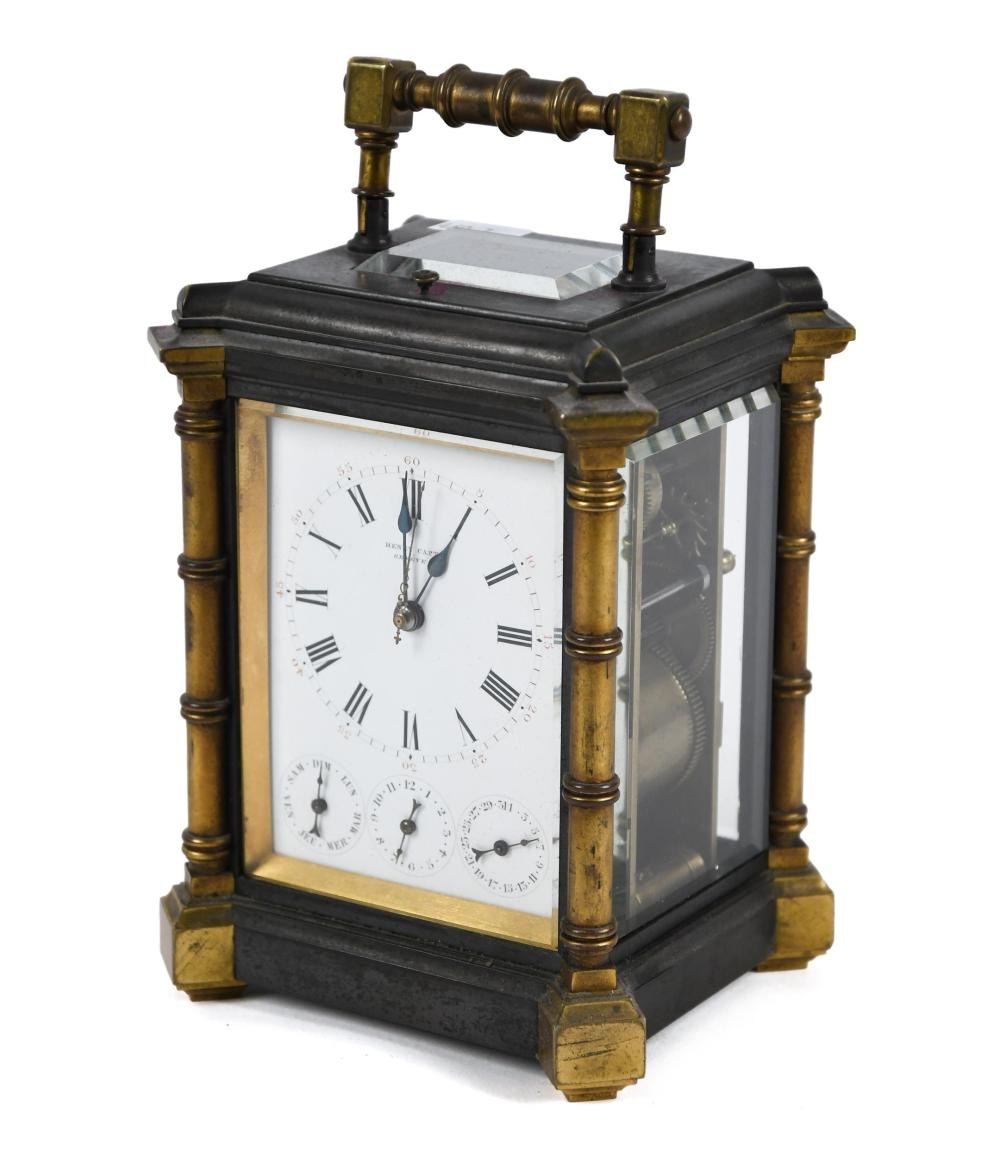
This 19th-century brass and glass carriage clock is designed in an Aesthetic faux-bamboo style, featuring ring-turned columns at each corner and a matching hinged handle atop a dark-finished stepped case. The white enamel dial features black Roman hour numerals, outer Arabic five-minute markings, and the maker signature Henry Capt Geneve. Three subsidiary dials positioned beneath indicate the day of the week, alarm time, and calendar date. A beveled oval or rectangular top window reveals the escapement platform, while clear beveled side panels expose the brass movement inside.

Three-quarter front view of the Henry Capt carriage clock showing bamboo-style corner pillars and calendar dials
Three-quarter front view of the Henry Capt carriage clock showing bamboo-style corner pillars and calendar dials — William Smith Auctions. Rights pending — permission not yet requested. Original source

Catalogue identity

Source
www.invaluable.com
Category
Clock · Carriage clock
Maker / attribution
Henry Capt
Reference
Not recorded
Catalogue / lot identifier
479
Source-reported date
19th C.
Country
Switzerland

Source-reported attribution and specifications are not independent authentication. A listing does not establish present ownership, current display, availability or permission to reproduce.

Object description

Case Architecture and Aesthetic Design

The lot is catalogued as a 19th-century carriage clock measuring 6 inches high, 4.5 inches wide, and 4 inches deep, constructed from brass and glass. Visible features include turned brass faux-bamboo columns that frame the four case corners and form the articulated carrying handle.

Beveled glass panels enclose the movement, including a viewing aperture on the top plate. The top plate and plinth moldings exhibit a contrasting darkened, patinated finish against the gilded brass elements.

Evidence for this section
  • “A good 19th C. brass and glass carriage clock with original case.”
  • “Clock 6”H x 4.5”W x 4”D.”
  • “Turned brass faux-bamboo columns frame the four case corners and form the articulated carrying handle.”
  • “Beveled glass panels enclose the movement, including a viewing aperture on the top plate.”
  • “The top plate and plinth moldings exhibit a contrasting darkened, patinated finish against the gilded brass elements.”

Dial Configuration and Indications

The primary time display features a white enamel dial showing Roman hour numerals, signed 'HENRY CAPT GENEVE'. The auction description similarly records the dial signed as 'Henry Capt Geneve'.

Arranged horizontally beneath the main dial are three subsidiary indicators. The auction house notes it 'Includes three additional dials, including date, day and alarm', visibly laid out as the day of the week on the left, a 12-hour alarm setting dial in the center, and the day of the month on the right.

Evidence for this section
  • “Dial signed, ‘Henry Capt Geneve’.”
  • “Includes three additional dials, including date, day and alarm.”
  • “The white enamel primary dial shows Roman hour numerals and is signed 'HENRY CAPT GENEVE'.”
  • “Three subsidiary dials are set in a horizontal row below the main dial, showing day of the week, 12-hour alarm setting, and numerical day of the month.”

Reported Movement Marks and Accessories

The cataloguer notes that the back of the works is signed 'Aigulles' (likely a misreading of 'Aiguilles' for hand-setting).

According to the auction house's condition report, the 'Original key winds clock, alarm sounds, case with heavy wear.' However, neither the key nor the original case are depicted in the primary auction photograph, leaving their precise form unrecorded in this imagery.

Evidence for this section
  • “Back of works signed Aigulles.”
  • “Original key winds clock, alarm sounds, case with heavy wear.”

Open research questions

  • Does the back plate bear an actual maker stamp or caliber serial numbers beneath or beside the setting inscription misread as 'Aigulles'?
  • What escapement mechanism is fitted to the platform visible through the top viewing panel?
  • What are the specific materials and style of the reported outer travel case?

Source evidence

Recorded claims and source quotations for Henry Capt Geneva carriage clock with calendar and alarm dials
FieldSource-reported valueSource quotation
Dial SignatureHenry Capt Geneve“Dial signed, ‘Henry Capt Geneve’.”
Subsidiary DialsDate, day and alarm“Includes three additional dials, including date, day and alarm.”
Movement InscriptionAigulles“Back of works signed Aigulles.”
Dimensions6”H x 4.5”W x 4”D“Clock 6”H x 4.5”W x 4”D.”
Original Case ConditionHeavy wear (as reported by auctioneer)“case with heavy wear.”
Reported FunctionalityKey winds clock, alarm sounds (per seller condition report)“Original key winds clock, alarm sounds”

Visible details

  • Turned brass faux-bamboo columns frame the four case corners and form the articulated carrying handle.
  • The white enamel primary dial shows Roman hour numerals and is signed 'HENRY CAPT GENEVE'.
  • Three subsidiary dials are set in a horizontal row below the main dial, showing day of the week, 12-hour alarm setting, and numerical day of the month.
  • Beveled glass panels enclose the movement, including a viewing aperture on the top plate.
  • The top plate and plinth moldings exhibit a contrasting darkened, patinated finish against the gilded brass elements.

Research qualifications

  • The auction house notes the back of the works is signed 'Aigulles' (likely misreading 'Aiguilles' setting instructions).
  • The original carrying case and winding key mentioned in the auction description are not depicted in the primary photograph.
  • The country of origin is attributed based on the dial signature 'Geneve'.

Photograph identity and source facts were screened before import; rights clearance remains pending.

Consulted source

Sold at Auction: 19TH C. HENRY CAPT GENEVA CARRIAGE CLOCK.

Reviewed 2026-10-21 · Record 1d328ed48d

Terms in this record

Glossary explanations for terms named in this object’s record.