
Skip to content
The Encyclopedia of Horology

Tool · Italian quadrant

Giovanni Battista Giusti Quadrant

Partially verified

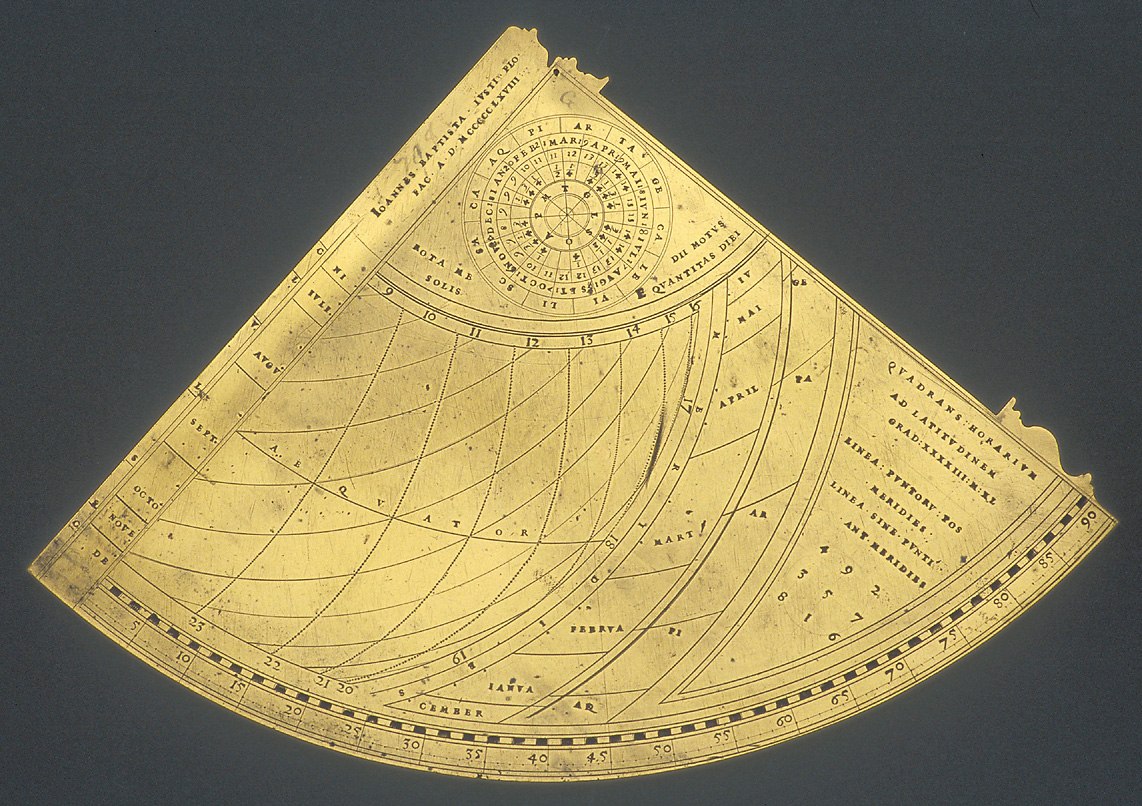
This brass quadrant, measuring 226 mm in radius, was made by Giovanni Battista Giusti in Florence in 1568. The instrument is designed for the latitude of 43° 40'. One face contains an Italian hours dial, a zodiacal calendar, a magic square, and a 'Rota medii motus et quantitas diei' for calculating solar motion and day length. The limb is calibrated from 0 to 90 degrees. Two decoratively moulded block sights are positioned on the top edge, and a hole at the apex allows for a suspension thread. The reverse side features an engraved shadow square of 12. The maker, Giovanni Battista Giusti, was active in Florence during the 1560s. This instrument currently resides in the collection of the Istituto e Museo di Storia della Scienza, Firenze.

Front face of the Giovanni Battista Giusti quadrant dated 1568.
Front face of the Giovanni Battista Giusti quadrant dated 1568. — Istituto e Museo di Storia della Scienza, Firenze. Rights pending — permission not yet requested. Original source

Catalogue identity

Source
www.mhs.ox.ac.uk
Category
Tool · Italian quadrant
Maker / attribution
Giovanni Battista Giusti
Reference
Not recorded
Catalogue / lot identifier
2520
Source-reported date
1568
Source-reported place
Italy

Source-reported attribution and specifications are not independent authentication. A listing does not establish present ownership, current display, availability or permission to reproduce.

Object description

Instrument Layout and Calibrations

The front face of the quadrant is densely engraved with multiple astronomical and mathematical scales. The limb features a scale of 90 degrees, divided into 1-degree increments indicated by alternating hatched and unhatched markings, with larger divisions marked by dots at five-degree intervals. The instrument is calibrated specifically for the latitude of 43 degrees and 40 minutes, which corresponds to Florence.

In addition to the timekeeping scales, the quadrant includes a circular table in the apex labeled 'Rota medii motus solis e quantitatis diei'. This feature consists of six concentric rings used to track solar motion and determine the length of the day. A three-by-three magic square is also present on the face, totaling 15 in all directions, as well as a diagram for an Italian hours dial marked from 9 to 23.

Evidence for this section
  • “The limb of the instrument carries a scale of 90? reading to 1?”
  • “In the apex of the instrument is a circular table labelled 'ROTA MEDII MOTVS SOLIS E QUANTITATIS DIEI'”
  • “Below this is a magic square of three, '4 9 2' / '3 5 7' / '8 1 6' which totals 15 in all directions”

Sighting and Orientation Features

For the purpose of solar observation, the quadrant is equipped with two decoratively moulded block sights fixed to the top edge. These sights allow the user to align the instrument with the sun. A suspension hole located at the apex of the quadrant serves as an attachment point for a thread cursor and runner.

By using a plumb-line suspended from this point, the user could determine the sun's height. The altitude is indicated by reading the degrees on the limb of the quadrant. The morning hours on the Italian hours dial are delineated with smooth lines, while afternoon hours are marked with dotted lines.

Evidence for this section
  • “Two decoratively moulded block sights are set along the top edge of the instrument”
  • “there is a suspension hole for a thread cursor and runner at the centre/apex of the quadrant”
  • “The hour was indicated with the aid of a plumb-line which allowed the height of the sun at a particular moment to be calculated”

Reverse and Inscriptions

The reverse of the brass instrument contains an engraved shadow square of 12. This scale is divided into segments read to half-points and is numbered in groups of three. The numbered divisions extend as radial lines toward the center of the quadrant to assist in calculations.

The front face bears a specific inscription providing the instrument's function and the latitude for which it was calculated. The maker, Giovanni Battista Giusti, is also identified by a signature on the instrument, dating his work to 1568.

Evidence for this section
  • “The reverse of the instrument is engraved with a shadow square of 12”
  • “The maker, Giovanni Battista Giusti , worked in Florence in the 1560s, probably in the Medicean metal workshop.”
  • “the remaining space at the right of the instrument carries the inscription 'QUADRANS: HORARIVM AD LATITVDINEM GRAD{I}: XXXXIII: M{INUTA} XL”

Open research questions

  • What specific evidence links the work of Giusti to the Medicean metal workshop?
  • How frequently were magic squares included on sixteenth-century horological instruments as functional or symbolic components?

Source evidence

Recorded claims and source quotations for Giovanni Battista Giusti Quadrant
FieldSource-reported valueSource quotation
MakerGiovanni Battista Giusti“Signed by Giovanni Battista Giusti”
Date1568“Dated 1568; Florence”
MaterialBrass“Brass; 226 mm in radius”
Latitude43° 40'“calibrated for the latitude of 43? 40'”
Inventory Number2520“Inventory number: 2520”
InscriptionQuadrans horarium“'QUADRANS: HORARIVM AD LATITVDINEM GRAD{I}: XXXXIII: M{INUTA} XL LINEA: PVNTORV{M}: POS{T} MERIDIES. LINEA SINE PVNTI ANT{E} MERIDIES'”

Visible details

  • Limb calibrated from 0 to 90 degrees
  • Magic square displaying numbers 4, 9, 2 / 3, 5, 7 / 8, 1, 6
  • Two decoratively moulded block sights along the top edge
  • Circular rotating table in the apex

Research qualifications

  • Originality of the plumb-line cursor not confirmed
  • Exact workshop production location within Florence is based on probability

Photograph identity and source facts were screened before import; rights clearance remains pending.

Consulted source

Quadrant

Reviewed 2026-10-26 · Record abc356bc19