
Skip to content
The Encyclopedia of Horology

Clock · Table clock / Tower clock (Tischuhr)

German gilt and engraved brass Augsburg tower clock (Tischuhr)

Partially verified

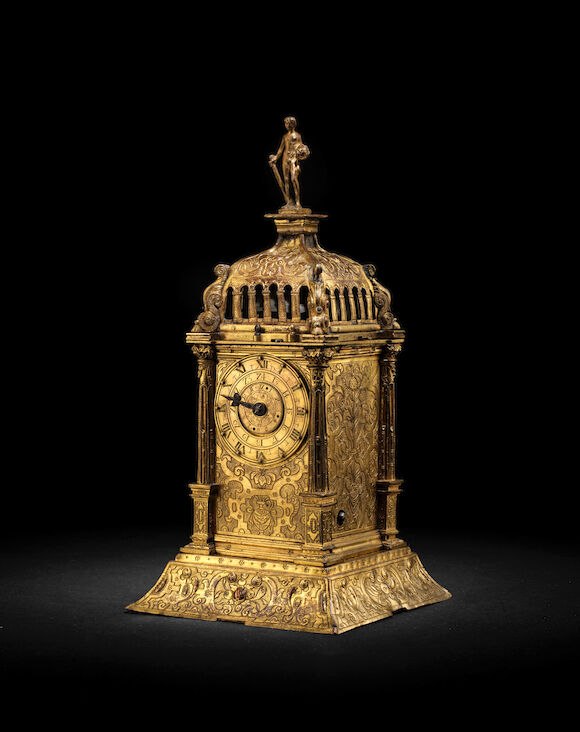
This late 16th-century German tower clock, or Tischuhr, is housed in an architectural gilt and engraved brass case surmounted by a standing figure of Hercules holding his club and the Hesperides. The case features a repoussé cupola above an arched colonnade concealing an internal bell, flanked by stop-fluted Corinthian columns on pedestal bases and engraved with strapwork, urns, and foliage. The 2.5-inch main dial incorporates a Roman chapter ring with twelve touch pins for night reading, an inner 13–24 Arabic hour ring, and a central alarm-setting disc. Its spring-driven movement uses chain fusees, a verge escapement with an un-sprung balance wheel, and countwheel striking.

Three-quarter front view of the German gilt and engraved brass Augsburg tower clock showing the dial, arched colonnade, and Hercules finial
Three-quarter front view of the German gilt and engraved brass Augsburg tower clock showing the dial, arched colonnade, and Hercules finial — Bonhams. Rights pending — permission not yet requested. Original source

Catalogue identity

Source
www.bonhams.com
Category
Clock · Table clock / Tower clock (Tischuhr)
Maker / attribution
Not established
Reference
Not recorded
Catalogue / lot identifier
112
Source-reported date
late 16th century
Country
Germany

Source-reported attribution and specifications are not independent authentication. A listing does not establish present ownership, current display, availability or permission to reproduce.

Object description

Case Construction and Decoration

The clock is housed in an architectural gilt brass case, identified by the source as an Augsburg 'Tischuhr'. The structure is supported by a spreading foot and features fluted Corinthian columns with pedestal bases at each corner. The upper section comprises a repoussé cupola and an arched colonnade that conceals an internal bell.

The surface is ornamented with engraved strapwork, urns, and foliate panels, along with punched fruit and flowerheads. The top of the case features a cast gilt figure of Hercules shown holding his club and the Hesperides.

Evidence for this section
  • “The case surmounted by the standing figure of Hercules holding the Hesperides and his club”
  • “over a repoussé cupola raised on a colonnade of Roman arches, the bell hidden from view behind”
  • “each corner set with a cast volute scroll on a stop-fluted Corinthian column on a pedestal base”
  • “decorated with engraved urns issuing exotic flowers within burnished strapwork and foliage; further decorated with punched flowerheads and fruit.”

Dial and Timekeeping Features

The main 2.5-inch brass dial features a Roman chapter ring equipped with twelve raised touch pins to facilitate tactile reading at night. The dial also displays an inner 13-24 hour Arabic numeral band and a central alarm-setting disc.

The rear panel contains a 2-inch solid numbered countwheel with a scroll-engraved center, accompanied by a blued steel hand that indicates the hour of the last strike.

Evidence for this section
  • “The main 2.5 inch brass dial with Roman chapter ring framed by twelve raised touch pins for tactile reading at night, with simple half-hour marks enclosing the 13-24 hour Arabic inner hour band, and central alarm-setting disc”
  • “The rear panel set with a 2 inch solid numbered countwheel with scroll-engraved centre and blued steel hand indicating the last hour struck.”

Movement and Functionality

The movement is spring-driven with steel top and bottom plates connected by square-section posts. The going and strike trains are arranged sequentially, each utilizing a chain fusee. Timekeeping is regulated by a verge escapement with an un-sprung steel balance wheel on the top plate.

The strike train utilizes a countwheel mechanism acting on a single bell, which also serves for the alarm. The alarm is wound from the right side. The source notes the clock is currently ticking, striking, and has an operational alarm.

Evidence for this section
  • “The spring driven movement with steel top and bottom plates united by square-section posts”
  • “the going with chain fusee and verge escapement with un-sprung steel balance wheel mounted on the top plate”
  • “the strike train to the rear with separate chain fusee, countwheel strike on a single bell and alarm work sounding on the same bell.”
  • “Ticking, striking and with operational alarm.”

Open research questions

  • What specific workshop techniques or stylistic markers within the engraving might further narrow the origin beyond the general Augsburg attribution?
  • Has the internal movement, specifically the un-sprung balance wheel, undergone documented modifications or replacements since its original 16th-century manufacture?
  • Are the touch pins on the chapter ring consistent with original period craftsmanship or do they represent later additions?

Source evidence

Recorded claims and source quotations for German gilt and engraved brass Augsburg tower clock (Tischuhr)
FieldSource-reported valueSource quotation
Finial figureStanding figure of Hercules holding the Hesperides and his club“The case surmounted by the standing figure of Hercules holding the Hesperides and his club”
Tactile dial featuresTwelve raised touch pins for tactile reading at night“Roman chapter ring framed by twelve raised touch pins for tactile reading at night”
Movement escapementVerge escapement with un-sprung steel balance wheel“verge escapement with un-sprung steel balance wheel mounted on the top plate”
Height27 cm (11 inches)“27cms (11ins) high.”

Visible details

  • Gilt brass architectural case with extensively engraved and chased strapwork and foliate panels
  • Open arched colonnade below the dome concealing the bell
  • Surmounted by a cast gilt figure of Hercules standing atop the cupola
  • Fluted Corinthian corner columns resting on square pedestal bases above a wide spreading plinth
  • Winding aperture visible on the lower right flank for the alarm mechanism

Research qualifications

  • No maker's signature or workshop mark is documented in the auction catalogue
  • Internal movement plates, countwheel, and rear panel are not visible from the frontal image

Photograph identity and source facts were screened before import; rights clearance remains pending.

Terms in this record

Glossary explanations for terms named in this object’s record.