Construction and Design
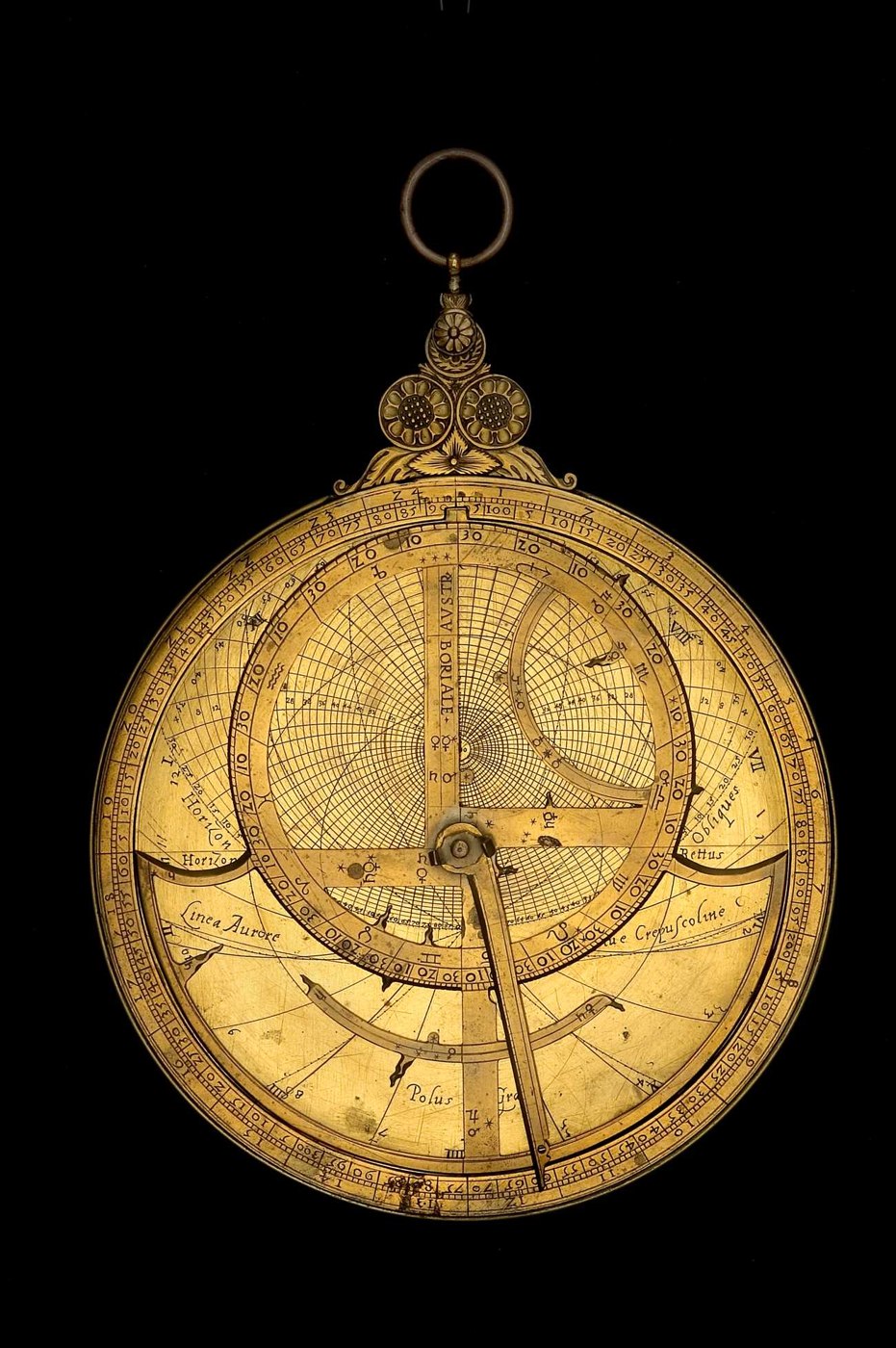
The astrolabe is a brass instrument of German manufacture dated 1521. Its structural integrity relies on a three-lobed throne, which is fixed to the body via an integrated base. The lower two lobes feature five-petalled floral motifs, while the upper lobe is finished with floral engraving. The suspension system consists of a simple round cross-section ring attached to an eye-bolt type shackle, which rotates on an ∩-shaped member secured by a pin to the throne.
The mater and limb form a singular construction unit. To enhance the edge of the limb, a brass wire is inlaid within a scored groove. The device utilizes a nut and bolt to secure the rete, which is of an unusual ecliptic-type design. The rete features 37 star pointers of varied types, specifically flamant, knobbed, and engraved examples, and is clearly marked for North and South orientations.
Evidence for this section
- “The throne is of the
three-lobed type made of brass attached with integrated base”
- “The mater and limb are of one-piece
construction”
- “The rete is attached using a nut & bolt.”
Back Plate and Scales
The reverse side of the instrument serves as a complex astronomical calculator. The upper area displays a diagram depicting the celestial spheres, complete with planetary symbols. Four central blank spheres are present, which the records suggest may have been intended for symbols representing the four elements. The back is organized into five functional circular scales: degree, zodiacal signs, calendar, lunar mansions, and a shadow square.
The degree scale covers 0-90 degrees, while the zodiacal scale provides divisions for the signs. The calendar scale tracks the days of the year, complemented by a scale for lunar mansions. In the lower quadrants, a shadow square calibrated from 1 to 12 fingers is engraved, providing the capability to perform height and distance calculations based on shadows.
Evidence for this section
- “The upper portion of the back bears
a diagram of the celestial spheres, with planetary symbols
for each of the planetary spheres.”
- “The back contains 5 scales of the following types:
Degree; Zodiacal signs; Calendar; Lunar Mansions; Shadow
square.”
Alidade and Rete Details
The inclusion of three separate plates allows for varying latitudes from 35 to 52 degrees, extending the utility of the instrument across different geographic regions.
The ecliptic scale on the rete is divided into 30-degree segments. The star pointers are categorized with specific astronomical data, such as declination and mediation, visible on the rete itself. These pointers are categorized by type, showing a mix of flamant and engraved styles, with specific stars like Deneb Kaitos, Rigel, and Betelgeuse marked on the rete's surface.
Evidence for this section
- “Pointer Single-ended, counter-changed.”
- “Alidade Double-ended, counter-changed.”
- “There are 3 plates
with latitudes ranging from 35°0' to 52°0' .”