
Skip to content
The Encyclopedia of Horology

Clock · Drop-dial wall timepiece

George III mahogany drop-dial fusee wall timepiece by William Dutton and Sons

Partially verified

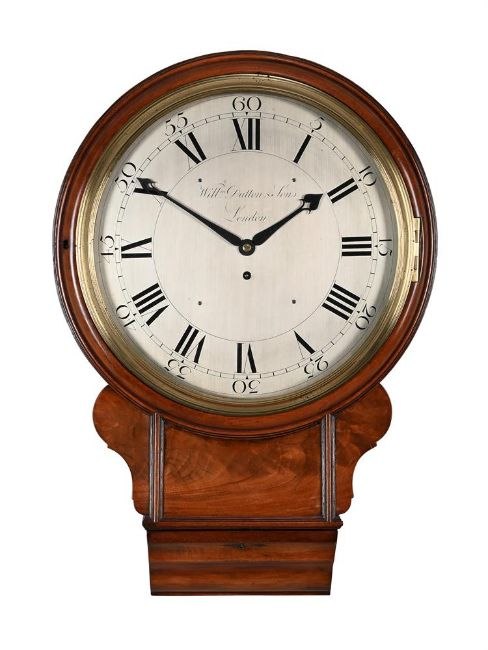
This George III drop-dial fusee wall timepiece reflects Mudge and Dutton's 'Phase II' design and is attributed by the source to William Dutton and Sons, London, circa 1794. The clock features a four knopped pillar single-fusee movement with thick plates and an anchor escapement regulated by a steel-rod lenticular bob pendulum stamped with serial number 227. Its 14-inch circular silvered brass dial presents Roman numerals, outer Arabic five-minute divisions, and pierced blued steel spade hands. The movement is housed inside a mahogany drop-trunk box case characterized by flame-figured paneling, flanking ogee-shaped ears, and a moulded bottom flap.

Frontal view of the George III mahogany drop-dial fusee wall timepiece showing the dial and drop-trunk case
Frontal view of the George III mahogany drop-dial fusee wall timepiece showing the dial and drop-trunk case — Dreweatts. Rights pending — permission not yet requested. Original source

Catalogue identity

Source
auctions.dreweatts.com
Category
Clock · Drop-dial wall timepiece
Maker / attribution
William Dutton and Sons
Reference
Not recorded
Catalogue / lot identifier
206
Source-reported date
circa 1794
Country
United Kingdom
Source-reported serial
227

Source-reported attribution and specifications are not independent authentication. A listing does not establish present ownership, current display, availability or permission to reproduce.

Object description

Case and Dial Construction

The timepiece is housed in a mahogany drop-trunk box case. The upper section consists of a circular cushion-moulded wooden surround, fitted with a glazed cavetto moulded cast brass bezel. The drop-trunk section includes a flame-figured panel within an astragal moulded surround, flanked by ogee-shaped ears, with an angled cavetto and ogee moulded hinged flap at the base. The case includes doors to each side behind the dial.

The 14-inch circular silvered brass dial features Roman numerals and an outer track with Arabic five-minute divisions. The dial is signed 'Will'm Dutton & Sons, London' at the center and uses pierced blued steel spade hands.

Evidence for this section
  • “the 14 inch circular silvered brass Roman numeral dial signed Will'm Dutton & Sons, London to centre and with Arabic five minutes beyond the outer minute track”
  • “with pierced blued steel spade hands set behind generous hinged glazed cavetto moulded cast brass bezel applied to the circular cushion-moulded wooden surround, secured to the front of the substantially constructed drop-trunk box case with doors to each side behind the dial”
  • “over flame-figured panel within astragal moulded surround flanked by ogee-shaped ears, the base with angled cavetto over ogee moulded hinged flap to front.”

Movement and Pendulum

The clock utilizes a four knopped pillar single-fusee movement with plates measuring 6.25 by 5 inches. The movement is secured to a seatboard, which is part of the internal case structure, by large screws passed through the bottom pillars.

The train includes an anchor escapement regulated by a steel-rod lenticular bob pendulum. The pendulum features an effective length of approximately 15 inches, a T-bar suspension, and a calibrated rating nut. The rear of the bob is stamped with the serial number 227.

Evidence for this section
  • “The four knopped pillar single fusee movement with thick plates measuring 6.25 by 5 inches secured via large screws through the bottom pillars onto a seatboard forming part of the internal structure of the case”
  • “the train terminating with anchor escapement regulated by steel-rod lenticular bob pendulum with an effective length of approximately 15 inches, incorporating T-bar suspension, calibrated rating nut and stamped with serial number 227 to the rear of the bob”

Historical Context and Attribution

The timepiece is identified as a 'Phase II' design, a style noted in exhibition literature as dating between approximately 1780 and 1810. Based on the serial number 227, the source attributes the manufacture to circa 1794.

The maker is recorded as William Dutton and Sons, a partnership formed in approximately 1775. The source states that William Dutton died in 1794, and identifies this timepiece as likely being among the last produced by the firm under his leadership.

Evidence for this section
  • “David Penney in Tobias Birch's 2019 exhibition catalogue THOMAS MUDGE AND WILLIAM DUTTON, A PERFECT PARTNERSHIP notes that the Mudge and Dutton dial clocks of 'Phase II' design were made between around 1780-1810”
  • “From the serial number stamped on the pendulum of the present timepiece it can be dated to around 1794”
  • “William Dutton died in 1794 leaving the business to be continued very much in his tradition by his sons Thomas and Matthew.”
  • “would have been one of the last timepieces produced by the William Dutton and Sons before the death of William senior in November of that year.”

Open research questions

  • Are there any identifying stamps or marks on the case or dial plate other than the signature and pendulum serial number?
  • Does the source provide images confirming the internal movement condition or side door mechanisms?

Source evidence

Recorded claims and source quotations for George III mahogany drop-dial fusee wall timepiece by William Dutton and Sons
FieldSource-reported valueSource quotation
Maker and originWilliam Dutton and Sons, London“WILLIAM DUTTON AND SONS, LONDON, No. 227 CIRCA 1794”
Movement designFour knopped pillar single fusee movement with anchor escapement“The four knopped pillar single fusee movement with thick plates measuring 6.25 by 5 inches secured via large screws through the bottom pillars onto a seatboard forming part of the internal structure of the case, the train terminating with anchor escapement”
Pendulum detailsSteel-rod lenticular bob pendulum stamped with serial number 227“regulated by steel-rod lenticular bob pendulum with an effective length of approximately 15 inches, incorporating T-bar suspension, calibrated rating nut and stamped with serial number 227 to the rear of the bob”
Dial description14-inch circular silvered brass dial with Roman numerals and Arabic five minutes“the 14 inch circular silvered brass Roman numeral dial signed Will'm Dutton & Sons, London to centre and with Arabic five minutes beyond the outer minute track”
Case dimensions66 cm high, 44.5 cm wide, 16 cm deep“66cm (26ins) high, 44.5cm (17.5ins) wide, 16cm (6.25ins) deep.”
Dimensions66 cm high, 44.5 cm wide, 16 cm deep“66cm (26ins) high, 44.5cm (17.5ins) wide, 16cm (6.25ins) deep.”

Visible details

  • Circular silvered dial framed by a brass bezel with visible side hinge.
  • Mahogany drop-trunk section features a flame-veneered rectangular panel bordered by moulded edges and shaped side ears.
  • Pierced blued steel spade hour and minute hands point to black Roman numerals and an outer track.

Research qualifications

  • Internal movement, side doors, and rear pendulum markings are not visible in the provided image.
  • Dating to circa 1794 is based on catalogue serial number analysis and maker history rather than an inscribed date.

Photograph identity and source facts were screened before import; rights clearance remains pending.

Terms in this record

Glossary explanations for terms named in this object’s record.