
Skip to content
The Encyclopedia of Horology

Clock · Swinging regulator

French swinging regulator clock

Partially verified

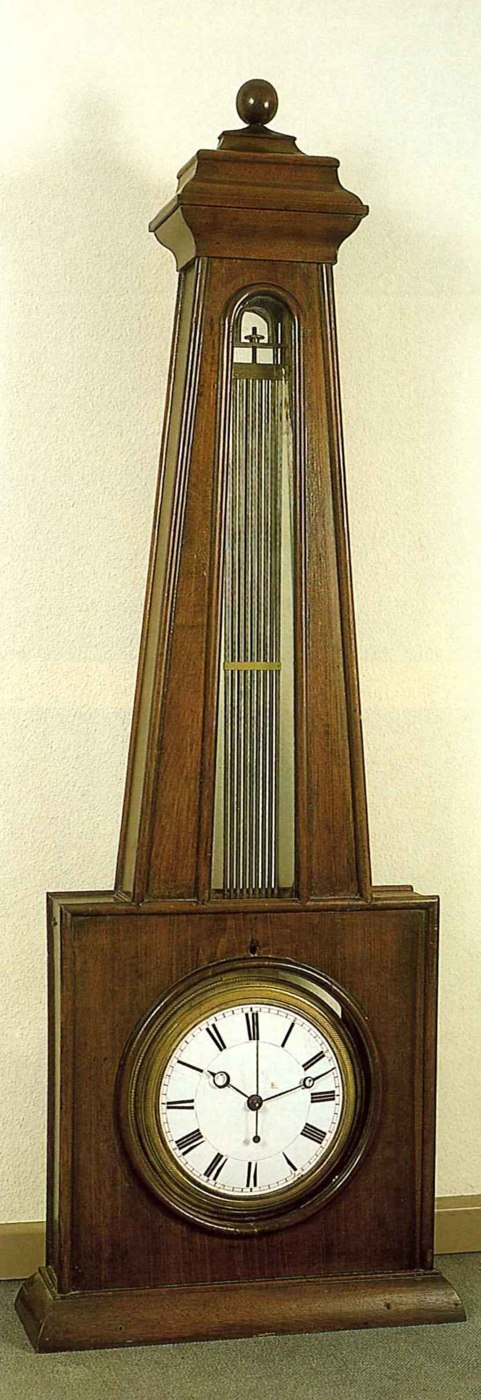
This swinging regulator, or balancelle, is a double-faced clock manufactured in France circa 1870. The clock is housed in a shaped mahogany case featuring a moulded pediment topped with a bail finial, which conceals the bracket supporting the pendulum mechanism. The clock is glazed on both faces, with white enamel dials on the front and rear, both marked with Roman numerals and equipped with blued steel Breguet hands for the centre seconds and time indication. The movement is constructed of brass and utilizes a going barrel with a pin-wheel escapement. The mechanism is mounted within the bob of a gridiron, second-beating pendulum suspended by a knife-edge. The clock measures 156 by 54 by 16 centimeters. The source notes that such regulators were intended for display in shop windows, allowing time to be read from both the street and the shop interior.

A front view of the mahogany-cased swinging regulator showing the gridiron pendulum and dial.
A front view of the mahogany-cased swinging regulator showing the gridiron pendulum and dial. — Antiquorum. Rights pending — permission not yet requested. Original source

Catalogue identity

Source
catalog.antiquorum.swiss
Category
Clock · Swinging regulator
Maker / attribution
Not established
Reference
Not recorded
Catalogue / lot identifier
131
Source-reported date
circa 1870
Source-reported place
France

Source-reported attribution and specifications are not independent authentication. A listing does not establish present ownership, current display, availability or permission to reproduce.

Object description

Case and Dial Construction

The clock is housed in a mahogany case characterized by its shaped, moulded exterior and vertical taper. The structure includes a moulded pediment featuring a bail finial, which serves to hide the bracket that suspends the clock's pendulum.

The design incorporates glazing on both faces, accommodating the double-sided nature of the regulator. Both the front and rear faces possess white enamel dials with Roman numerals. The time display on both sides is completed by blued steel Breguet-style hands.

Evidence for this section
  • “chaped mahogany case”
  • “moulded pediment with bail finial disclosing the braket supporting the regulator”
  • “White enamel on the front with Roman numerals and centre seconds”
  • “White enamel on the rear face with Roman numerals”

Movement and Pendulum

The clock utilizes a brass movement powered by a going barrel. Regulation is maintained through a pin-wheel escapement system. The movement is integrated directly into the bob of a gridiron, second-beating pendulum.

The pendulum assembly relies on a knife-edge suspension to facilitate the swinging motion of the clock. This arrangement is visible through the glazed sections of the mahogany housing.

Evidence for this section
  • “Brass with going barrel and pin-wheel escapement”
  • “it is set in the bob of a gridiron, second beating pendulum with knif-edge suspension”

Historical Context

The object is identified as a swinging regulator, known as a 'balancelle'. These clocks were primarily produced in Morez, in the French Jura region, frequently associated with the maker Prosdame.

These instruments were designed for installation in the windows of watchmakers or jewelers. Their double-faced design allowed for dual visibility, serving both the shop interior and the exterior street environment to attract interest.

Evidence for this section
  • “Most of these swinging regulators were produced in Morez (French Jura), by Prosdame”
  • “They were made for the jewellers and watchmakers, to be hung in their windows”
  • “Therefore the time could be seen both from the street and from the shop and constituted a kind of attraction”

Open research questions

  • What specific archival evidence links the production of this individual lot to the Morez workshops?
  • Are there detectable internal components that clarify if the movement is a later replacement for the original 1870 assembly?

Source evidence

Recorded claims and source quotations for French swinging regulator clock
FieldSource-reported valueSource quotation
Datecirca 1870“circa 1870”
Country of originFrance“French”
Case materialMahogany“chaped mahogany case”
Dimensions156 x 54 x 16 cm“Dim. 156 x 54 x 16 cm”
Escapement typePin-wheel escapement“pin-wheel escapement”
Pendulum suspensionKnife-edge“knif-edge suspension”
Dial materialWhite enamel“White enamel on the front”

Visible details

  • Gridiron pendulum structure clearly visible within the mahogany case housing
  • Clock case displays a tapered, architectural form with a finial at the apex
  • Front dial features Roman numerals and central seconds tracking
  • Moulded wooden frame construction with glass panelling

Research qualifications

  • The source suggests the piece may be a unique special order rather than a standard commercial product
  • Attribution to the maker Prosdame is noted in the text as a general production context for such regulators rather than a confirmed maker for this specific lot

Photograph identity and source facts were screened before import; rights clearance remains pending.

Terms in this record

Glossary explanations for terms named in this object’s record.