
Skip to content
The Encyclopedia of Horology

Clock · Portico mantel clock

French Empire Portico Mantel Clock

Partially verified

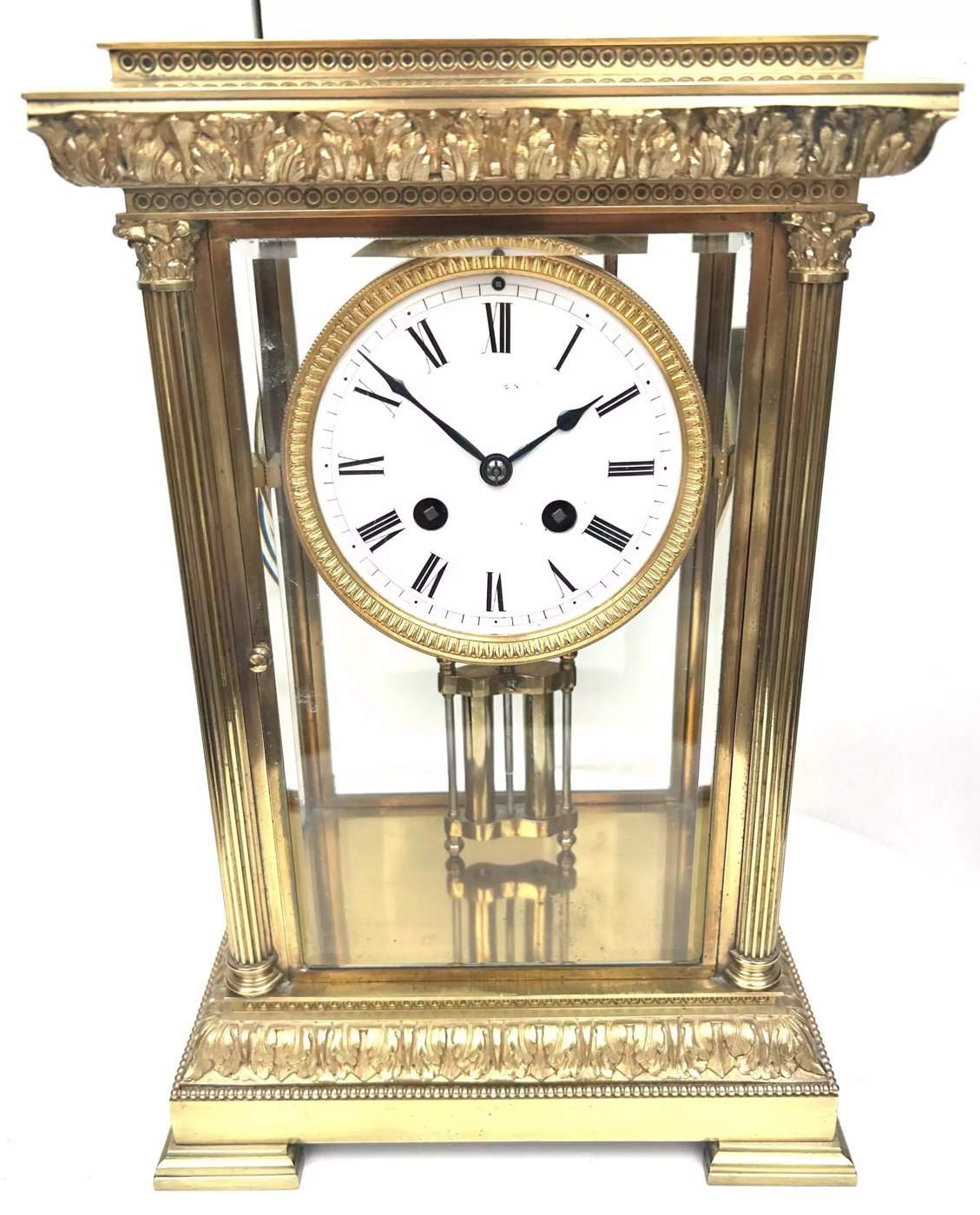
This French Empire-period portico mantel clock stands 52 cm high, 28 cm wide, and 11 cm deep. It features a architectural portico design supported by ormolu and marble pillars, accented with ormolu mounts and a top finial modeled as a basket of flowers. The time is displayed on a convex dial, signed "Lefevre De Bella A Paris," which utilizes Roman numerals. The movement is an 8-day, bell-striking mechanism with a visible pendulum suspended by a silk thread. The clock is documented as having been recently serviced and is in working order. The auction description reports that the clock is in good condition for its age, though it exhibits slight signs of wear.

A front-facing view of the French Empire portico clock, showing the convex dial and the visible pendulum.
A front-facing view of the French Empire portico clock, showing the convex dial and the visible pendulum. — Vintage Clocks UK. Rights pending — permission not yet requested. Original source

Catalogue identity

Source
vintageclocks.uk
Category
Clock · Portico mantel clock
Maker / attribution
Lefevre De Bella
Reference
1471
Catalogue / lot identifier
1471
Source-reported date
circa 1830
Source-reported place
France

Source-reported attribution and specifications are not independent authentication. A listing does not establish present ownership, current display, availability or permission to reproduce.

Object description

Case Construction

The clock is housed in a portico-style case characterized by architectural uprights and a raised top cornice. The structure is supported by four pillars, which the source describes as being composed of ormolu and marble. These pillars terminate in detailed ormolu capitals and bases.

The upper portion of the case is surmounted by a decorative ormolu basket of flowers. The central section of the clock is enclosed by glass, which allows for a full view of the oscillating pendulum and the internal suspension assembly.

Evidence for this section
  • “Portico clock”
  • “Ormolu and marble pillars”
  • “Ormolu basket of flowers to the central finial”

Dial and Movement

The timekeeping is facilitated by an 8-day movement capable of striking a bell. The dial is described as convex in form and features a signature identifying the maker, Lefevre De Bella, based in Paris.

The escapement utilizes a visible pendulum attached to a silk suspension system. The source states the movement was recently serviced and is currently in working order.

Evidence for this section
  • “Dial signed Lefevre De Bella A Paris”
  • “Bell Striking”
  • “visible pendulum hangs on a silk suspension”
  • “Recently serviced”

Condition and Attribution

The auction description reports that the clock is in good condition for its age. It notes that the item exhibits slight signs of use consistent with its history.

The piece is attributed to the French Empire period with an approximate manufacturing date of circa 1830. The listing identifies the object as an early French-made portico clock.

Evidence for this section
  • “Good condition for age, showing slight signs or age”
  • “The clock is early circa 1830”
  • “Early French made clock”

Open research questions

  • What is the full history of the Lefevre De Bella workshop in Paris?
  • Do the marble and ormolu components show evidence of 19th-century casting or later modification?

Source evidence

Recorded claims and source quotations for French Empire Portico Mantel Clock
FieldSource-reported valueSource quotation
MakerLefevre De Bella“Dial signed Lefevre De Bella A Paris”
Datecirca 1830“The clock is early circa 1830”
Dimensions52cm x 28cm x 11cm“Measures 52cm high by 28cm wide & 11cm deep”
SuspensionSilk“visible pendulum hangs on a silk suspension”
SKU1471“SKU: 1471”

Visible details

  • Convex white enamel dial with Roman numerals
  • Visible pendulum with silk thread suspension
  • Four-pillar architecture with ormolu capitals and bases
  • Ormolu flower basket finial at the center of the top cornice

Research qualifications

  • The full extent of the restoration or components replaced during the 'recently serviced' work is not specified
  • The term 'Empire Period' is applied by the source for an object dated circa 1830

Photograph identity and source facts were screened before import; rights clearance remains pending.

Terms in this record

Glossary explanations for terms named in this object’s record.