
Skip to content
The Encyclopedia of Horology

Clock · Portico mantel clock

French Empire ormolu and rouge marble portico mantel clock

Partially verified

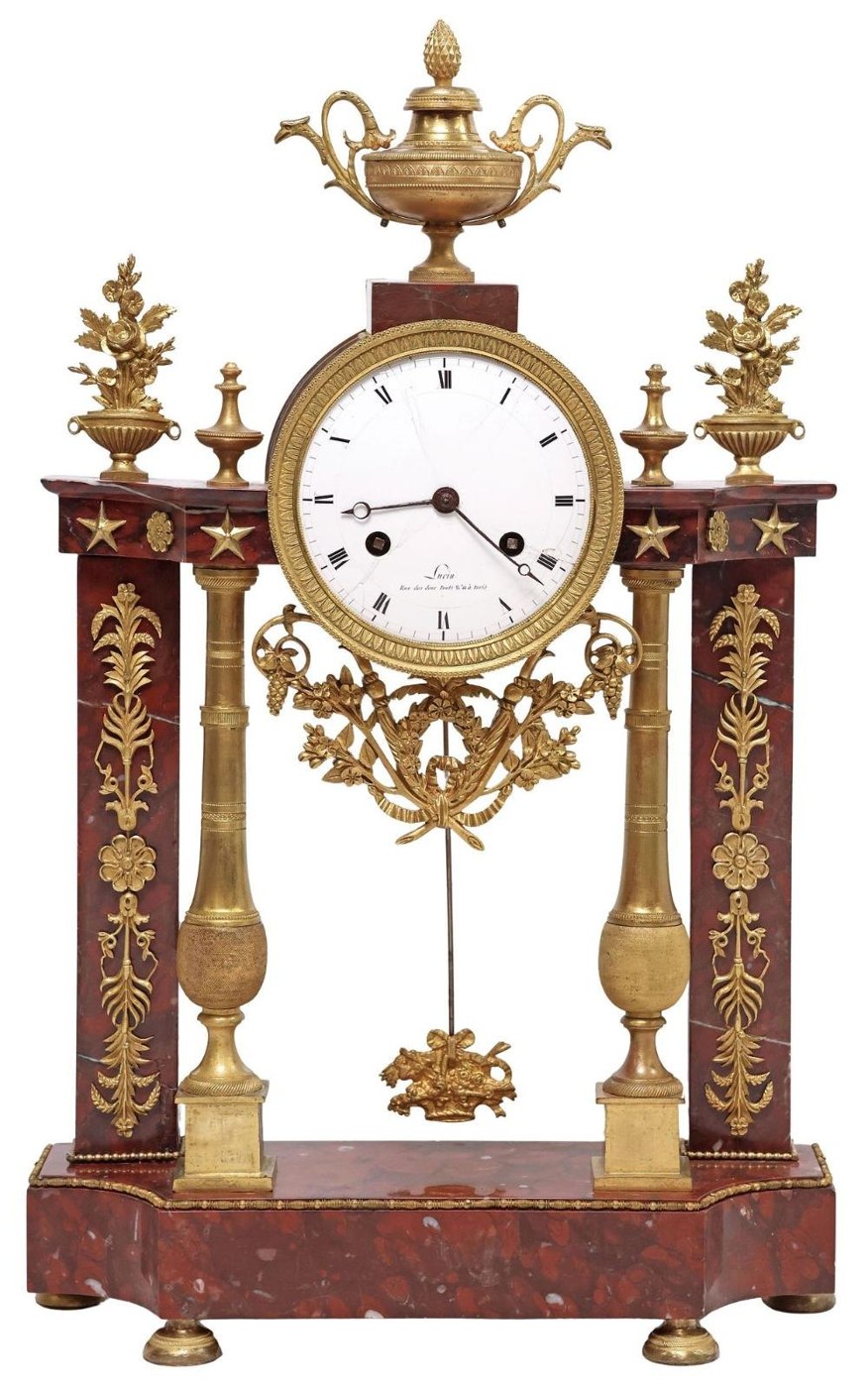
This French Empire period portico mantel clock is constructed from bronze dore (ormolu) and rouge marble. The architectural frame consists of two turned-form columns and squared uprights that support the movement, all resting upon a shaped base with circular feet. The white porcelain dial features black Roman numeral hour markers and is signed "Lucin, Rue des Deux Ponts No. 14 a Paris." The clock is topped with a central vasiform finial flanked by two flowering urns. Decorative elements include an openwork floral spray, wreath and grape cluster motifs, and applied star ornaments on the upper lintel. The timepiece is powered by a time-and-strike movement utilizing a silk suspension system. Accessories supplied with the clock consist of the original pendulum and a winding key. The clock measures 20 inches in height, 12 inches in width, and 4 inches in depth, with a total recorded weight of 21 pounds.

Front view of the French Empire portico mantel clock showing the porcelain dial, columns, and ormolu ornamentation.
Front view of the French Empire portico mantel clock showing the porcelain dial, columns, and ormolu ornamentation. — Austin Auction Gallery, via Invaluable. Rights pending — permission not yet requested. Original source

Catalogue identity

Source
orbiscollectibles.com
Category
Clock · Portico mantel clock
Maker / attribution
Lucin
Reference
Not recorded
Catalogue / lot identifier
Source URL identifies the listing
Source-reported date
early 19th c.
Source-reported place
France

Source-reported attribution and specifications are not independent authentication. A listing does not establish present ownership, current display, availability or permission to reproduce.

Object description

Architectural Case and Ornamentation

The clock features a portico-style architectural structure, characterized by a design centered on two primary turned-form columns. These pillars are complemented by squared supports, providing a balanced verticality to the piece. The structure rests upon a shaped base supported by circular feet, grounding the architectural form. The base and primary supports are fashioned from rouge marble, which creates a visual contrast with the metallic components.

The ormolu ornamentation is integrated throughout the design. The upper section displays a vasiform finial positioned between two flanking urns filled with floral decorations. Additionally, the lintel above the columns is embellished with metallic star appliqués. An openwork floral spray is mounted directly beneath the dial, incorporating motifs of wreaths and grape clusters, which frame the pendulum's path.

Evidence for this section
  • “architectural design features dual turned-form columns and squared supports resting on a shaped base with circular feet”
  • “surmounted by a vasiform finial flanked by flowering urns”
  • “Beneath the dial, the movement is decorated with an openwork floral spray featuring wreath and grape cluster motifs”

Dial and Movement

The clock face is a white porcelain dial marked with black Roman numerals indicating the hours. The dial bears a signature, "Lucin, Rue des Deux Ponts No. 14 a Paris," which provides the identifying detail for the object. The dial shows signs of age, specifically with stable hairlines present across the surface, as reported in the documentation.

The movement is a time-and-strike mechanism, a type commonly utilized in period mantel clocks. The pendulum, essential to the timekeeping function, is included as an original accessory, along with the winding key required for operation. The movement is described as being in operating condition.

Evidence for this section
  • “white porcelain dial with black Roman numeral hour markers, signed "Lucin, Rue des Deux Ponts No. 14 a Paris.”
  • “timepiece utilizes a time-and-strike movement with a silk suspension system”
  • “is in operating condition, noting stable hairlines to the dial”

Physical Specifications

The physical proportions of the clock indicate a size suited for mantel display, measuring 20 inches in height by 12 inches in width and 4 inches in depth. The materials listed include bronze dore (ormolu), rouge marble, and porcelain. The total weight of the object is recorded at 21 pounds.

The provenance and specific history of this piece are not detailed beyond its identification in an auction listing. The documentation specifies that these measurements and details pertain to this specific example, acknowledging that variations may exist in similar objects from the French Empire period.

Evidence for this section
  • “measures approximately 20 inches in height, 12 inches in width, and 4 inches in depth, with a total weight of 21 pounds”
  • “Details apply to that one example; other examples of the type may differ”

Open research questions

  • What is the specific production date for movements signed by Lucin at Rue des Deux Ponts?
  • Are there archival records documenting the workshops active at Rue des Deux Ponts during the early 19th century?

Source evidence

Recorded claims and source quotations for French Empire ormolu and rouge marble portico mantel clock
FieldSource-reported valueSource quotation
MakerLucin“signed "Lucin, Rue des Deux Ponts No. 14 a Paris.”
Movement typetime-and-strike“timepiece utilizes a time-and-strike movement”
Materialsbronze dore, rouge marble, porcelain“crafted from bronze dore (ormolu) and rouge marble”
Dimensions20 x 12 x 4 inches“measures approximately 20 inches in height, 12 inches in width, and 4 inches in depth”
Weight21 lbs“total weight of 21 pounds”
Suspensionsilk“silk suspension system”
Conditionoperating condition with dial hairlines“is in operating condition, noting stable hairlines to the dial”

Visible details

  • Porcelain dial exhibits visible hairlines
  • Applied star ornaments visible on upper frieze
  • Silk suspension mechanism indicated
  • Openwork bronze ornament below dial features grape motifs

Research qualifications

  • Exact date of manufacture is not established beyond early 19th century
  • Attribution to maker Lucin is based solely on the dial signature

Photograph identity and source facts were screened before import; rights clearance remains pending.

Consulted source

French Empire ormolu and rouge marble portico mantel clock

Reviewed 2026-11-02 · Record 4edd69d71b

Terms in this record

Glossary explanations for terms named in this object’s record.