
Skip to content
The Encyclopedia of Horology

Clock · Portico mantel clock

French Empire Portico Mantel Clock

Partially verified

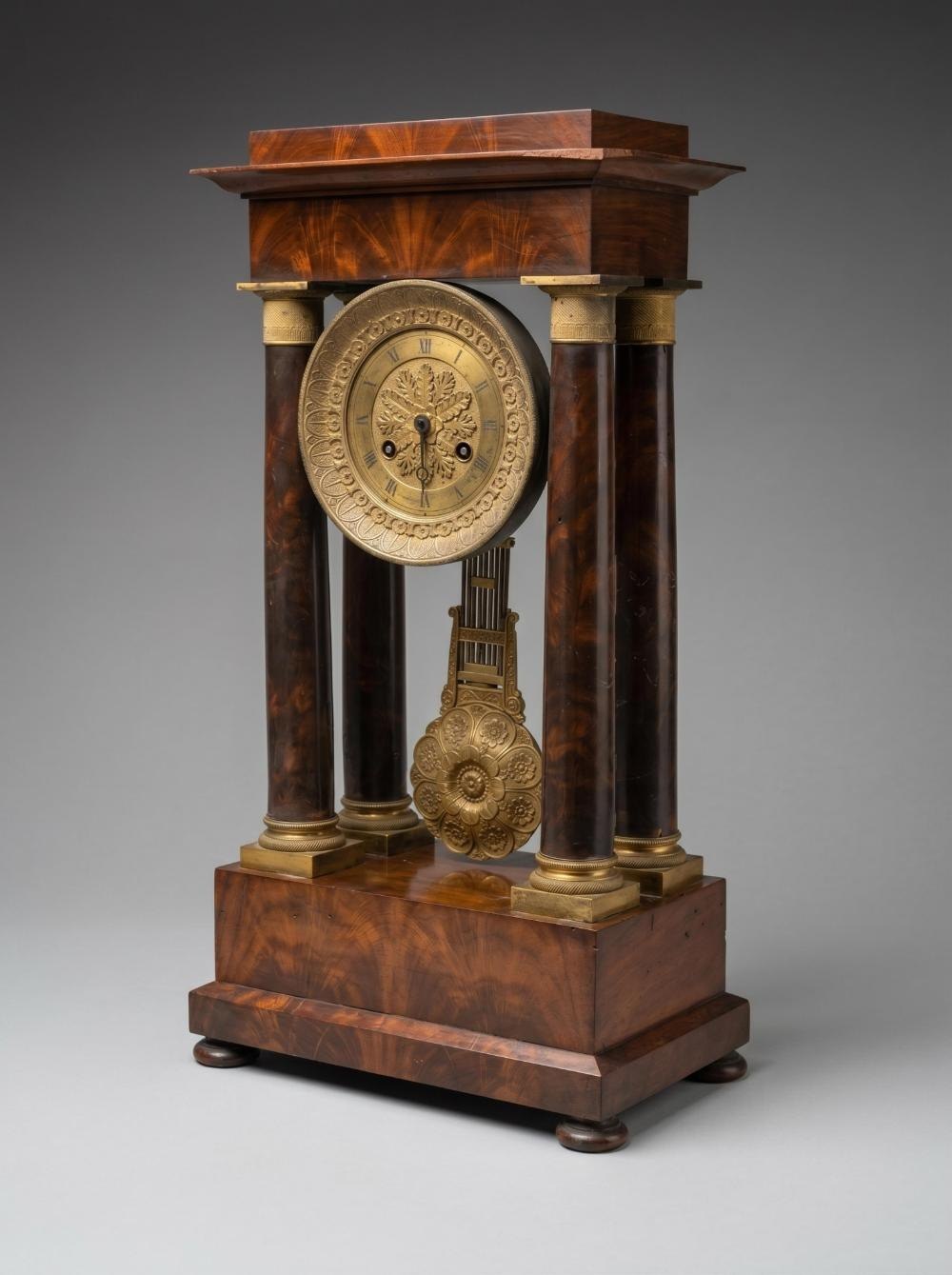
This French Empire portico mantel clock, dated to the early 19th century, features a substantial architectural case constructed from mahogany veneer. The dial is executed in gilded metal and features Roman numerals alongside intricate floral motifs. A notable functional and aesthetic component of the clock is the visible grid-iron pendulum, which is also decorated with floral work. The clock measures approximately 19 1/2 inches in height. The mahogany case contrasts with ornate gilt bronze, or ormolu, mounts located at the column bases and capitals. While the mahogany veneer exhibits signs of age, including instances of loss, the piece remains an example of 19th-century horological furniture,

French Empire portico mantel clock with mahogany case, gilt bronze mounts, and visible grid-iron pendulum.
French Empire portico mantel clock with mahogany case, gilt bronze mounts, and visible grid-iron pendulum. — Auction house “Collective Hudson, LLC”, via Invaluable. Rights pending — permission not yet requested. Original source

Catalogue identity

Source
orbiscollectibles.com
Category
Clock · Portico mantel clock
Maker / attribution
Not established
Reference
Not recorded
Catalogue / lot identifier
Source URL identifies the listing
Source-reported date
early 19th century
Source-reported place
France

Source-reported attribution and specifications are not independent authentication. A listing does not establish present ownership, current display, availability or permission to reproduce.

Object description

Case and Architectural Design

The clock is designed in the form of a portico, utilizing an architectural structure that defines its neoclassical appearance. The primary material is mahogany, finished with a veneer that displays figured wood grain throughout the base, the supporting columns, and the upper cornice. The clock's silhouette is symmetrical, supported by four independent columns that create an open central space where the pendulum is suspended.

The case is further embellished with gilt bronze, or ormolu, mounts. These elements are utilized as capitals and bases for the columns, providing a gold-toned contrast to the dark mahogany veneer.

Evidence for this section
  • “The clock features a substantial structure crafted from richly figured mahogany veneer”
  • “Designed as a portico, the case is supported by four classic columns that establish an imposing, symmetrical silhouette.”

Dial and Timekeeping Components

The dial is finished in gilded metal and displays the time using Roman numerals. The surface of the dial is detailed with fine floral motifs, which coordinate with the decorative themes present elsewhere on the clock. The design emphasizes the mechanical nature of the object by exposing the pendulum to view between the columns.

A prominent feature is the grid-iron pendulum. This component is designed with a grid-iron configuration, a functional arrangement intended to compensate for temperature changes. The pendulum is also decorated with a floral motif, matching the aesthetic found on the dial.

Evidence for this section
  • “The dial, finished in gilded metal, features Roman numerals and is decorated with fine floral motifs.”
  • “A prominent element of the design is the visible grid-iron pendulum”

Reported Condition

The current condition of the mahogany case reflects the passage of time. The exterior surfaces show evidence of wear, specifically in the form of losses to the mahogany veneer. These losses are noted as signs of age within the provided source documentation.

The mechanical or internal condition is not further described beyond its visual presence.

Evidence for this section
  • “While the mahogany case displays some signs of age, including veneer losses”
  • “the object remains a quintessential example of French portico clocks”

Open research questions

  • What is the specific manufacturer or retailer associated with this clock?
  • Are there specific marks or stamps on the movement that could identify the date more precisely than 'early 19th century'?

Source evidence

Recorded claims and source quotations for French Empire Portico Mantel Clock
FieldSource-reported valueSource quotation
MaterialsMahogany veneer, gilt bronze (ormolu)“Mahogany veneer, gilt bronze (ormolu)”
Height19 1/2 inches“Measuring approximately 19 1/2 inches in height”
Dial displayRoman numerals“The dial, finished in gilded metal, features Roman numerals”
Pendulum typeGrid-iron pendulum“visible grid-iron pendulum”
OriginFrance“French 19th Century Empire”
Condition noteVeneer losses present“While the mahogany case displays some signs of age, including veneer losses”

Visible details

  • Visible grid-iron pendulum with floral pattern decoration
  • Four mahogany columns with gilt bronze capitals and bases
  • Mahogany veneer showing loss along the base and structure
  • Gilded metal dial featuring engraved Roman numerals and central floral design

Research qualifications

  • The dating is approximate as 'early 19th century'
  • Condition report notes veneer losses which are visible but not fully quantified

Photograph identity and source facts were screened before import; rights clearance remains pending.

Consulted source

French 19th Century Empire Mahogany and Gilt Bronze Portico Mantel Clock

Reviewed 2026-11-02 · Record c51dc6231e

Terms in this record

Glossary explanations for terms named in this object’s record.