
Skip to content
The Encyclopedia of Horology

Clock · Carriage clock

French Corniche Case Carriage Clock

Partially verified

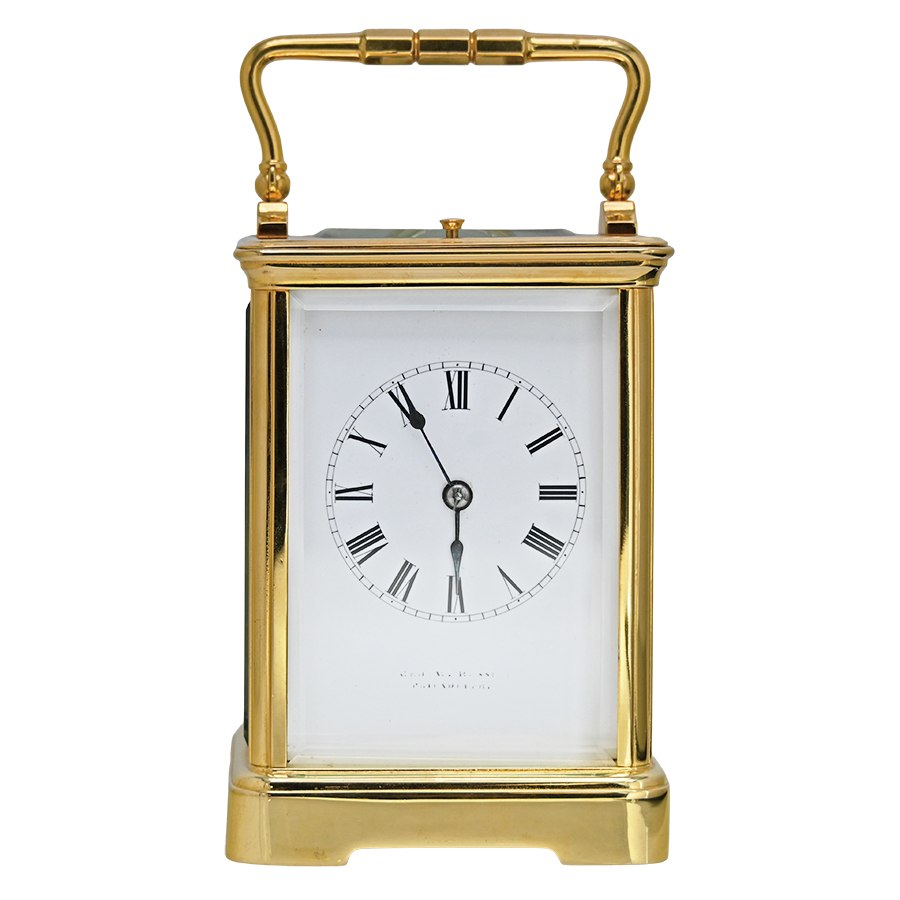
This antique French carriage clock is housed in a gilt brass Corniche-style case measuring 7 inches high, 4 inches wide, and 3.25 inches deep. The source dates the timepiece to circa 1880. It features beveled glass panels, a top escapement viewing window, and an overhead folding handle with a repeat-at-will button situated behind it. The white porcelain dial displays black Roman numeral hour markers, an outer minute ring, and blued spade hands. Indistinct signature lettering is printed beneath the Roman numeral VI. According to the seller, the clock is powered by an 8-day mechanical movement striking the hours and half-hours on a gong.

Front view of the French Corniche case carriage clock with porcelain dial and overhead handle
Front view of the French Corniche case carriage clock with porcelain dial and overhead handle — Renaissance Antiques. Rights pending — permission not yet requested. Original source

Catalogue identity

Source
www.renaissanceantiques.com
Category
Clock · Carriage clock
Maker / attribution
Not established
Reference
RJ 1478
Catalogue / lot identifier
RJ 1478
Source-reported date
Circa 1880
Country
France

Source-reported attribution and specifications are not independent authentication. A listing does not establish present ownership, current display, availability or permission to reproduce.

Object description

Case Architecture and Form

The carriage clock is housed in a gilt brass Corniche case measuring 7 inches high, 4 inches wide, and 3.25 inches deep. The source reports beveled glass panels on all sides, an escapement viewing window on the top plate, and a folding carry handle.

Visual observation of the front aspect confirms a polished brass Corniche form with molded base and corner pillars. A small push button is positioned on the top plate behind the handle, associated with the repeat-at-will feature.

Evidence for this section
  • “This lovely carriage clock presents in a gilt brass Corniche case with beveled glass panels on all sides, an escapement viewing window atop, and requisite carry handle.”
  • “7″H x 4″W x 3.25″D”
  • “Polished brass Corniche case with molded base, corner pillars, and folding overhead carry handle.”
  • “Small repeat button situated on the top case plate behind the handle.”

Dial Presentation and Inscription

The front displays a white porcelain dial with black Roman hour numerals, an outer minute ring, and dark spade hands. Physical inspection shows an indistinct two-line inscription faintly printed directly beneath the numeral VI.

The seller explicitly describes the dial as indistinctly signed. Because the text cannot be legibly deciphered from the available image, any specific maker or retailer designation remains unverified in this record.

Evidence for this section
  • “The time displays on a Roman numeral porcelain dial with spade hands. The dial is indistinctly signed.”
  • “White porcelain dial with black Roman numerals, outer chapter ring, and dark spade hands.”
  • “Indistinct two-line inscription faintly printed below the numeral VI.”

Reported Movement and Mechanism

According to the dealer description, the clock is powered by an 8-day mechanical movement. The striking mechanism is described by the source as marking the hour and half-hour on a gong, accompanied by a repeat-at-will option.

The source dates the piece to circa 1880 and advertises it as restored with a one-year warranty. Internal movement details, backplate stamps, and the gong assembly are not visible in the primary frontal photograph and remain strictly seller-reported.

Evidence for this section
  • “An 8-day mechanical movement powers the clock, marking the hour and half-hour with a pleasing gong strike and with repeat-at-will option.”
  • “Circa 1880”
  • “this carriage clock bears a full restoration and a one-year warranty.”

Open research questions

  • What wording or retailer signature is printed beneath the numeral VI when examined under magnification?
  • Are there manufacturer trademarks, serial numbers, or French patent stamps (e.g., Drocourt or Couaillet) visible on the rear movement backplate?
  • What type of escapement platform (cylinder or lever) is visible through the top viewing window?

Source evidence

Recorded claims and source quotations for French Corniche Case Carriage Clock
FieldSource-reported valueSource quotation
Case MaterialGilt brass“gilt brass Corniche case”
Movement Duration8-day mechanical“8-day mechanical movement”
Striking MechanismGong strike with repeat-at-will“marking the hour and half-hour with a pleasing gong strike and with repeat-at-will option.”
Dial MaterialPorcelain“Roman numeral porcelain dial with spade hands.”
Dimensions7″H x 4″W x 3.25″D“7″H x 4″W x 3.25″D”
Date of ProductionCirca 1880“Circa 1880”
Case FeaturesBeveled glass panels on all sides with top escapement window“gilt brass Corniche case with beveled glass panels on all sides, an escapement viewing window atop, and requisite carry handle.”
Dial SignatureIndistinctly signed“The dial is indistinctly signed.”
Seller ReferenceRJ 1478“SKU: RJ 1478”

Visible details

  • Polished brass Corniche case with molded base, corner pillars, and folding overhead carry handle.
  • White porcelain dial with black Roman numerals, outer chapter ring, and dark spade hands.
  • Small repeat button situated on the top case plate behind the handle.
  • Indistinct two-line inscription faintly printed below the numeral VI.

Research qualifications

  • The dial signature is indistinct and cannot be legibly deciphered from the image.
  • Internal movement features and gong mechanism are source-reported and not directly visible in the single front photograph.

Photograph identity and source facts were screened before import; rights clearance remains pending.

Consulted source

French Corniche Case Carriage Clock - Renaissance Antiques

Reviewed 2026-10-21 · Record 997053e675

Terms in this record

Glossary explanations for terms named in this object’s record.