
Skip to content
The Encyclopedia of Horology

Clock · Carriage clock

French Carriage Clock with Automata Singing Bird

Partially verified

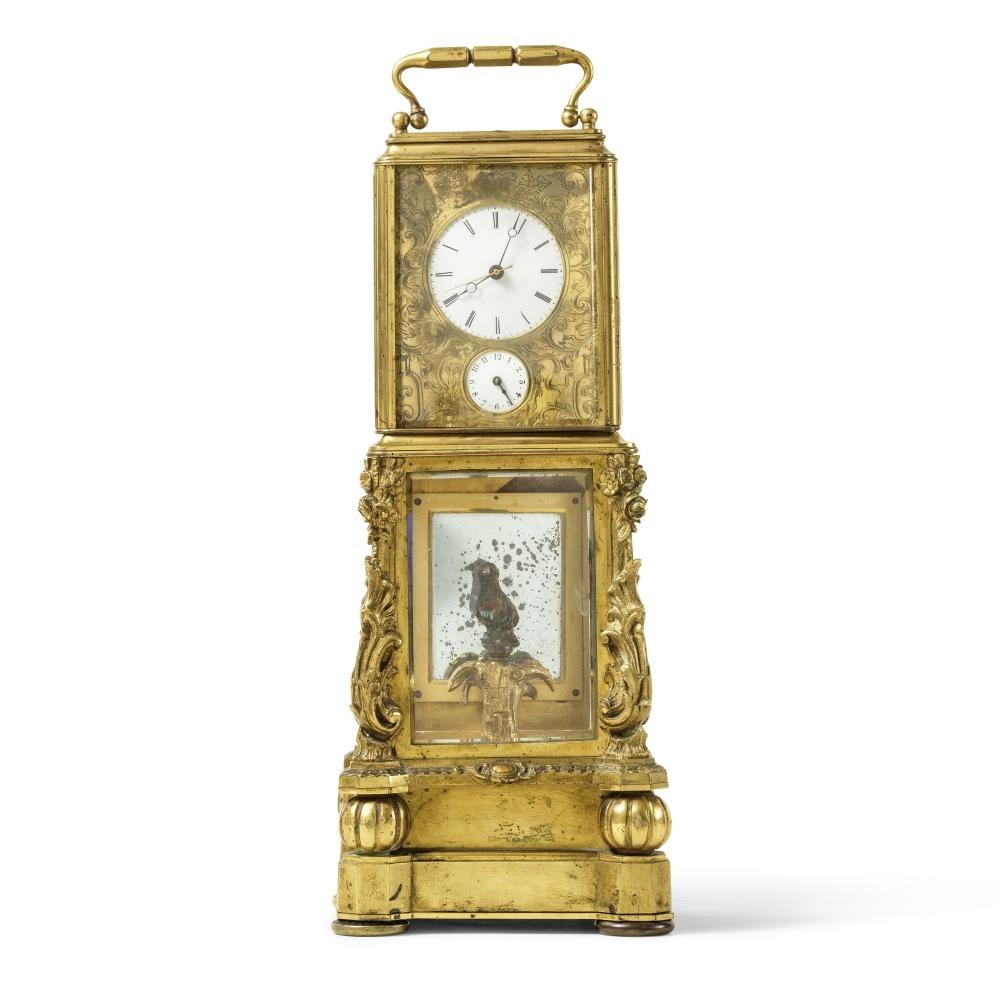
This mid-19th century French carriage clock, attributed to the Chinese market, is a combined horological and automata device. Standing 34 cm high, the clock features a one-piece case with a three-part handle and bevelled glass panels. The upper section houses a circular enamel Roman dial with moon hands and a centre seconds hand, positioned above an alarm disc, all mounted on a scroll-engraved mask. The lower section contains an automata singing bird with iridescent wings and a moving beak, set atop a naturalistic tree stump on a pierced base, viewed against a mirrored back. The clock is powered by a spring-driven movement featuring a 'crab-claw' duplex escapement with a steel balance incorporating 'bats wing' timing weights. The music box mechanism is housed within the stepped plinth and is wound from the side of the base.

Front view of the French carriage clock featuring the upper timekeeping dial and lower automata bird display.
Front view of the French carriage clock featuring the upper timekeeping dial and lower automata bird display. — Bonhams (via Invaluable). Rights pending — permission not yet requested. Original source

Catalogue identity

Source
www.invaluable.com
Category
Clock · Carriage clock
Maker / attribution
Not established
Reference
Not recorded
Catalogue / lot identifier
60
Source-reported date
Mid-19th century
Source-reported place
France

Source-reported attribution and specifications are not independent authentication. A listing does not establish present ownership, current display, availability or permission to reproduce.

Object description

Clock and Automata Case Design

The object is designed as a vertical carriage clock. The upper section comprises a case with a three-part handle surmounting a glazed housing. The central portion of this housing contains the timekeeping dial, protected by bevelled glass panels. The dial itself consists of a circular enamel plate featuring Roman numerals, paired with moon hands and a central seconds hand, situated above a dedicated alarm disc.

The lower section of the object serves as a display for an automata singing bird. This bird, finished with iridescent wings and an articulated beak, is positioned on a naturalistic tree stump. The background is provided by a mirrored surface inside a rectangular glazed section, flanked by cast decorative columns. The entire assembly sits upon a stepped plinth, which encloses the music box mechanism, wound from the side of the base.

Evidence for this section
  • “The one-piece style clock case surmounted by a three-part handle over a bevelled glass inspection panel and matching sides”
  • “The circular enamel Roman dial with moon hands and centre seconds hand set above an alarm disc”
  • “automata singing bird with iridescent wings and moving beak on a naturalistic tree stump”
  • “The music box wound from the side of the base.”

Movement and Technical Features

The horological movement is spring-driven and remains in an unrestored state. It employs a 'crab-claw' duplex escapement to govern the rate of the clock. This arrangement includes a steel balance wheel equipped with 'bats wing' style timing weights. The clock architecture is configured with a platform that supports the escapement.

The singing bird automata and the clock mechanism are described as currently non-functional. The auction description reports that while the clock platform may tick when power is applied, there is significant discolouration and oxidation on the internal steel components. The singing bird mechanism is noted as having damage to the bellows, and a wheel pivot has sustained a fracture, preventing proper power transmission.

Evidence for this section
  • “The spring-driven movement with engraved platform supporting a 'crab-claw' duplex escapement”
  • “The platform does tick when power is applied, though there is some general discolouration to the steelwork throughout from oxidisation and oil.”
  • “The singing bird mechanism also looks to be complete, though it is in quite derelict condition. The bellows are damaged, and one of the wheel pivots has snapped”

Condition and Historical Presentation

Regarding the physical state of the object, the case exhibits general grime and residue consistent with historical storage, such as marks left by packing tape. The aperture surrounding the winding square in the plinth has previously undergone repair. Furthermore, while the repeat mechanism of the clock appears to be intact, the repeat button is presently detached, though it is retained within the case.

The documentation attributes the production of the clock to the mid-19th century and specifies that it was created for the Chinese market. It is noted that neither the clock movement nor the music box movement has been fully removed from the case for examination. Professional service and a complete overhaul are suggested by the auction description due to the duration the clock has been idle.

Evidence for this section
  • “The case is generally dirty and bears old marks from packing tape”
  • “the repeat button is currently detached from the clock (but present within the case)”
  • “The aperture around the winding square in the base has been repaired.”
  • “We would recommend a full overhaul for reliable use, as the clock has not been run for some considerable time.”

Open research questions

  • What is the specific mechanical connection between the clock repeat train and the automata singing bird bellows?
  • Are there any maker's marks on the movement plates that would clarify the specific French workshop responsible for this export clock?

Source evidence

Recorded claims and source quotations for French Carriage Clock with Automata Singing Bird
FieldSource-reported valueSource quotation
DateMid-19th century“Milieu du XIXe siècle”
Height34 cm (13 3/8 in.)“34 cm (13 3/8 in.) high”
EscapementCrab-claw duplex escapement“'crab-claw' duplex escapement”
OriginMade for the Chinese market“MADE FOR THE CHINESE MARKET”
Case featuresOne-piece style with bevelled glass and mirror back“The one-piece style clock case surmounted by a three-part handle over a bevelled glass inspection panel and matching sides, set on a rectangular glazed case with a mirrored back”
Dial configurationRoman dial with centre seconds and alarm disc“The circular enamel Roman dial with moon hands and centre seconds hand set above an alarm disc within a scroll engraved mask.”
Condition statusUnrestored condition“The movements are in unrestored condition, and the clock mechanism is fairly dirty.”

Visible details

  • Carriage clock with integrated lower automata compartment
  • Bird figure featuring iridescent wings and moving beak
  • Gilt metal case with cast columns
  • Dual dial arrangement on upper section

Research qualifications

  • Uncertain working state of singing bird bellows and wheel pivots
  • Detached repeat button and general oxidation to steelwork
  • Unverified internal condition of music box and clock movements

Photograph identity and source facts were screened before import; rights clearance remains pending.

Terms in this record

Glossary explanations for terms named in this object’s record.