
Skip to content
The Encyclopedia of Horology

Clock · Table clock

Franz Xaver Liebherr I Carillon Table Clock

Partially verified

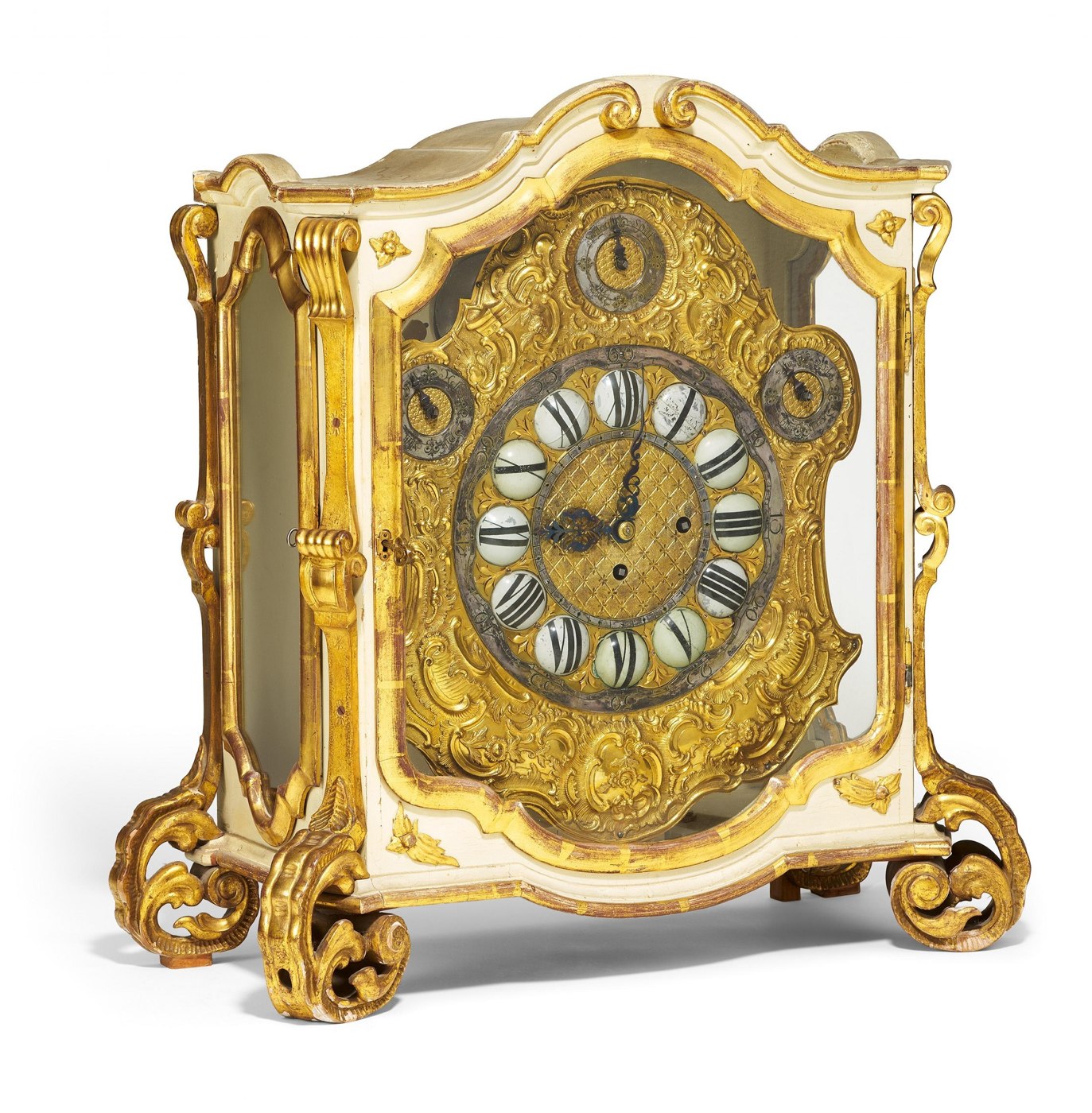
This carillon table clock is attributed to Franz Xaver Liebherr I of Immenstadt, dating to approximately 1770. The clock is housed in a rectangular, glazed case of painted and partially gilded wood, featuring four volute feet and a pedimented top with a curved profile. Access is provided by hinged doors on the front and left side. The front plate of the brass movement is decorated with fire-gilded rocaille, floral, and shell motifs, surrounding a silvered chapter ring displaying Roman hour and Arabic minute numerals. The movement is powered by a key-wound mechanism with fixed spring barrels, offering a reported 30-hour power reserve. It incorporates a carillon system comprising ten bronze bells, sixteen hammers, and a selector for four melodies. Timekeeping is regulated by a verge escapement with a cycloidal pendulum suspension. The back plate of the movement is signed "Xaveri Liebherr Im(m)enstatt".

Front view of the Franz Xaver Liebherr I carillon table clock showing the ornate dial and glazed wooden case.
Front view of the Franz Xaver Liebherr I carillon table clock showing the ornate dial and glazed wooden case. — Van Ham Kunstauktionen. Rights pending — permission not yet requested. Original source

Catalogue identity

Source
zamanito.com
Category
Clock · Table clock
Maker / attribution
Franz Xaver Liebherr I
Reference
Not recorded
Catalogue / lot identifier
Source URL identifies the listing
Source-reported date
circa 1770
Source-reported place
Germany

Source-reported attribution and specifications are not independent authentication. A listing does not establish present ownership, current display, availability or permission to reproduce.

Object description

Case and Dial

The table clock is enclosed within a rectangular case constructed from painted wood, featuring partial gilding and glazed panels. The design includes a curved, pedimented top and four prominent volute feet, contributing to its structural silhouette. Access to the internal mechanism is facilitated by hinged doors located on the front and left side of the case, allowing for maintenance and adjustment.

The dial assembly is mounted on a brass plate adorned with fire-gilded rocaille, floral, and shell ornaments. A silvered ring is integrated into the center, indicating the hours using Roman numerals and the minutes using Arabic numerals.

Evidence for this section
  • “محفظه مستطیلی شیشه‌دار از چوب رنگ‌آمیزی‌شده و طلاکاری جزئی، چهار پایه ولوت و پیشانی قوس‌دار دارد”
  • “صفحه جلویی موتور به شکل کارتوژ، با طلاکاری آتش، نقش‌های روکای، گل و صدف تزئین شده است”

Movement and Carillon Mechanism

The movement is a brass, solid-plate construction designed for key-winding. It utilizes fixed spring barrels that provide an approximate 30-hour power reserve. The timekeeping is governed by a verge escapement, featuring a cycloidal pendulum suspension system.

The clock features an integrated carillon, which utilizes ten bronze bells and sixteen hammers to produce four selectable melodies. The selection is managed via a position selector. The carillon is powered by a chain and fusee mechanism, including speed-regulating fans, a manual start via cord, and a sound-dampening feature using felt. The system produces melodies lasting approximately 20 to 30 seconds, depending on the spring force.

Evidence for this section
  • “موتور برنجی صفحه‌توپر، کوک کلیدی و محفظه‌های فنر ثابت با ذخیره اعلام‌شده ۳۰ ساعت توصیف شده است”
  • “کاریلون ده زنگ برنزی و شانزده چکش دارد و چهار ملودی با انتخاب‌گر موقعیت ساعت ۲ انتخاب می‌شوند”
  • “چرخ‌گریز ویژه ورج با دو بخش مستقل متصل به پین، تعلیق نخی و پاندول سیکلوئیدی در منبع آمده است”

Signatures and Attribution

The clock is attributed to Franz Xaver Liebherr I of Immenstadt, with a production date estimated around 1770. This attribution is based on records from Van Ham Kunstauktionen.

The signature is found on the movement's back plate, where the inscription reads "Xaveri Liebherr Im(m)enstatt." The cataloguer notes that the source material for this listing includes a key for the locking mechanism. The authentication of the components and the operational status are not independently verified.

Evidence for this section
  • “نوشته Xaveri Liebherr Im(m)enstatt روی صفحه پشتی موتور قرار دارد”
  • “این ساعت رومیزی به Franz Xaver Liebherr I در Immenstadt و حدود سال ۱۷۷۰ نسبت داده شده است”

Open research questions

  • What is the specific provenance of this clock prior to the 2021 auction?
  • Are there recorded examples of other carillon clocks by Franz Xaver Liebherr I to compare the mechanical design of this unit?

Source evidence

Recorded claims and source quotations for Franz Xaver Liebherr I Carillon Table Clock
FieldSource-reported valueSource quotation
MakerFranz Xaver Liebherr I“Franz Xaver Liebherr I”
Datecirca 1770“حدود ۱۷۷۰”
Case dimensions59 x 57 x 25 cm“۵۹ × ۵۷ × ۲۵ سانتی‌متر”
Movement dimensions44.5 x 36.5 x 15 cm“۴۴٫۵ × ۳۶٫۵ × ۱۵ سانتی‌متر”
Power reserve30 hours“ذخیره اعلام‌شده ۳۰ ساعت”
SignatureXaveri Liebherr Im(m)enstatt“Xaveri Liebherr Im(m)enstatt”
EscapementVerge escapement with cycloidal suspension“چرخ‌گریز ویژه ورج با دو بخش مستقل متصل به پین، تعلیق نخی و پاندول سیکلوئیدی”

Visible details

  • Painted and partially gilded wooden case with volute feet
  • Silvered chapter ring with Roman and Arabic numerals
  • Movement back plate signature: 'Xaveri Liebherr Im(m)enstatt'
  • Carillon mechanism with ten bells and sixteen hammers

Research qualifications

  • Service history and originality of all components cannot be verified from the source
  • The source does not provide an independent condition report regarding mechanical function or timekeeping accuracy

Photograph identity and source facts were screened before import; rights clearance remains pending.

Consulted source

ساعت رومیزی کاریلون Franz Xaver Liebherr I حدود ۱۷۷۰

Reviewed 2026-11-02 · Record 88f74c4614

Terms in this record

Glossary explanations for terms named in this object’s record.