
Skip to content
The Encyclopedia of Horology

Pocket watch · Pocket watch

Ferdinand Berthoud pocket watch

Partially verified

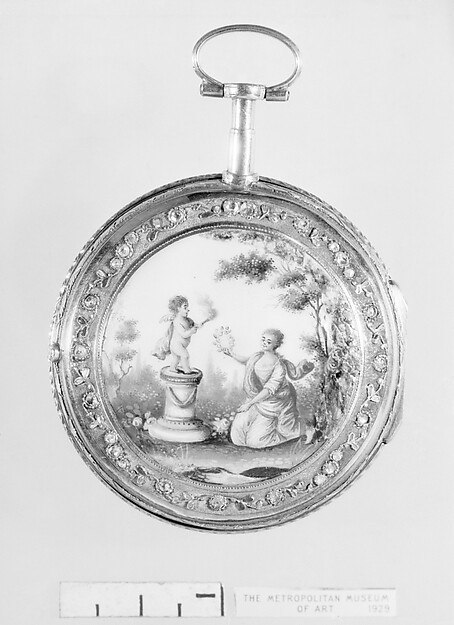
This pocket watch was produced by the watchmaker Ferdinand Berthoud (1727–1807) in Paris during the late 18th century. The watch is part of the collection at The Metropolitan Museum of Art, entering the institution as a bequest of Laura Frances Hearn in 1917. The timepiece is constructed from gold and embellished with rose diamonds. Measuring 2 inches (5.1 cm) in diameter, the object reflects the production of a maker who held the titles of Horologist-Mechanic to the King and the Navy. The case features decorative work surrounding a central scene. The documentation provided by The Metropolitan Museum of Art confirms the materials and attribution to Berthoud, who was a significant figure in the development of both domestic timepieces and marine chronometers during this period of French horological history.

View of the gold and rose diamond pocket watch by Ferdinand Berthoud, late 18th century.
View of the gold and rose diamond pocket watch by Ferdinand Berthoud, late 18th century. — The Metropolitan Museum of Art, New York. Rights pending — permission not yet requested. Original source

Catalogue identity

Source
orbiscollectibles.com
Category
Pocket watch · Pocket watch
Maker / attribution
Ferdinand Berthoud
Reference
17.101.12
Catalogue / lot identifier
17.101.12
Source-reported date
late 18th century
Source-reported place
France

Source-reported attribution and specifications are not independent authentication. A listing does not establish present ownership, current display, availability or permission to reproduce.

Object description

Construction and Physical Form

The pocket watch is described as a circular timepiece constructed from gold. The exterior is adorned with rose diamonds, which form a decorative border around the central face of the watch. The object has a recorded diameter of 2 inches (5.1 cm), which is consistent with pocket watches produced in the late 18th century.

The design includes a pendant and bow at the top, allowing for attachment to a chain or ribbon. The case demonstrates the decorative techniques applied by Parisian workshops during this era, integrating precious metals and gemstones into the horological housing.

Evidence for this section
  • “Gold, rose diamonds”
  • “Diameter: 2 in. (5.1 cm)”

Maker and Historical Context

The watch is attributed to Ferdinand Berthoud, who was active in Paris during the 18th century. Berthoud achieved the status of master watchmaker in 1753 and later received official appointments as Horologist-Mechanic to the King and the Navy. His work spanned a wide variety of timekeeping instruments, from marine chronometers to domestic pieces.

Produced in Paris, this object originates from a center for scientific and decorative horology. The association with Berthoud places the watch within the output of a maker known for his contributions to both precision timekeeping and the decorative arts of the period.

Evidence for this section
  • “made in Paris during the late eighteenth century by the scientist and watchmaker Ferdinand Berthoud”
  • “appointed Horologist-Mechanic to the King and the Navy”

Institutional Documentation

This object is currently housed in the collection of The Metropolitan Museum of Art and is identified by the accession number 17.101.12. It is categorized within the Department of European Sculpture and Decorative Arts. The item was acquired by the museum in 1917 as part of the bequest of Laura Frances Hearn.

The information regarding the watch is derived from the museum's own records. The institution classifies the watch as a piece of horological interest, though the documentation focuses primarily on the general attribution and physical description rather than an analysis of the internal movement components or specific serial numbers.

Evidence for this section
  • “The Metropolitan Museum of Art holds this object as 17.101.12.”
  • “Department: European Sculpture and Decorative Arts.”
  • “Credit line: Bequest of Laura Frances Hearn, 1917.”

Open research questions

  • Does the movement contain serial numbers or markings that confirm a specific production year within the late 18th century?
  • Are the rose diamonds original to the case construction, or do they represent a later modification?

Source evidence

Recorded claims and source quotations for Ferdinand Berthoud pocket watch
FieldSource-reported valueSource quotation
MakerFerdinand Berthoud“Watchmaker: Ferdinand Berthoud (French, 1727–1807)”
Museum Number17.101.12“The Metropolitan Museum of Art holds this object as 17.101.12.”
MaterialsGold and rose diamonds“The museum records its materials as: Gold, rose diamonds.”
Diameter2 inches (5.1 cm)“Diameter: 2 in. (5.1 cm).”
Datelate 18th century“late 18th century”
ProvenanceBequest of Laura Frances Hearn, 1917“Credit line: Bequest of Laura Frances Hearn, 1917.”

Visible details

  • The watch case is decorated with a border of rose diamonds.
  • The dial or case back features a pictorial scene depicting a figure kneeling before a statue of Cupid.
  • The watch includes a standard top-mounted bow and pendant for suspension.

Research qualifications

  • The specific movement caliber and internal hallmarks are not detailed in the source.
  • The extent of potential later modifications to components such as hands or the dial remains unverified by the provided documentation.

Photograph identity and source facts were screened before import; rights clearance remains pending.

Consulted source

Watch by Ferdinand Berthoud, French, Paris, late 18th century

Reviewed 2026-11-02 · Record c2f719159d

Terms in this record

Glossary explanations for terms named in this object’s record.