
Skip to content
The Encyclopedia of Horology

Clock · Mantle regulator

F. Luthi Mantle Regulator

Partially verified

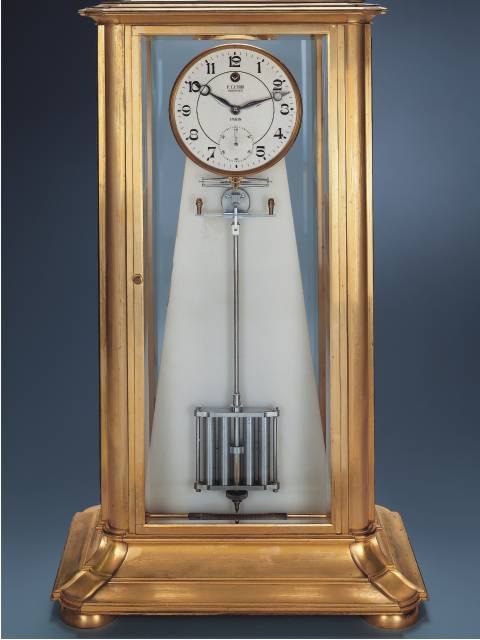
This 8-day going mantle regulator is attributed to F. Luthi, Horloger à Paris, dating to circa 1920. The clock features a gilt bronze molded case with four glazed faces and a glazed top, supported by four bun feet. The interior houses the movement, which is mounted against a large, white, pyramidal stand. The dial is silvered with Arabic numerals and a subsidiary seconds indicator, complemented by polished steel Breguet-style hands. The brass movement is constructed with circular plates and cylindrical pillars secured by screws. It utilizes a going barrel and incorporates a Vérité constant force escapement, paired with a half-second beating invar-elinvar pendulum featuring spring suspension. The clock measures 60 x 37.5 x 26.5 cm. The dial bears the signature of the maker. This piece is documented for its specific escapement mechanism, which references the design invented by L. A. Vérité and improved by J.-Th. Winnerl.

Front view of the gilt bronze mantle regulator featuring a white pyramidal stand and a visible pendulum.
Front view of the gilt bronze mantle regulator featuring a white pyramidal stand and a visible pendulum. — Antiquorum. Rights pending — permission not yet requested. Original source

Catalogue identity

Source
catalog.antiquorum.swiss
Category
Clock · Mantle regulator
Maker / attribution
F. Luthi
Reference
Not recorded
Catalogue / lot identifier
138
Source-reported date
circa 1920
Source-reported place
France

Source-reported attribution and specifications are not independent authentication. A listing does not establish present ownership, current display, availability or permission to reproduce.

Object description

Case and Dial

The mantle regulator is housed in a gilt bronze case designed with a molded profile. The structure is supported by four bun feet. Visibility of the movement is provided by glazed panels on all four faces and the top of the case. Internally, the clock mechanism is mounted on a substantial white, pyramidal-shaped stand, which contrasts with the metallic finish of the case and movement components.

The silvered dial displays the time through Arabic numerals. A subsidiary dial for the seconds is positioned at the lower portion of the primary dial. The time is indicated by polished steel hands, described as Breguet style. The maker's name and location are signed directly on the dial surface.

Evidence for this section
  • “Gilt bronze molded, standing on four bun-feet and glazed four faces and top”
  • “Silvered with Arabic numerals and subsidiary seconds. Polished steel Breguet hands.”
  • “Signed on the dial.”

Movement and Escapement

The movement is constructed with brass circular plates and secured by cylindrical pillars using screws. Power is provided by a going barrel. The regulator is designed to run for eight days. The timekeeping is regulated by a half-second beating pendulum made of invar and elinvar, suspended by a spring.

The escapement mechanism is identified as a Vérité constant force escapement. This design traces its origins to an invention by L. A. Vérité, which was exhibited in 1839 and subsequently refined in the same year by J.-Th. Winnerl. The clock is noted for the inclusion of this mechanism in its construction.

Evidence for this section
  • “Brass circular with cylindrical pillars secured by screws, going barrel, Vérité constant force escapement”
  • “half-second beating invar-elinvar pendulum with spring suspension.”
  • “This constant force escapement is based on the one invented byL. A. Vérité, exhibited in 1839, it was improved the same year by J.-Th. Winnerl.”

Condition and Documentation

The auction description provides a grading for the clock components. The case is graded as 2, indicating it is in very good condition. The dial is listed with a grade of 2.

Regarding technical documentation, the escapement mechanism is specifically cited in historical literature. It is described and illustrated in the second edition of 'Echappements d'Horloges et de Montres' by Charles Grosin, specifically on pages 219 through 221, in figure 218.

Evidence for this section
  • “Grading System Grade: Case: 2 Very good Movement: 2* Very good Overhaul recommended, at buyer's expense Dial: 2”
  • “It is described and illustrated by Charles Grosin "Echappements d'Horloges et de Montres", 2ème Edition,pp. 219 - 221, fig. 218.”

Open research questions

  • What is the specific production output of F. Luthi in Paris during the early 20th century?
  • How does the execution of the Vérité escapement in this specific movement compare to the original 1839 design by Winnerl?

Source evidence

Recorded claims and source quotations for F. Luthi Mantle Regulator
FieldSource-reported valueSource quotation
MakerF. Luthi“F. Luthi, Horloger à Paris”
Datecirca 1920“circa 1920”
EscapementVérité constant force escapement“Vérité constant force escapement”
Dimensions60 x 37.5 x 26.5 cm“Dim. 60 x 37,5 x 26,5 cm.”
Case materialGilt bronze“Gilt bronze molded”
Dial signatureSigned on the dial“Signed on the dial.”
MovementBrass circular with cylindrical pillars“Brass circular with cylindrical pillars secured by screws”
PendulumHalf-second beating invar-elinvar“half-second beating invar-elinvar pendulum”

Visible details

  • Case features four glazed faces and a glass top.
  • The dial includes a subsidiary seconds register.
  • The clock is supported by a large white pyramidal internal stand.
  • The pendulum is an invar-elinvar construction with spring suspension.

Research qualifications

  • The exact history of the F. Luthi workshop is not detailed.
  • The necessity of an overhaul is noted in the source's grading system.

Photograph identity and source facts were screened before import; rights clearance remains pending.

Terms in this record

Glossary explanations for terms named in this object’s record.