
Skip to content
The Encyclopedia of Horology

Clock · Bracket clock

English bracket clock with planetary complication by John Wright

Partially verified

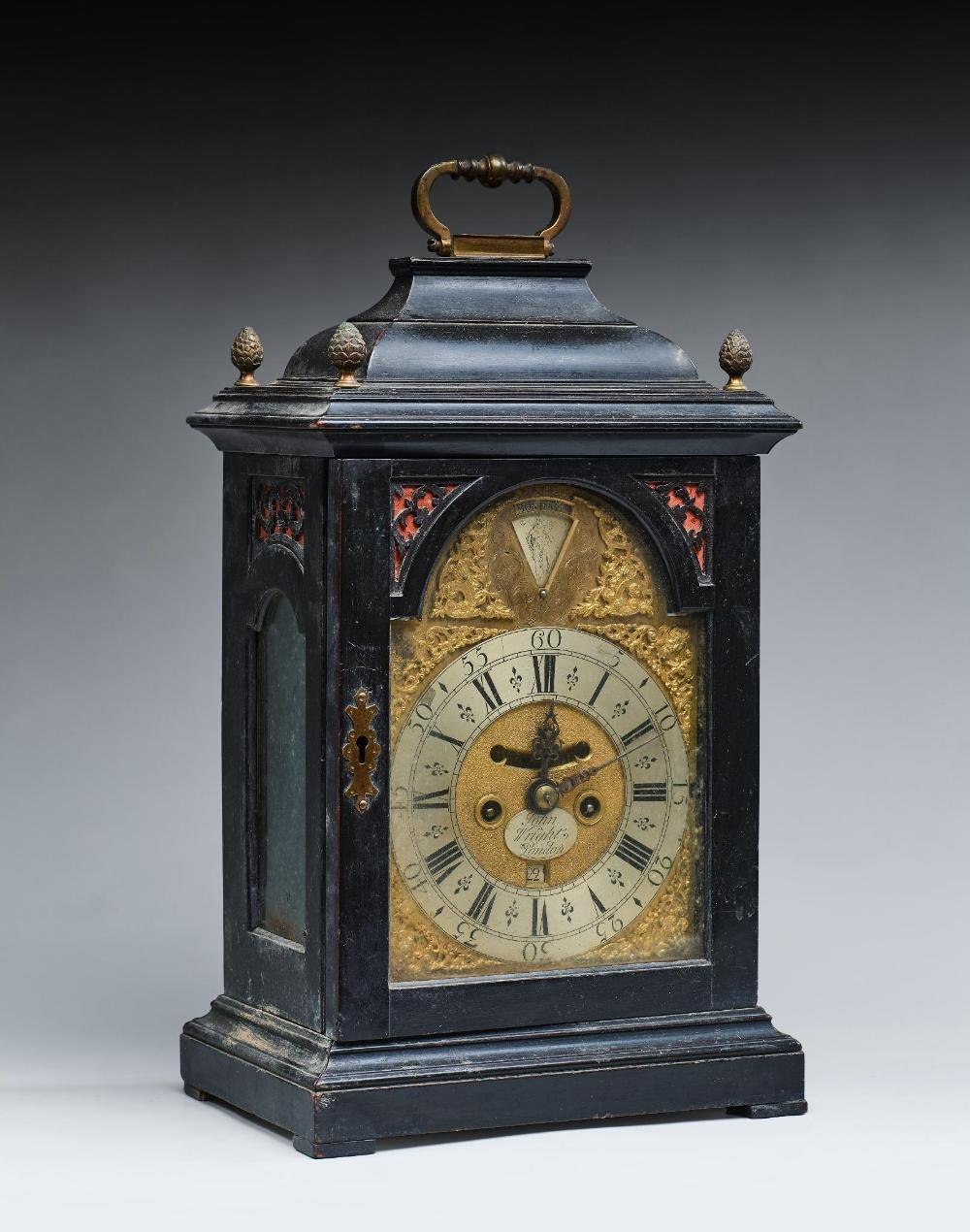
This English bracket clock, attributed to John Wright circa 1720, features an architectural case constructed from ebony with molded, carved, and openwork elements. The design incorporates glazed panels on all sides, with the top section surmounted by four pinecone finials and a central carrying handle. The corner spandrels are detailed with red fabric meant to imitate tortoiseshell. The movement is distinguished by an elaborate striking system utilizing eight bells and eight hammers, providing a sonnerie à la demande function. Complementing the timekeeping is a complex planetary calendar system, featuring three rotating pewter cartouches that indicate days of the week alongside allegorical engravings of the seven planetary deities.

Front view of the English bracket clock showing the dial, hands, and ebony case.
Front view of the English bracket clock showing the dial, hands, and ebony case. — Auction house “ARTESIA - Maison de Ventes aux Enchères”, via Invaluable. Rights pending — permission not yet requested. Original source

Catalogue identity

Source
orbiscollectibles.com
Category
Clock · Bracket clock
Maker / attribution
John Wright
Reference
Not recorded
Catalogue / lot identifier
Source URL identifies the listing
Source-reported date
circa 1720
Source-reported place
England

Source-reported attribution and specifications are not independent authentication. A listing does not establish present ownership, current display, availability or permission to reproduce.

Object description

Case and Dial Construction

The timepiece is housed in an architecturally shaped case constructed from molded, carved, and openwork ebony. This housing features glazed panels on all sides to allow for visibility into the interior of the clock. The design of the case is completed with four pinecone finials located at the top and a carrying handle. The corner spandrels feature a decorative treatment using red fabric intended to imitate tortoiseshell.

The dial of the clock is crafted from engraved and niello-filled pewter. It is an annular dial that displays Roman numerals for the hours interspersed with fleur-de-lis motifs. The minutes are tracked on a railway-style track marked with Arabic numerals.

Evidence for this section
  • “The timepiece is housed in an architecturally shaped case made of molded, carved, and openwork ebony, featuring glazed panels on all sides and corner spandrels accented with red fabric imitating tortoiseshell.”
  • “The annular dial is crafted from engraved and niello-filled pewter, displaying Roman numerals for the hours with fleur-de-lis motifs, and a railway-style minutes track with Arabic numerals.”

Movement and Complications

The clock contains a striking system described as having eight bells and eight hammers. This mechanism allows for a striking function on demand. The backplate of the movement is embellished with intricate engravings depicting foliage and scrolls. Additionally, the backplate features an antique-style bust that is flanked by depictions of eagles.

The clock includes a planetary calendar system. This complication operates through three rotating pewter cartouches. These components display the days of the week and provide allegorical engravings that reference the seven planetary deities. The combination of the striking mechanism and the planetary complication serves as the primary technical output for this instrument.

Evidence for this section
  • “The movement features an exceptional striking system with eight bells and eight hammers, capable of striking on demand.”
  • “The backplate is intricately engraved with foliage, scrolls, and an antique-style bust flanked by eagles.”
  • “A complex calendar system incorporates three rotating pewter cartouches displaying the days of the week alongside allegorical engravings related to the seven planetary deities.”

Provenance and Identification

The clock is attributed to the maker John Wright, who was active around 1720. The object is recorded in an auction-house listing, which provides the primary documentation for its physical characteristics and historical attribution. The listing notes the association with John Wright, who is also cited in records as a member of the Clockmakers’ Company.

The physical dimensions of the clock are recorded as 48 cm in height, 26.5 cm in width, and 18 cm in depth. While this example is identified as a bracket clock with a specific set of complications, the information provided is supplementary evidence based on the singular listing identified in the auction record. No further catalogue numbers or museum provenance records were identified for this item.

Evidence for this section
  • “English bracket clock with planetary complication by John Wright, c. 1720”
  • “John WRIGHT (XVII-XVIIIème), membre de la Clockmakers’ Company - actif vers 1700.”

Open research questions

  • What is the specific mechanical linkage between the planetary cartouches and the primary movement?
  • Are there known movements by John Wright that feature an identical eight-bell striking configuration?

Source evidence

Recorded claims and source quotations for English bracket clock with planetary complication by John Wright
FieldSource-reported valueSource quotation
MakerJohn Wright“John Wright”
Datecirca 1720“c. 1720”
Width26.5 cm“26.5 cm”
Case materialsebony, pewter, brass, bronze, glass, fabric“ebony, pewter, brass, bronze, glass, fabric”
Striking systemEight bells and eight hammers“striking system with eight bells and eight hammers”

Visible details

  • Ebony case with openwork carving
  • Eight-bell striking mechanism
  • Planetary calendar system with pewter cartouches
  • Engraved backplate with antique-style bust

Research qualifications

  • Attribution of date remains approximate
  • Planetary complication function is described but not fully detailed in mechanism

Photograph identity and source facts were screened before import; rights clearance remains pending.

Consulted source

English bracket clock with planetary complication by John Wright, c. 1720

Reviewed 2026-11-02 · Record 13c9ba2d1c

Terms in this record

Glossary explanations for terms named in this object’s record.