
Skip to content
The Encyclopedia of Horology

Clock · Desk clock

Ecole d'Horlogerie World Time Desk Clock

Partially verified

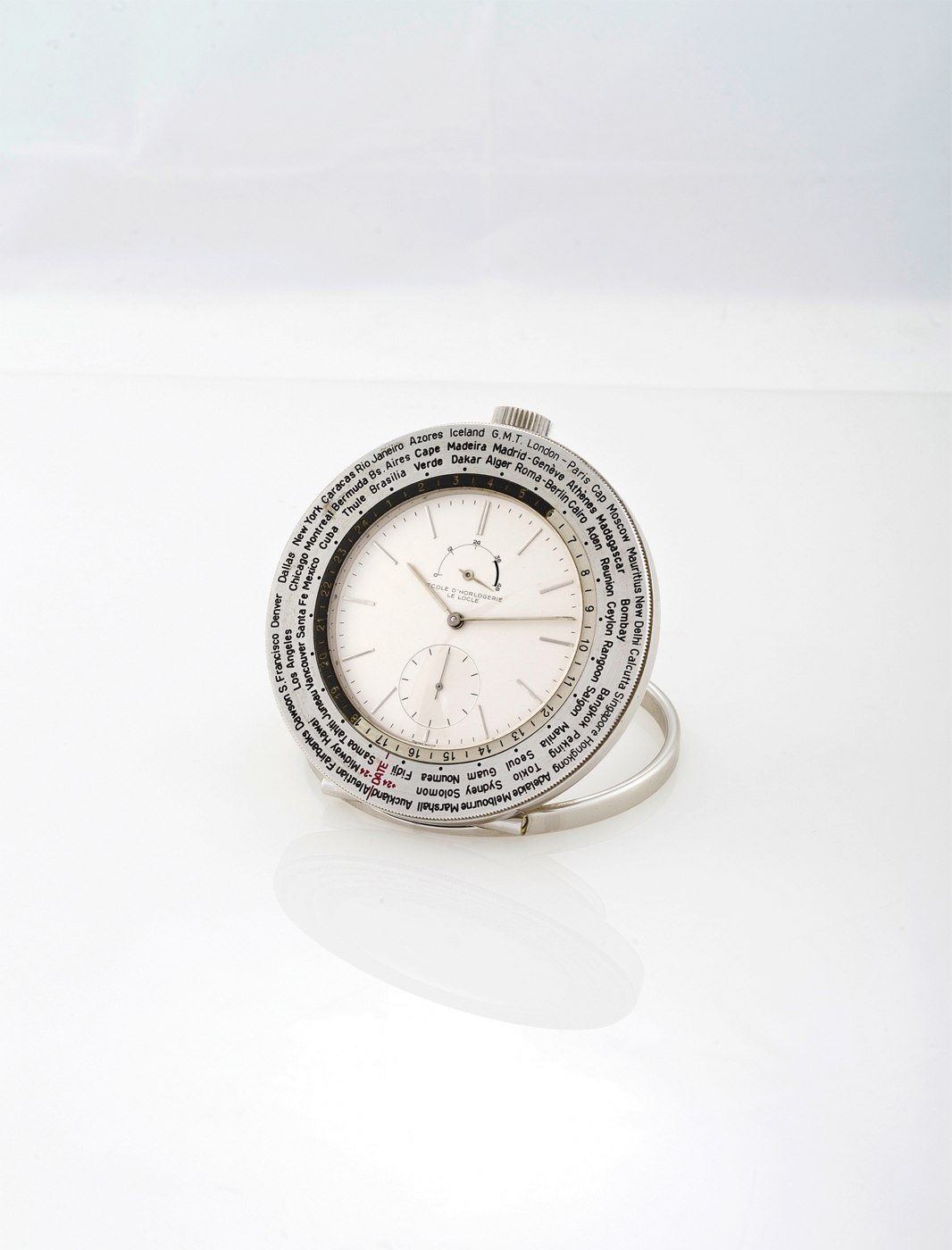
This desk clock, created in 1973, is signed by N. Linder and the Ecole d'Horlogerie in Le Locle. Housed in a stainless steel four-body circular case, the clock measures 75 mm in diameter and features both polished and brushed finishes. It is equipped with a hinged strut and a transparent back. The dial is matte silvered with applied steel baton indexes and steel baton hands, incorporating a subsidiary seconds dial and a sector for power-reserve indication. The world-time mechanism functions via an inner 24-hour ring for diurnal and nocturnal hours, combined with an outer revolving ring engraved with 68 world cities. Powering the device is a 22 ligne rhodium-plated movement, which boasts 17 jewels, a straight-line lever escapement, a monometallic balance with a self-compensating overcoil balance spring, and shock absorbers. It is a 2-day going, keyless clock.

The Ecole d'Horlogerie world-time desk clock with revolving city bezel and power-reserve indicator.
The Ecole d'Horlogerie world-time desk clock with revolving city bezel and power-reserve indicator. — Antiquorum. Rights pending — permission not yet requested. Original source

Catalogue identity

Source
catalog.antiquorum.swiss
Category
Clock · Desk clock
Maker / attribution
N. Linder
Reference
Not recorded
Catalogue / lot identifier
281
Source-reported date
1973
Source-reported place
Switzerland
Source-reported serial
10

Source-reported attribution and specifications are not independent authentication. A listing does not establish present ownership, current display, availability or permission to reproduce.

Object description

Case and Dial

The clock is constructed with a four-body, circular stainless steel case measuring 75 mm in diameter. The exterior finish combines both polished and brushed surfaces. For display, the object features a hinged strut, allowing it to stand on a desk, and a transparent case back. The bezel serves a functional purpose, containing an inner ring displaying 24 hours to track diurnal and nocturnal cycles, alongside an outer ring that revolves and is engraved with the names of 68 different cities around the world.

The dial is matte silvered and features applied steel baton-style indexes. It includes a subsidiary seconds dial positioned at the bottom, while a power-reserve indicator is located on a sector at the top. The time is indicated by steel baton hands. The auction house notes that both the dial and the movement are signed, and the hands are considered original.

Evidence of the watchmaking school's involvement is reflected in the signature, while the world-time complication is designed to track global time zones.

Evidence for this section
  • “Four-body, circular, polished and brushed, the bezel with inner 24-hour ring for the diurnal and nocturnal hours of the world-time, outer revolving ring engraved with the names of 68 world cities, transparent back, hinged strut.”
  • “Matte silvered with applied steel baton indexes, outer minute divisions, subsidiary seconds, sector for the powerreserve.”
  • “Dial and movement signed.”

Movement and Escapement

The movement is a 22 ligne caliber, rhodium-plated and finished with fausses cotes decoration. The mechanism contains 17 jewels and utilizes a straight-line lever escapement. The escapement assembly includes a monometallic balance, a self-compensating alloy balance spring with an overcoil, and shock protection devices.

The clock is designed as a keyless, 2-day going model. It features an index regulator for precision adjustments.

The movement functions within the stainless steel housing and is paired with the world-time complication as specified in the cataloging notes.

Evidence for this section
  • “22''', rhodium plated, fausses cotes decoration, 17 jewels, straight line lever escapement, monometallic balance, self-compensating alloy balance spring with overcoil, shock absorbers, index regulator.”
  • “Overhaul recommended, at buyer's expense”

Provenance and Condition

The object is identified as lot number 281. The auction description provides a grading system, evaluating the case as 'Good' (grade 3) and the dial as 'Very good' (grade 2-01). The movement is described as 'Very good' (grade 2*), though this is qualified by the recommendation for servicing.

Documentation confirms the piece was made in 1973 and carries the serial number 10. The attribution is clearly linked to the Ecole d'Horlogerie in Le Locle and the individual maker N. Linder.

Evidence for this section
  • “LOT 281”
  • “Made in 1973.”
  • “N. Linder, Ecole D'Horlogerie, Le Locle, No. 10.”
  • “Grading System Grade: AA Very good Case: 3 Good Movement: 2* Very good”

Open research questions

  • What was the specific relationship between N. Linder and the students or faculty of the Ecole d'Horlogerie in Le Locle in 1973?
  • How many examples of this world-time desk clock were produced by the school?

Source evidence

Recorded claims and source quotations for Ecole d'Horlogerie World Time Desk Clock
FieldSource-reported valueSource quotation
MakerN. Linder, Ecole D'Horlogerie“N. Linder, Ecole D'Horlogerie, Le Locle”
Date1973“Made in 1973.”
Jewels17“17 jewels”
Diameter75 mm“DIAM. 75 mm.”
Case materialStainless steel“stainless steel”
Power reserve2-day“2-day going”

Visible details

  • The world-time bezel lists 68 international city names.
  • The power-reserve indicator is positioned at the top of the dial.
  • A hinged strut is visible on the rear for desktop positioning.

Research qualifications

  • The movement requires an overhaul as per the auction description.
  • The specific association between N. Linder and the Ecole d'Horlogerie in the production process is stated but not detailed.

Photograph identity and source facts were screened before import; rights clearance remains pending.

Terms in this record

Glossary explanations for terms named in this object’s record.