
Skip to content
The Encyclopedia of Horology

Tool · Italian quadrant

Ebony Quadrant of Cosimo I de' Medici

Partially verified

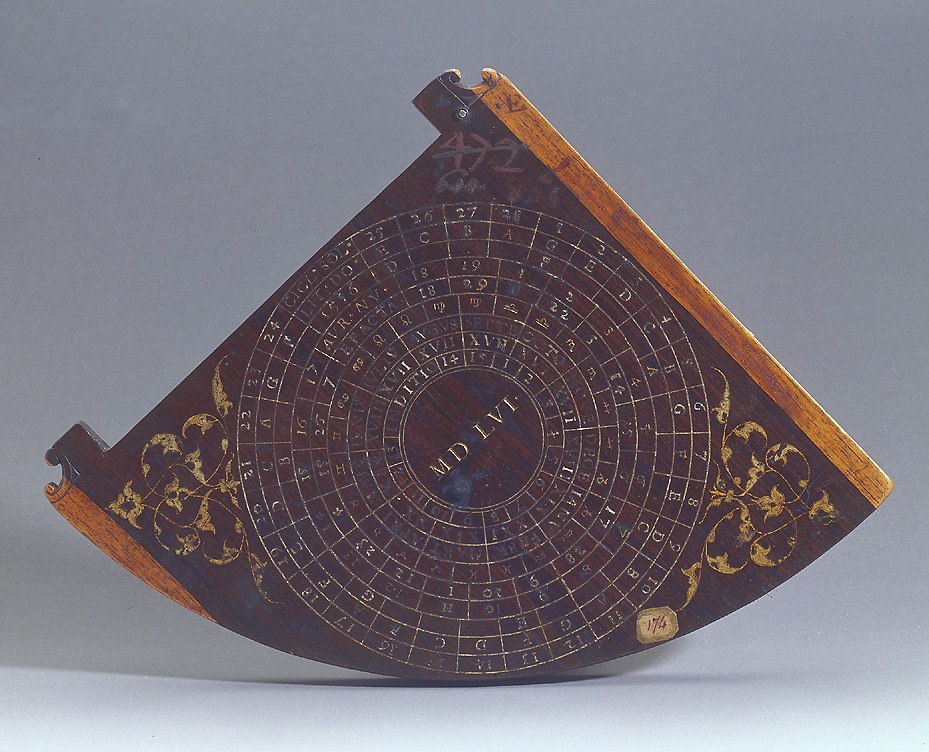
This 167 mm radius ebony quadrant is dated 1556 and dedicated to Cosimo de' Medici. The instrument features two distinct faces. One side functions as an horary quadrant calibrated for the latitude of 43 degrees 45 minutes, corresponding to Florence. It includes an Italian hours dial (9 to 24) marked with silver lines for morning hours and gold lines for the afternoon, alongside a zodiacal calendar and a shadow square of twelve. A bas-relief head of a man within sun rays serves as the apex attachment for a thread cursor. The reverse side contains a complex circular diagram with nine concentric rings detailing solar cycle information, dominical letters, leap years, the golden number, and epact. Two sighting blocks are mounted on the side. The instrument is associated with the collection of Cosimo I, second Duke of Florence, and remains in the possession of the Istituto e Museo di Storia della Scienza in Florence.

Rear face of the ebony quadrant, showing the concentric circular calendar diagram and decorative foliate elements.
Rear face of the ebony quadrant, showing the concentric circular calendar diagram and decorative foliate elements. — Istituto e Museo di Storia della Scienza, Firenze. Rights pending — permission not yet requested. Original source

Catalogue identity

Source
www.mhs.ox.ac.uk
Category
Tool · Italian quadrant
Maker / attribution
Attributed to Giovanni Battista Giusti or the Medicean workshop
Reference
Not recorded
Catalogue / lot identifier
2521
Source-reported date
1556
Source-reported place
Italy

Source-reported attribution and specifications are not independent authentication. A listing does not establish present ownership, current display, availability or permission to reproduce.

Object description

Face and Dial Configuration

The front face of the quadrant is structured around a limb divided into a 90-degree scale, incrementing by single degrees within groups of five. The main field incorporates an Italian hours dial (9 to 24), specifically calibrated for the latitude of Florence at 43 degrees 45 minutes. The temporal differentiation is achieved through the use of inlaid lines: morning hours are rendered in silver, while afternoon hours are depicted in gold.

Above this dial sits a shadow square of twelve, numbered in three groups of four. The area is inscribed with guidance for reading the morning and afternoon hours. The instrument's vertex serves as the pivot for a thread cursor, featuring a silver attachment ring centered on a male head in bas-relief, set against a circular arrangement of sun rays.

Evidence for this section
  • “The face of the quadrant is divided on the limb with a scale of 90? reading to 1? by numbered groups of five.”
  • “the morning hours being indicated by silver lines, the afternoon hours by gold lines.”
  • “At the apex/centre of the instrument is a silver attachment ring for the thread cursor rotatable around a male head executed in relief against a ring of sun rays.”

Reverse and Astronomical Details

These rings contain calendrical and astronomical data, including the solar cycle for twenty-eight years, dominical letters, leap year cycles starting from 1556, the golden number, and the epact. Additionally, a zodiacal calendar is included, spanning three rings to denote the sun's entry into each sign.

The center of this diagram displays the date 1556 in Roman numerals. The lower corners of the instrument are embellished with symmetrical scrolled foliate designs in gold paint. Functionally, the side of the quadrant features two sighting blocks with pinnules and level lines to facilitate its use as a measuring instrument.

Evidence for this section
  • “The reverse of the instrument is entirely filled with a circular diagram of nine rings”
  • “The centre of the circle is filled by the date repeated in Roman numerals”
  • “Two sighting blocks with scrolled backs are set on the longer side of the instrument, the back sight with pinnule, the fore sign with level line.”

Attribution and Provenance

The instrument is attributed either to Giovanni Battista Giusti or to the Medicean workshop responsible for Grand Ducal measuring instruments. For instance, the use of a specific shadow square division and unique spelling choices suggest a different hand.

Ownership is confirmed by an inventory record of 1574 regarding the goods of Cosimo and Francesca Medici, which explicitly mentions the ebony quadrant. The instrument bears an inscription identifying the owner as the second Duke of Florence, Cosimo I, confirming its presence within the ducal collection during the 16th century.

Evidence for this section
  • “Although the instrument is unsigned, it is attributed to Giovanni Battista Giusti or to the Medicean workshop”
  • “A number of other differences such as use of the unusual division of the shadow square into three numbered groups 4, 8, 12 rather than 3, 6, 9, 12 and the spelling 'HORARVM' rather than the form 'HORARIVM' found on other quadrants by Giusti, argue against ascription of this instrument to him.”
  • “This ownership inscription, which is certainly contemporary with the other inscriptions on the instrument, is confirmed by the entry in the inventory of Cosimo and Francesca Medici's goods in 1574”

Open research questions

  • What is the specific composition of the workshop staff that might have produced this quadrant if not Giusti himself?
  • Is there further archival evidence within the Medicean records regarding the specific purchase or commission of this quadrant in 1556?

Source evidence

Recorded claims and source quotations for Ebony Quadrant of Cosimo I de' Medici
FieldSource-reported valueSource quotation
Radius167 mm“167 mm in radius”
Date1556“Dated 1556”
Inventory Number2521“Inventory number: 2521”
Latitude Calibration43 degrees 45 minutes“calibrated for the latitude of 43? 45' corresponding to Florence”
InscriptionQVADRANS HORARVM AD LAT. GRA. XLIII. MIN. XLV“'QVADRANS HORARVM AD LAT{ITUDINEM} GRA{DUUM} XLIII. MIN{UTA} XLV'”
ProvenanceCosimo I, second Duke of Florence“Provenance: Cosimo I, second Duke of Florence as inscribed on the instrument who was later to become Ist Grand-Duke of Tuscany.”

Visible details

  • Sighting blocks with scrolled backs on the longer side
  • Bas-relief male head at the apex within sun rays
  • Gold-painted symmetrical scrolled foliate decoration in lower corners
  • Circular calendar diagram on the reverse with nine concentric rings

Research qualifications

  • Authorship remains debated; while tentatively ascribed to Giovanni Battista Giusti in 1954, differences in material and lettering compared to signed works suggest it may be from a Medicean workshop
  • The inscription 'COSIMO M.R.P. FLO. DVC. II' may perhaps be interpreted as referring to Cosimo Medici, second Duke of the State of Florence

Photograph identity and source facts were screened before import; rights clearance remains pending.

Consulted source

Quadrant

Reviewed 2026-10-26 · Record 793844d402

Terms in this record

Glossary explanations for terms named in this object’s record.