
Skip to content
The Encyclopedia of Horology

Clock · Musical grandfather clock

Dutch Louis XV style musical grandfather clock

Partially verified

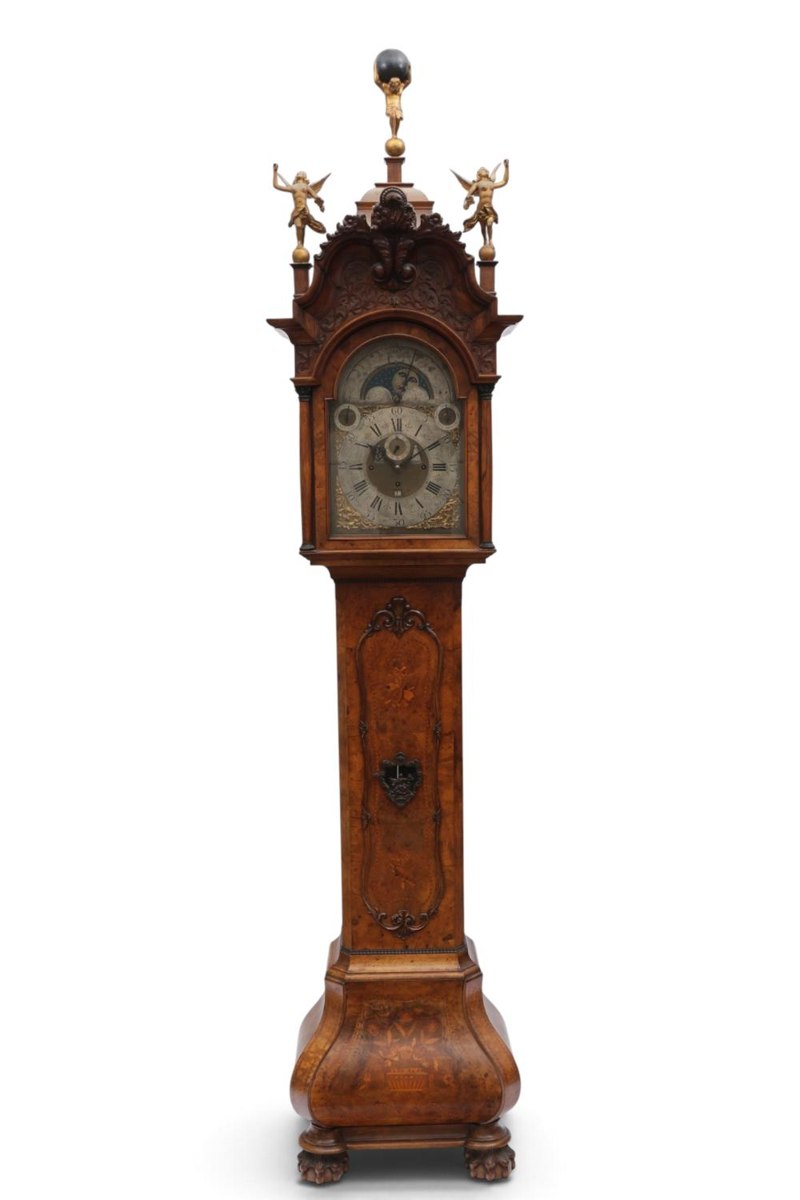
This Dutch longcase clock is executed in the Louis XV style and dates to circa 1900 according to the auction cataloguer. The clock features a burl walnut veneered oak case measuring approximately 320 cm in height, capped by an arched hood surmounted by carved figures of Atlas supporting a globe flanked by two Victories. The arched brass dial has an engraved silvered chapter ring, calendar displays, strike and tune selectors, and a rolling moon phase in the arch. The source reports that while the dial is signed Dirk van Haarst Amsterdam, the movement was likely manufactured around 1900 by the firm van Wijck in The Hague, featuring an eight-day, weight-driven anchor escapement and a musical work playing six melodies on bells.

Dutch Louis XV style musical grandfather clock in burl walnut case, circa 1900
Dutch Louis XV style musical grandfather clock in burl walnut case, circa 1900 — Veilinggebouw de Zwaan. Rights pending — permission not yet requested. Original source

Catalogue identity

Source
www.invaluable.com
Category
Clock · Musical grandfather clock
Maker / attribution
Van Wijck
Reference
Not recorded
Catalogue / lot identifier
7746
Source-reported date
circa 1900
Country
Netherlands

Source-reported attribution and specifications are not independent authentication. A listing does not establish present ownership, current display, availability or permission to reproduce.

Object description

Case Construction and Ornamentation

The longcase clock is executed in a Louis XV style, featuring an oak case with burl walnut veneer and a total height of approximately 320 cm. The base is of a bombé design, raised on ball-and-claw feet, and decorated with floral marquetry.

The case is capped by a contoured, arched hood featuring foliate pierced fretwork. The cresting includes a central carved figure of Atlas supporting a celestial sphere, flanked by two figures identified as Victories. The trunk door is mounted with a cast brass lenticle ornament depicting Chronos.

Evidence for this section
  • “Bur walnut veneered oak case with domed top with figures of Atlas and Victories.”
  • “Foliate pierced fretwork on the front and sides.”
  • “Long door with a cast brass Chronos lenticle, bombé base is raised on ball-and-claw feet.”
  • “h. ca. 320 cm”

Dial and Complications

The clock features an arched brass dial with silvered engraving and pierced corner spandrels. Functional displays include a full calendar and a rolling moon phase disc within the arch.

The dial includes controls for the movement's settings, specifically indicating strike/not strike and playing/not playing. It is signed 'Dirk van Haarst Amsterdam,' though the cataloguer attributes the clock's manufacture to the firm van Wijck.

Evidence for this section
  • “Brass and silverered engraved dial with full calender, indication of playing/not playing, strik/not strike, rolling moon, finely pierced hands”
  • “Signed Dirk van Haarst Amsterdam, but made by The Hague firm van Wijck”

Movement and Attribution

The movement is described as an eight-day, three-weight-driven system regulated by an anchor escapement and a pendulum. It performs a Dutch half-hour strike on two alternating bells.

The musical work utilizes a pinned cylinder to play six melodies on a set of bells and hammers. The auction description notes the movement was likely made by the firm van Wijck in The Hague, intended to emulate 18th-century antique examples.

Evidence for this section
  • “Movement driven by three weights, duration of eight days. Regulated by anchor escapement in combination with a pendulum, Dutch half-hour striking on two alternating bells.”
  • “Musical movement with six melodies playing on pinned cylinder on a set of bells and hammers.”
  • “made by The Hague firm van Wijck after antique examples.”

Open research questions

  • What is the historical relationship between the firm van Wijck and the replication of 18th-century musical clocks?
  • Does the signature of Dirk van Haarst on the dial imply a specific association with an earlier 18th-century clock or represent a later commemorative addition?

Source evidence

Recorded claims and source quotations for Dutch Louis XV style musical grandfather clock
FieldSource-reported valueSource quotation
Maker attributionVan Wijck (signed Dirk van Haarst Amsterdam)“Signed Dirk van Haarst Amsterdam, but made by The Hague firm van Wijck after antique examples.”
Movement drive and durationThree weights, eight-day duration“Movement driven by three weights, duration of eight days.”
Escapement and regulationAnchor escapement with pendulum“Regulated by anchor escapement in combination with a pendulum”
Striking and musical trainDutch half-hour striking, six-melody pinned cylinder on bells“Musical movement with six melodies playing on pinned cylinder on a set of bells and hammers.”
Case construction and heightBurl walnut veneered oak, height circa 320 cm“Bur walnut veneered oak case with domed top with figures of Atlas and Victories.”
Dial featuresBrass and silvered engraved dial with full calendar and rolling moon“Brass and silverered engraved dial with full calender, indication of playing/not playing, strik/not strike, rolling moon, finely pierced hands”
ProvenancePrivate Amsterdam estate“Provenance: from a private Amsterdam estate, collected between the 1960's and 1980's”

Visible details

  • Full-height standing longcase clock with an arched hood crowned by a central carved Atlas figure supporting a celestial sphere, flanked by two winged trumpet-blowing figures.
  • Trunk door framed by carved rococo scrollwork and mounted with an ornate dark cast brass lenticle ornament depicting Chronos/Father Time.
  • Bombé lower section displaying floral marquetry inlays, supported on carved ball-and-claw feet.
  • Arched dial with rolling moon phase disc in the upper arch and pierced corner spandrels.

Research qualifications

  • The dial bears the signature of Dirk van Haarst, Amsterdam, but the cataloguer attributes manufacture to the The Hague firm van Wijck circa 1900 following earlier 18th-century antique models.
  • The movement, bells, cylinder mechanism, weights, and pendulum are housed inside and not visible in the provided exterior photograph.

Photograph identity and source facts were screened before import; rights clearance remains pending.

Consulted source

At Auction: HOLLAND, MUSICAL GRANDFATHER CLOCK, LOUIS XV STYLE, CIRCA 1900;

Reviewed 2026-10-25 · Record ff674ebb33

Terms in this record

Glossary explanations for terms named in this object’s record.