
Skip to content
The Encyclopedia of Horology

Clock · Skeleton clock

Directoire gilt-bronze, enamel and white marble skeleton clock

Partially verified

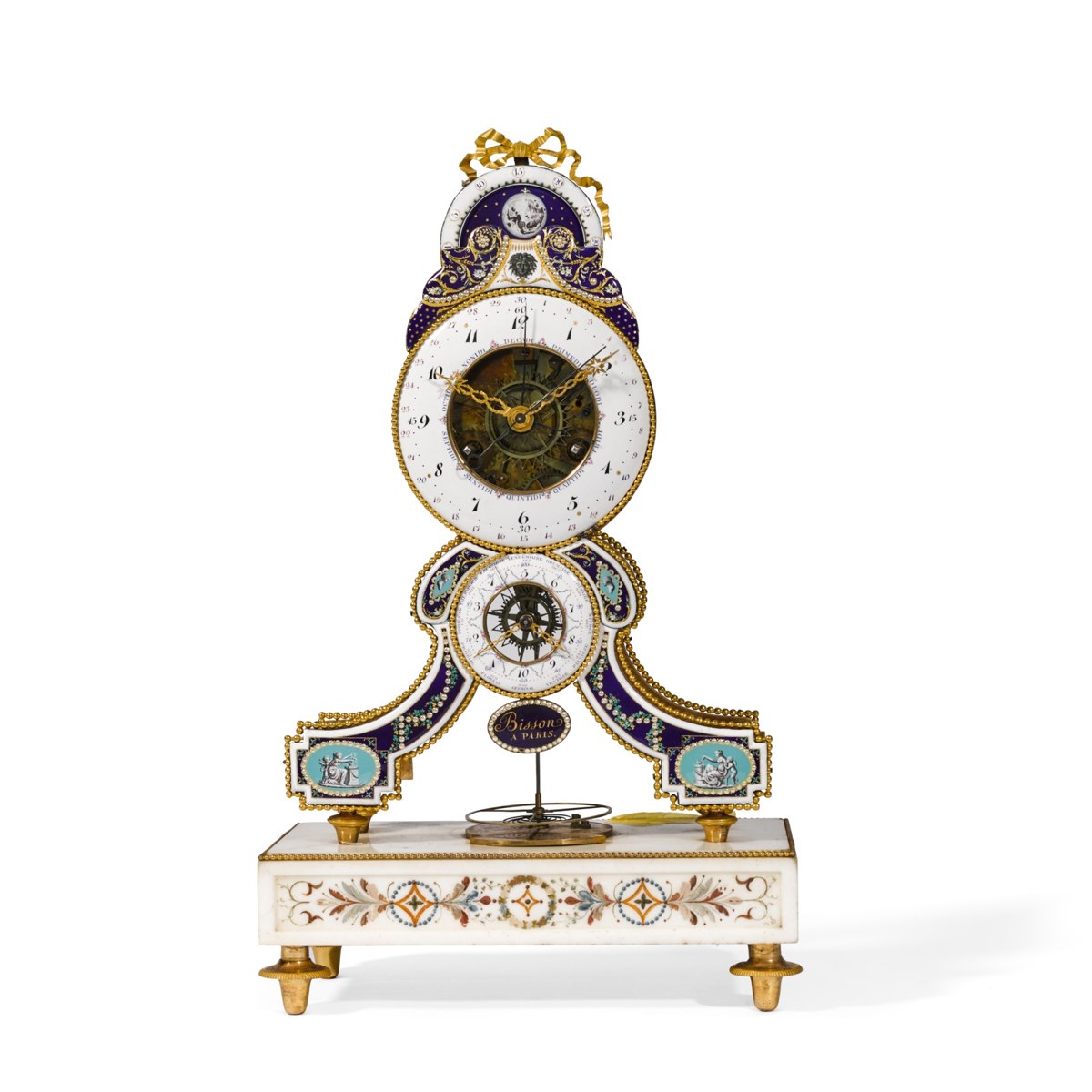
This Directoire skeleton clock, attributed to Bisson in Paris circa 1795, features painted and jewelled enamels documented as being by Joseph Coteau. Resting on a painted white marble plinth raised on gilt toupie feet, the openwork frame is topped by a ribbon crest above a lunar arch. The upper five-inch enamel dial displays concentric calendar dates, standard hours, minutes, and Revolutionary weekdays around a skeletonised centre. Below, a subsidiary enamel dial indicates Revolutionary decimal time alongside Gregorian and Revolutionary months. A signed plaque inscribed 'Bisson A Paris' sits directly over a horizontal three-arm balance wheel.

Front view of the Directoire skeleton clock showing enamel dials, painted marble base, and horizontal balance wheel
Front view of the Directoire skeleton clock showing enamel dials, painted marble base, and horizontal balance wheel — Sotheby's. Rights pending — permission not yet requested. Original source

Catalogue identity

Source
www.sothebys.com
Category
Clock · Skeleton clock
Maker / attribution
Bisson
Reference
Not recorded
Catalogue / lot identifier
104
Source-reported date
circa 1795
Country
France

Source-reported attribution and specifications are not independent authentication. A listing does not establish present ownership, current display, availability or permission to reproduce.

Object description

Dial Arrangement and Calendrical Display

The skeletonised frame incorporates multiple enamel elements for displaying standard and French Revolutionary time and calendrical cycles. The primary 5-inch enamel chapter ring indicates concentric dates, conventional minutes and hours, and Revolutionary days of the week, displaying finely pierced and engraved gilt time hands alongside blued steel centre seconds. Positioned directly above is a ribbon-tied surmount containing a lunar dial.

Below the upper dial sits a subsidiary enamel chapter ring indicating Revolutionary decimal hours and minutes together with both Revolutionary and Gregorian months. The frame is further mounted with painted and jewelled enamel panels, including a signature panel inscribed 'Bisson A Paris' that the source states is also marked 'Coteau' to the reverse.

Evidence for this section
  • “5-inch enamel chapter ring with concentric date, conventional minutes and hours and revolutionary days of the week, finely pierced and engraved gilt time hands, blued steel centre seconds”
  • “subsidiary chapter ring below with revolutionary and Gregorian months and revolutionary decimal hours and minutes”
  • “the frame with ribbon-tied surmount above a detailed lunar dial and further mounted with finely painted and jewelled enamel panels, a signature panel signed Bisson A Paris and also inscribed to the rear Coteau”

Movement and Framework

The open gilt-bronze framework rests on a white marble plinth painted with foliage, supported by toupie feet. Directly beneath the signature plaque and above the marble base, a horizontal three-arm balance is visible.

According to the catalogue description, the movement features a pin wheel escapement mounted on the backplate, while the striking train utilises a conventional outside count wheel striking on a bell. These rear-mounted movement components, along with the rear signature inscription, are not visible in the direct frontal view.

Evidence for this section
  • “the movement with pin wheel escapement mounted on the backplate and with a large horizontal three-arm balance mounted below, conventional outside count wheel striking on a bell”
  • “the marble plinth painted with foliage, on toupie feet”
  • “Horizontal three-arm balance visible above the base beneath the Bisson plaque”

Dimensions, Provenance, and Literature

The clock is catalogued to circa 1795 with enamels by Joseph Coteau. The clock measures 44 cm (17¼ in.) high on its own, with a total height of 51 cm (20 in.) when measured with its accompanying giltwood stand and glazed cover; neither the stand nor the glass cover is visible in the primary auction photograph.

Documented provenance records that the piece was acquired from the collection of Pascal Izarn in Paris. The lot is also recorded in literature references, including Pierre Kjellberg's 'Encyclopédie de la Pendule Française du moyen age au XXe siècle' (1997, p. 324) and Wannenes' 'Les plus belles pendules françaises' (2013, p. 299 and cover).

Evidence for this section
  • “Bisson, Paris, circa 1795, the enamels by Joseph Coteau”
  • “together with a giltwood stand and glazed cover, Clock 44cm. 17¼in. high Base and Cover 51cm. 20in. high”
  • “Acquired from the collection of Pascal Izarn, Paris.”
  • “P. Kjellberg, Encyclopédie de la Pendule Française du moyen age au XXe siècle , Paris, 1997, p.324 (illustrated). Wannenes, Les plus belles pendules françaises, Florence, 2013, p.299 (and illustrated on cover).”

Open research questions

  • What specific inscription or date marking, if any, accompanies the 'Coteau' signature on the reverse of the enamel signature plaque?
  • Does the count wheel striking train retain its original bell, count wheel, and hammer without later modification or alteration?
  • What is the design and condition of the accompanying giltwood stand and glazed cover listed in the catalogue description but not depicted in the frontal photograph?

Source evidence

Recorded claims and source quotations for Directoire gilt-bronze, enamel and white marble skeleton clock
FieldSource-reported valueSource quotation
Maker and OriginBisson, Paris“Bisson, Paris, circa 1795, the enamels by Joseph Coteau”
EnamellerJoseph Coteau“the enamels by Joseph Coteau”
EscapementPin wheel escapement“movement with pin wheel escapement mounted on the backplate”
Clock Height44cm (17¼in.)“Clock 44cm. 17¼in. high”
Striking MechanismOutside count wheel striking on a bell“conventional outside count wheel striking on a bell”
Height with Base and Cover51 cm (20 in.)“Base and Cover 51cm. 20in. high”
Enameller Signature MarkingInscribed 'Coteau' to the reverse of the signature panel“a signature panel signed Bisson A Paris and also inscribed to the rear Coteau”
Documented ProvenanceAcquired from the collection of Pascal Izarn, Paris“Acquired from the collection of Pascal Izarn, Paris.”

Visible details

  • Semicircular lunar dial beneath a gilded ribbon surmount with blue enamel and gold stars
  • Painted foliage and geometric motifs across the white marble plinth
  • Gilt toupie feet supporting the rectangular marble base
  • Horizontal three-arm balance visible above the base beneath the Bisson plaque

Research qualifications

  • Rear movement plate, escapement, and bell are obscured from front view
  • The accompanying giltwood stand and glazed cover mentioned in the listing are not shown in this photo

Photograph identity and source facts were screened before import; rights clearance remains pending.

Consulted source

A rare Directoire gilt-bronze, enamel and white marble skeleton clock

Reviewed 2026-10-21 · Record 3e833f8f39

Terms in this record

Glossary explanations for terms named in this object’s record.