
Skip to content
The Encyclopedia of Horology

Tool · Nuremberg diptych dial

Diptych Dial by Paul Reinmann

Partially verified

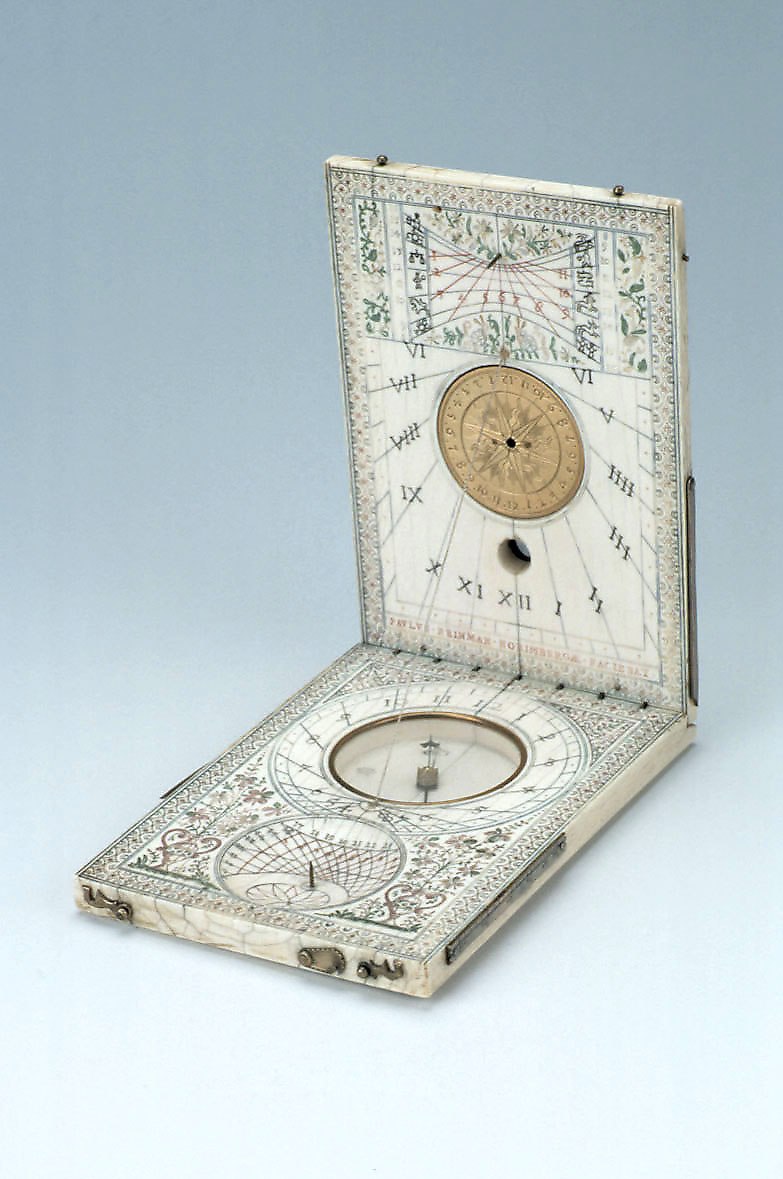
This diptych dial, created in Nuremberg circa 1600, is an ivory and brass instrument measuring 94 x 141 x 18 mm. Attributed to the maker Paul Reinmann, who signed the piece and included his crown mark, the dial is designed for multiple functions. It integrates a lunar volvelle, a wind rose, a universal equatorial dial, and zodiac and calendar scales. The instrument features a pin gnomon dial and a string gnomon dial, with various markings for planetary, Italian, and Babylonian hours. Its surface is extensively decorated with geometrical motifs, snails, flowers, and arabesques, and includes inscriptions from Ovid's Fasti. The construction incorporates a compass in the lower leaf and a latitude scale, with a compartment for a missing wind vane. The object is held by the Museum of the History of Science, Oxford, under inventory number 46175.

An open diptych dial in ivory and brass, featuring various hour scales, a central compass, and ornate floral decorations.
An open diptych dial in ivory and brass, featuring various hour scales, a central compass, and ornate floral decorations. — Museum of the History of Science, Oxford. Rights pending — permission not yet requested. Original source

Catalogue identity

Source
www.mhs.ox.ac.uk
Category
Tool · Nuremberg diptych dial
Maker / attribution
Paul Reinmann
Reference
Not recorded
Catalogue / lot identifier
46175
Source-reported date
circa 1600
Source-reported place
Nuremberg

Source-reported attribution and specifications are not independent authentication. A listing does not establish present ownership, current display, availability or permission to reproduce.

Object description

Construction and Design

The diptych dial is a multi-functional instrument comprising ivory leaves and brass components. Measuring 94 x 141 x 18 mm, the instrument is hinged to allow it to function in both folded and open configurations. The layout includes complex markings for timekeeping, including a string gnomon dial with common hours and multiple pin gnomon dials indicating planetary, Italian, and Babylonian hours.

The surface is adorned with varied ornamentation, including geometrical motifs, arabesques, snails, and floral imagery. A gilt brass plate, featuring a wind rose, is set into the center of the upper leaf's inner face. The structural design includes a brass arm for latitude adjustment and a specific compartment on the left edge intended for a wind vane, which is currently missing.

Evidence for this section
  • “Ivory and brass; 94 x 141 x 18 mm”
  • “At the centre of the inner face of the upper leaf there is a gilt brass plate decorated with a wind rose”
  • “On the left edge there is a compartment for the wind vane (missing)”

Signatures and Inscriptions

The object bears the signature of Paul Reinmann in Latin, reading 'PAVLVS REINMAN NORIMBERGAE FACIEBAT'. Additionally, the maker's mark, consisting of a crown, appears on the instrument. The maker also included an inscription in German at the bottom warning the user to avoid iron near the compass.

The dial includes text from Ovid’s Fasti, specifically lines 771-2 of book 6, detailing the passing of time.

Evidence for this section
  • “At the bottom an inscription reads 'PAVLVS REINMAN NORIMBERGAE FACIEBAT'.”
  • “Another inscription at the bottom reads 'wen ich kumpast recht sol weissen so richt mich nicht nahe bey eissen'”
  • “and is inscribed 'TEMPORA LABVNTVR TACITISQVE SENESCIMVS ANNIS ET FVGIVNT FRENO NON REMORANTE DIES'”

Provenance and Documentation

The dial is held in the collection of the Museum of the History of Science in Oxford, recorded under inventory number 46175. It is documented as part of the Epact archive regarding scientific instruments of medieval and Renaissance Europe.

The piece is identified in the academic literature concerning the manufacture of ivory sundials in Nuremberg between 1500 and 1700. Its features, including the specific maker's mark and the decorative program, assist in the attribution of the dial to the workshop of Paul Reinmann around the year 1600.

Evidence for this section
  • “Holding museum: Museum of the History of Science, Oxford”
  • “Inventory number 46175”
  • “See P. Gouk, The Ivory Sundials of Nuremberg 1500-1700 (Cambridge, 1988).”

Open research questions

  • What is the specific historical significance of the Ovidian inscription choice for this type of dial?
  • Are there identifiable remnants or records confirming the original form of the missing wind vane?

Source evidence

Recorded claims and source quotations for Diptych Dial by Paul Reinmann
FieldSource-reported valueSource quotation
MakerPaul Reinmann“Signed by Paul Reinmann”
Datecirca 1600“circa 1600; Nuremberg”
MaterialsIvory and brass“Ivory and brass”
Dimensions94 x 141 x 18 mm“94 x 141 x 18 mm”
SignaturePAVLVS REINMAN NORIMBERGAE FACIEBAT“'PAVLVS REINMAN NORIMBERGAE FACIEBAT'”
Inventory Number46175“Inventory number 46175”
Maker's MarkCrown“the maker's mark (a crown) painted twice”

Visible details

  • The dial is constructed from ivory leaves hinged together.
  • The central portion of the lower leaf contains an inset magnetic compass.
  • The interior of the upper leaf features a gilt brass plate with a wind rose.
  • There is visible surface decoration depicting flowers, vines, and snails.

Research qualifications

  • The source notes that the wind vane is missing from its compartment.
  • The original extent of the decorative finish on the ivory surface may have altered over time.

Photograph identity and source facts were screened before import; rights clearance remains pending.

Consulted source

Diptych Dial

Reviewed 2026-10-26 · Record 1aea5557a1

Terms in this record

Glossary explanations for terms named in this object’s record.