
Skip to content
The Encyclopedia of Horology

Tool · Nuremberg diptych dial

Diptych Dial

Partially verified

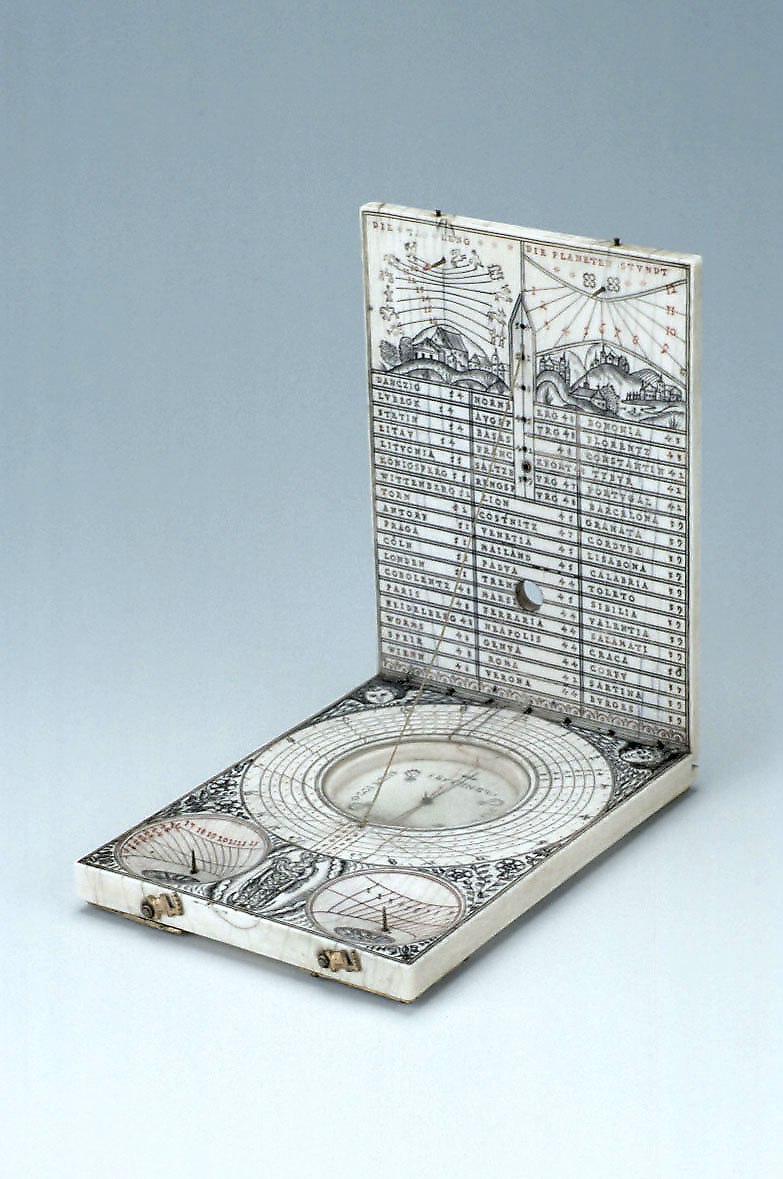
This diptych dial is a 17th-century instrument constructed from ivory and brass, measuring 100 x 140 x 15 mm. Attributed to the workshop of Paul Reinmann and dated 1612, the Nuremberg-made object serves as a complex timekeeping and astronomical tool. The upper leaf features two pin gnomon dials displaying day length and planetary hours, alongside a list of 54 cities with their corresponding latitudes. The lower leaf houses a compass and a string gnomon dial, with additional scaphe dials on its sides for Italian and Babylonian hours. The outer surfaces include a wind rose and a lunar volvelle with an epact table for 1612. Notable decorative elements include gilt brass plates depicting putti in the spandrel spaces and a figure of the Virgin and Child below the main dial. The instrument contains a known inscription error in the compass, where the cardinal direction 'SEPTENERO' is misspelled.

Diptych dial by the workshop of Paul Reinmann, 1612, showing the open inner leaves with latitude list, planetary hours, compass, and scaphe dials.
Diptych dial by the workshop of Paul Reinmann, 1612, showing the open inner leaves with latitude list, planetary hours, compass, and scaphe dials. — Museum of the History of Science, Oxford. Rights pending — permission not yet requested. Original source

Catalogue identity

Source
www.mhs.ox.ac.uk
Category
Tool · Nuremberg diptych dial
Maker / attribution
Workshop of Paul Reinmann
Reference
Not recorded
Catalogue / lot identifier
84206
Source-reported date
1612
Source-reported place
Germany

Source-reported attribution and specifications are not independent authentication. A listing does not establish present ownership, current display, availability or permission to reproduce.

Object description

Construction and Layout

The instrument is a folding diptych dial composed of ivory leaves featuring brass fittings. The outer side of the upper leaf contains a wind rose with 32 directions and weather types recorded in German, while the outer side of the lower leaf hosts a lunar volvelle table for the year 1612. The assembly is held together by brass components, including a counterchanged arm with Gothic-style ends.

The internal leaves are heavily engraved with multiple timekeeping systems. The upper leaf includes two pin gnomon dials and a list of 54 cities with their respective latitudes, allowing for adjustment to seven distinct settings. The lower leaf integrates a compass, a string gnomon dial for various latitudes, and two flanking scaphe dials indicating Italian and Babylonian hours, decorated with floral patterns and a figure of the Virgin and Child.

Evidence for this section
  • “The outer side of this dial has a wind rose with 32 directions”
  • “The inner side of the upper leaf has two pin gnomon dials”
  • “On its sides are two similar scaphe dials”

Decoration and Features

The dial displays intricate metalwork in its eight spandrel spaces, which house gilt brass triangular plates featuring the faces of putti. These plates function as feet for the base when the instrument is in a closed or displayed position. The central composition is further embellished with detailed landscape engravings beneath the pin gnomon dials on the upper leaf.

Despite the high quality of the ivory and the precision of the engraving, the instrument contains specific irregularities. Notably, the compass displays a misspelling of the cardinal point 'SEPTENERO'. The design also incorporates religious iconography, including a figure of the Virgin and Child situated below the central string gnomon dial area.

Evidence for this section
  • “In the spandrel spaces are four gilt brass triangular plates with faces of putti.”
  • “the misspelling 'SEPTENERO' in the compass is particularly noticable.”
  • “below the dial is a figure of the Virgin and Child.”

Horological Indicators

The diptych dial functions through multiple integrated systems. The upper leaf provides planetary hours numbered from 1 to 12 in red ink, and day length information marked from 8 to 16. The lower leaf features a string gnomon dial configured for seven different latitudes, with the 54-degree setting showing markings for half and quarter hours.

The side scaphe dials provide specialized temporal data, indicating Italian hours from 8 to 23 and Babylonian hours from 1 to 16. The instrument’s maker’s mark, a crown, is punched twice at the bottom of the lower leaf dial circle, confirming the workshop origin.

Evidence for this section
  • “planetary hours numbered from 1 to 12 in red.”
  • “indicating Italian hours numbered from 8 to 23 (on the left) and Babylonian hours numbered from 1 to 16 (on the right).”
  • “has the maker's mark (a crown) punched twice at the bottom.”

Open research questions

  • What was the specific function of the brass plates in the spandrel spaces beyond their use as feet?
  • Are there extant examples of similar Reinmann diptych dials with the complete lunar volvelle intact?

Source evidence

Recorded claims and source quotations for Diptych Dial
FieldSource-reported valueSource quotation
MakerWorkshop of Paul Reinmann“Workshop of Paul Reinmann”
Date1612“Dated 1612”
MaterialsIvory and brass“Ivory and brass”
Dimensions100 x 140 x 15 mm“100 x 140 x 15 mm”
Place of OriginNuremberg“Nuremberg”
Inventory Number84206“Inventory number 84206”
Inscribed ErrorSEPTENERO“the mis-spelling 'SEPTENERO'”

Visible details

  • Ivory construction with inlaid brass elements
  • Engraved city latitude list on the inner upper leaf
  • Gilt brass decorative plates with putti motifs
  • Figure of the Virgin and Child engraved below the compass

Research qualifications

  • Compass ring is missing
  • Brass lunar volvelle on the lower leaf is missing

Photograph identity and source facts were screened before import; rights clearance remains pending.

Consulted source

Diptych Dial

Reviewed 2026-10-26 · Record 12655c5325

Terms in this record

Glossary explanations for terms named in this object’s record.