
Skip to content
The Encyclopedia of Horology

Tool · Nuremberg diptych dial

Diptych Dial

Partially verified

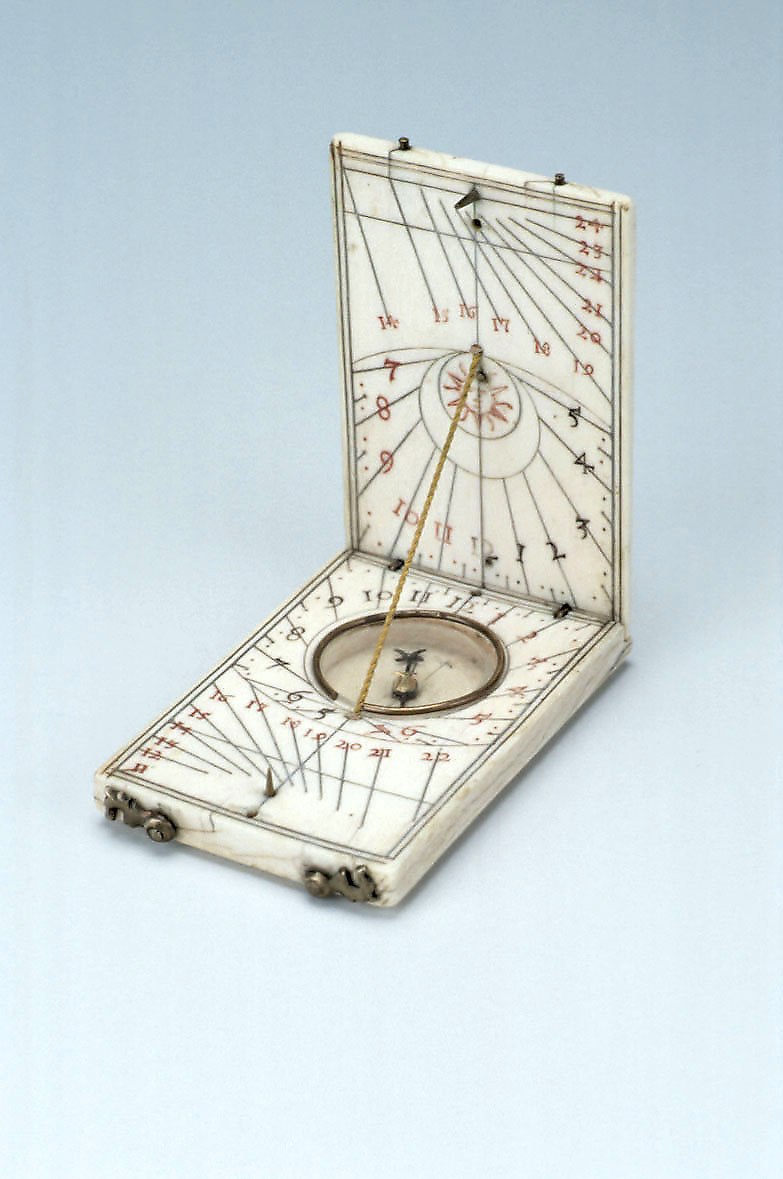
This diptych dial is a portable scientific instrument constructed from ivory and brass, measuring 40 x 63 x 9 mm. Held in the collection of the Museum of the History of Science, Oxford, the instrument is unsigned, though it bears a coronet-shaped maker's mark on the outer lower leaf. The device functions as a multi-purpose timekeeper. The upper leaf includes a lunar volvelle on the exterior, and internal pin gnomon and string gnomon dials. The lower leaf houses an internal compass with magnetic deviation indicated, alongside a string gnomon dial and a pin gnomon dial for Italian hours. The dial is attributed to Nuremberg circa 1600, with the maker's mark posing identification challenges, as it shares characteristics with both the Reinmann and Lesel families. It remains an example of 17th-century ivory instrument production in Nuremberg.

Diptych dial, Nuremberg, circa 1600, showing the interior dial faces and inset compass.
Diptych dial, Nuremberg, circa 1600, showing the interior dial faces and inset compass. — Museum of the History of Science, Oxford. Rights pending — permission not yet requested. Original source

Catalogue identity

Source
www.mhs.ox.ac.uk
Category
Tool · Nuremberg diptych dial
Maker / attribution
Not established
Reference
Not recorded
Catalogue / lot identifier
34722
Source-reported date
circa 1600
Source-reported place
Nuremberg

Source-reported attribution and specifications are not independent authentication. A listing does not establish present ownership, current display, availability or permission to reproduce.

Object description

Dial Layout and Configuration

The diptych dial features a complex arrangement of timekeeping surfaces on the interior faces of the ivory leaves. The upper leaf contains a pin gnomon dial for Italian hours, numbered in red from 14 to 24, and a string gnomon dial for common hours marked from 7 to 12 to 5. A sun effigy is engraved within eccentric circles at the center of this dial.

The lower leaf contains an inset compass with magnetic deviation markings. This is surrounded by a string gnomon dial for common hours, with numbering from 5 to 12 to 7, and a pin gnomon dial for Italian hours numbered in red from 11 to 22. Both string dials utilize dots and lines to indicate half and quarter-hour intervals.

Evidence for this section
  • “The inner part of the upper leaf has a pin gnomon dial for Italian hours numbered in red from 14 to 24.”
  • “The inner part of the lower leaf has a compass with magnetic deviation indicated, enclosed in a string gnomon dial with common hours numbered from 5 to 12 to 7 with dots and lines for the half and quarter of hours.”

Exterior Features and Attribution

The exterior of the upper leaf displays a lunar volvelle featuring a moon effigy. The exterior of the lower leaf is largely plain, serving primarily as the location for the maker's mark, which is a stamped coronet.

The instrument is unsigned and its manufacture remains associated with the Reinmann or Lesel families of Nuremberg based on the mark. The complexity of the markings indicates it was intended for use in calculating both common and Italian hours, supported by the integral compass for correct alignment.

Evidence for this section
  • “The outer side of the upper leaf has a lunar volvelle with a moon effigy at the centre.”
  • “The outer side of the lower leaf is blank except for the maker's mark (a coronet).”
  • “This mark is similar, but not identical, to those used by members of the Reinmann family.”

Collection and Reference

This object is part of the collection of the Museum of the History of Science in Oxford, recorded under the number 34722. It is included in the Epact database of scientific instruments from Medieval and Renaissance Europe.

The dial is referenced in the scholarly study, 'The Ivory Sundials of Nuremberg 1500-1700' by P. Gouk (1988). The attribution of the dial remains subject to academic review due to the ambiguous nature of the maker's punch.

Evidence for this section
  • “Holding museum: Museum of the History of Science, Oxford”
  • “See P. Gouk, The Ivory Sundials of Nuremberg 1500-1700 (Cambridge, 1988).”

Open research questions

  • Can specific variations in the coronet punch confirm a Reinmann vs. Lesel attribution?
  • Does the magnetic deviation marking suggest a specific intended latitude for the instrument's use?

Source evidence

Recorded claims and source quotations for Diptych Dial
FieldSource-reported valueSource quotation
Inventory Number34722“Inventory number: 34722”
Dimensions40 x 63 x 9 mm“40 x 63 x 9 mm”
MaterialsIvory and brass“Ivory and brass”
Maker's MarkCoronet“The outer side of the lower leaf is blank except for the maker's mark (a coronet).”
Maker AttributionUncertain (Reinmann or Lesel family)“The same mark in the form of a crown was used by some members of the Lesel family in Nuremberg.”
OriginNuremberg“Nuremberg”

Visible details

  • Internal brass compass with visible needle
  • Red ink used for Italian hour numbering
  • Two pin gnomons attached to the ivory leaves
  • Engraved sun effigy at the center of the upper dial

Research qualifications

  • Attribution is difficult due to an ambiguous maker's mark
  • The crown-shaped mark may belong to either the Reinmann or Lesel families

Photograph identity and source facts were screened before import; rights clearance remains pending.

Consulted source

Diptych Dial

Reviewed 2026-10-26 · Record 1219568f1a

Terms in this record

Glossary explanations for terms named in this object’s record.