
Skip to content
The Encyclopedia of Horology

Clock · Crucifix clock

Crucifix Clock by W. H. Arnstad

Partially verified

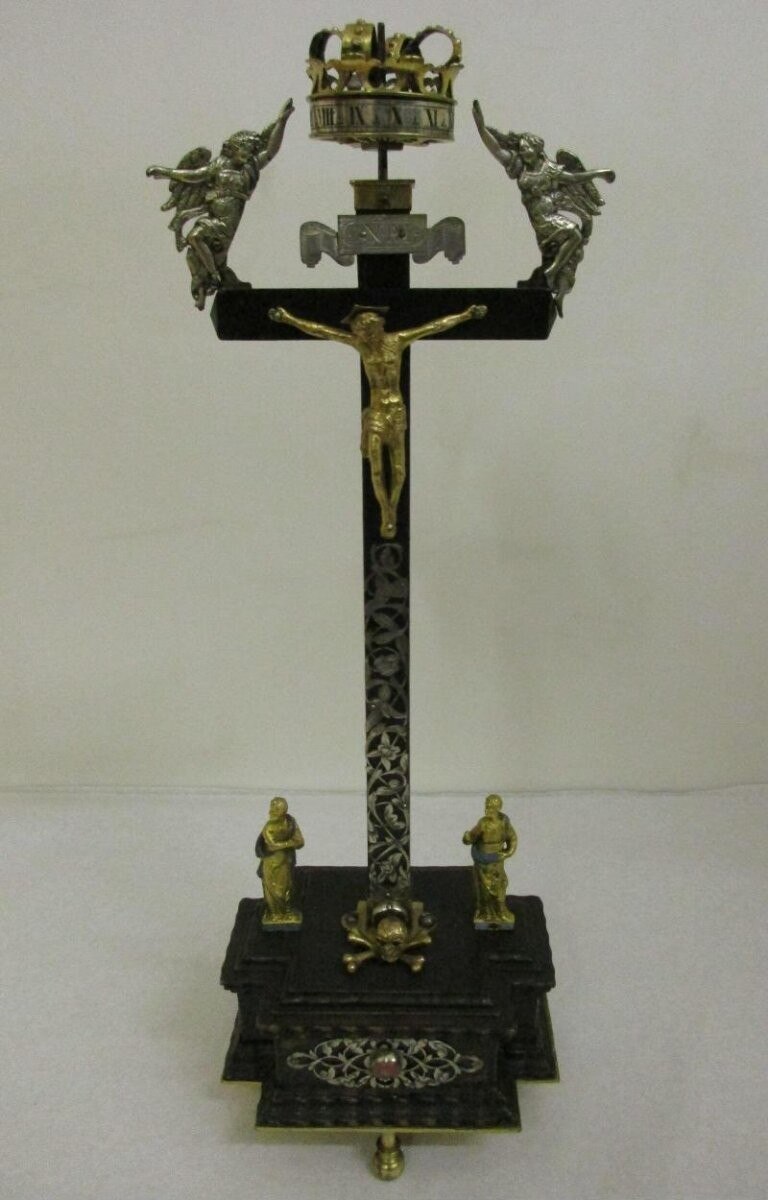
This table clock, created in the mid-17th century, is constructed as a crucifix mounted on an ebony pedestal. The primary structure is made of ebony with applied silver ornaments and gilt-metal figures representing Christ, the Virgin, and Saint John, alongside a skull and crossbones positioned at the foot of the cross. A silver scroll above the figure of Christ displays the motto INRI, flanked by silver angels cast in low relief. The timekeeping mechanism is housed within the rectangular pedestal, which rests on three turned gilt-metal feet. A revolving crown-shaped dial, formed from a silvered ring, sits at the top of the crucifix. The movement, signed by W. H. Arnstad on the bottom plate, features a verge escapement with an added balance spring and a Tompion-type regulator. The clock includes a locking-plate striking train and an outside count-wheel.

Full view of the crucifix clock, showing the dial, central crucifix, and pedestal base.
Full view of the crucifix clock, showing the dial, central crucifix, and pedestal base. — Victoria and Albert Museum. Rights pending — permission not yet requested. Original source

Catalogue identity

Source
collections.vam.ac.uk
Category
Clock · Crucifix clock
Maker / attribution
W. H. Arnstad
Reference
Not recorded
Catalogue / lot identifier
4095-1857
Source-reported date
mid-17th century
Source-reported place
France

Source-reported attribution and specifications are not independent authentication. A listing does not establish present ownership, current display, availability or permission to reproduce.

Object description

Case and Dial Design

The clock features a devotional aesthetic, centered on a crucifix supported by a pedestal of ebony. Applied silver ornaments and stones decorate the structure, which includes detailed figures of the Virgin and Saint John flanking the crucifix, with a skull and crossbones ornament at its base. The angels mounted on the arms of the cross serve as pointers to the dial.

The time-telling component is located at the top of the cross, consisting of a crown-shaped drum featuring a silvered ring that rotates once every twelve hours. This ring is engraved with Roman numerals from I to XII, including quarter-hour divisions, allowing the time to be read against the fixed positions of the flanking angels.

Evidence for this section
  • “Case: In the form of a crucifix on a pedestal; ebony with applied silver ornaments”
  • “Above is the dial, consisting of a silvered ring, rotating once in 12 hours and forming the drum-shaped part of a gilt-silver crown”

Movement and Mechanism

Housed within the rectangular pedestal, the movement is built on a 4.8 cm square plate. The going train utilizes an unprotected brass wheel assembly. Currently, the movement features a verge escapement and a balance that has been updated with a spring and a Tompion-type regulator.

The striking train is controlled by a locking-plate mechanism, also incorporating an open spring and an outside count-wheel. The bell required for the striking function is secured to a hinged door located at the bottom of the pedestal, allowing for sound output.

Evidence for this section
  • “The clock movement is contained within the pedestal”
  • “Verge escapement, and balance now fitted with a spring and Tompion-type regulator. Locking-plate striking train also with an open spring; outside count-wheel.”

History and Attribution

The clock is signed by W. H. Arnstad on the bottom plate of the movement. It has been attributed to a French origin, with a production date established in the mid-17th century, approximately 1650.

The object entered the institutional collection in 1857 through a purchase by the South Kensington Museum.

Evidence for this section
  • “briefDescription: Crucifix Clock, signed W. H. Arnstad, mid- 17th century.”
  • “Purchased by the South Kensington Museum in 1857”

Open research questions

  • What is the history of the Tompion-type regulator modification found on this clock?
  • Are there other known surviving crucifix clocks bearing the signature of W. H. Arnstad?

Source evidence

Recorded claims and source quotations for Crucifix Clock by W. H. Arnstad
FieldSource-reported valueSource quotation
MakerW. H. Arnstad“signed W. H. Arnstad”
Accession number4095-1857“4095-1857”
Dial typeRotating ring“a silvered ring, rotating once in 12 hours”
Movement signatureW. H. Arnstad“the bottom plate signed "W. H. Arnstad”
OriginFrance“French, 17th century”
MaterialsEbony, silver, gilt-metal“ebony with applied silver ornaments set with stones; the figure of gilt-metal”

Visible details

  • Skull and crossbones decoration at the base of the crucifix
  • Silvered ring dial rotating once every 12 hours
  • Angels on the cross arms pointing to the dial
  • Gilt-metal figure of Christ on the cross

Research qualifications

  • The stopwork for the going train is missing
  • The balance is currently fitted with a spring and a Tompion-type regulator, which may indicate later modification

Photograph identity and source facts were screened before import; rights clearance remains pending.

Consulted source

Crucifix Clock

Reviewed 2026-11-02 · Record 7c6079c50a

Terms in this record

Glossary explanations for terms named in this object’s record.