
Skip to content
The Encyclopedia of Horology

Clock · Wall clock

François Désiré Odobez Comtoise-style wall clock

Partially verified

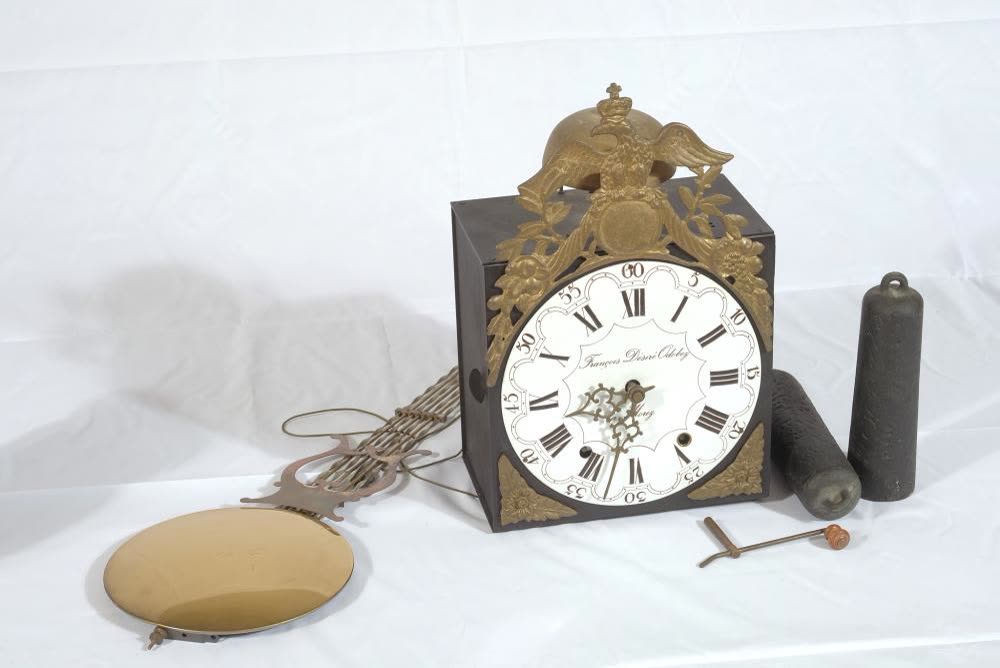
This wall clock featuring dial lettering reading François Désiré Odobez was catalogued by Auktionshaus Karrenbauer under a 20th-century heading, with a note stating that the dial and movement are likely original 19th-century components while the case is probably newer. The square case measures 24 by 24 cm and is surmounted by a bell and an embossed brass pediment featuring an eagle and foliage. The enamel dial displays Roman numeral hours and outer Arabic five-minute indicators. The lot includes a lyre-form gridiron pendulum with a circular brass bob, two weights, and a winding key.

Front view of the wall clock with brass eagle pediment, bell, detached pendulum, two weights, and winding key
Front view of the wall clock with brass eagle pediment, bell, detached pendulum, two weights, and winding key — Auktionshaus Karrenbauer. Rights pending — permission not yet requested. Original source

Catalogue identity

Source
www.invaluable.com
Category
Clock · Wall clock
Maker / attribution
François Désiré Odobez
Reference
Not recorded
Catalogue / lot identifier
433
Source-reported date
20. Jahrhundert
Country
France

Source-reported attribution and specifications are not independent authentication. A listing does not establish present ownership, current display, availability or permission to reproduce.

Object description

Dial and Case Description

The wall clock features a white enameled dial lettered across the center with 'François Désiré Odobez'. It is configured with black Roman numerals indicating the hours, flanked by outer Arabic markers denoting five-minute intervals. The lower register of the dial reveals two winding arbors, fitted with openwork metal hands.

The dial is set within a square dark-finished metal case measuring 24 by 24 cm, fitted with decorative brass spandrels at each corner. Above the dial structure, an embossed brass cresting depicts a crowned eagle flanked by laurel branches, positioned in front of an exposed top-mounted bell.

Evidence for this section
  • “White enameled dial is inscribed 'François Désiré Odobez' with black Roman hour numerals and Arabic five-minute numerals”
  • “Openwork metal hands with two winding arbors on the lower dial”
  • “Square dark-finished metal case with brass corner spandrels”
  • “Gehäuse 24x24cm”
  • “Embossed brass cresting depicts a crowned eagle flanked by laurel branches in front of a top-mounted bell”

Included Accessories

The lot includes a crank-style winding key, a gridiron pendulum with a circular brass bob, and two cylindrical weights.

The auction description explicitly confirms the inclusion of these ancillary pieces: 'Schlüssel vorhanden, Pendel & Gewichte vorhanden.'

Evidence for this section
  • “Accompanied by two cylindrical weights, a gridiron pendulum with a circular brass bob, and a crank-style winding key”
  • “Schlüssel vorhanden, Pendel & Gewichte vorhanden.”

Cataloguing and Dating Assessments

Auktionshaus Karrenbauer listed the object under the lot title 'Wanduhr, François Désiré Odobez, 20. Jahrhundert', placing the primary cataloguing date in the 20th century.

The cataloguer added a specific dating assessment regarding the constituent parts: 'Ziffernblatt und Uhrwerk wohl Original aus dem 19. Jahrhundert, Gehäuse wohl neu.' This indicates that the dial and movement are considered likely 19th-century originals, whereas the casing is likely newer or modern. Further details on internal movement markings or operational status are not recorded in the source.

Evidence for this section
  • “Wanduhr, François Désiré Odobez, 20. Jahrhundert”
  • “Ziffernblatt und Uhrwerk wohl Original aus dem 19. Jahrhundert, Gehäuse wohl neu.”

Open research questions

  • What stamps, maker markings, or escapement features are visible on the internal movement upon inspection?
  • Does the square case display modern manufacturing methods or materials consistent with the cataloguer's note that it is 'wohl neu'?
  • Is the name 'François Désiré Odobez' enamel-fired to the dial plate or applied at a later date?

Source evidence

Recorded claims and source quotations for François Désiré Odobez Comtoise-style wall clock
FieldSource-reported valueSource quotation
Maker / InscriptionFrançois Désiré Odobez“François Désiré Odobez”
Case Dimensions24x24cm“Gehäuse 24x24cm”
AccessoriesKey, pendulum, and weights present“Schlüssel vorhanden, Pendel & Gewichte vorhanden.”
Dating assessmentDial and movement probably 19th century, case probably modern“Ziffernblatt und Uhrwerk wohl Original aus dem 19. Jahrhundert, Gehäuse wohl neu.”
Cataloguer Dating AssessmentDial and movement probably 19th century, case probably new“Ziffernblatt und Uhrwerk wohl Original aus dem 19. Jahrhundert, Gehäuse wohl neu.”

Visible details

  • Embossed brass cresting depicts a crowned eagle flanked by laurel branches in front of a top-mounted bell
  • White enameled dial is inscribed 'François Désiré Odobez' with black Roman hour numerals and Arabic five-minute numerals
  • Openwork metal hands with two winding arbors on the lower dial
  • Square dark-finished metal case with brass corner spandrels
  • Accompanied by two cylindrical weights, a gridiron pendulum with a circular brass bob, and a crank-style winding key

Research qualifications

  • The auction house notes the dial and movement are probably 19th-century originals, while the case is probably modern
  • Internal movement condition and rear construction are not visible in the catalogue photograph

Photograph identity and source facts were screened before import; rights clearance remains pending.

Consulted source

Sold at Auction: Wanduhr, François Désiré Odobez, 20. Jahrhundert

Reviewed 2026-10-21 · Record d086fdb8e7

Terms in this record

Glossary explanations for terms named in this object’s record.