
Skip to content
The Encyclopedia of Horology

Pocket watch · Hunting-case pocket watch

Constant Girard 18K Yellow Gold and Enamel Hunting-Case Pocket Watch

Partially verified

This 18K yellow gold presentation pocket watch, numbered 12 241, is attributed to Constant Girard of La Chaux-de-Fonds, dating to approximately 1852-1856. Retailed by Charles Suchy & Fils in Prague, it was produced for the Central-Eastern-European market. The five-body 'bassine et filets' case features intricate decoration: the hinged cover displays a multicoloured enamelled coat of arms under a Count crown, surrounded by garland foliage executed in ors paillonnés and ramolayé techniques. The reverse depicts an enamelled floral bouquet set against a lake landscape, framed by champlevé and taille-douce engraving. The interior contains a hinged gold cuvette signed by the retailer. The movement, potentially utilizing an ébauche by Antoine LeCoultre, is a frosted gilt brass bridge calibre with nineteen jewels, a straight-line lever escapement, and an early keyless-winding system. The white enamel dial features black Roman numerals and blued steel hands.

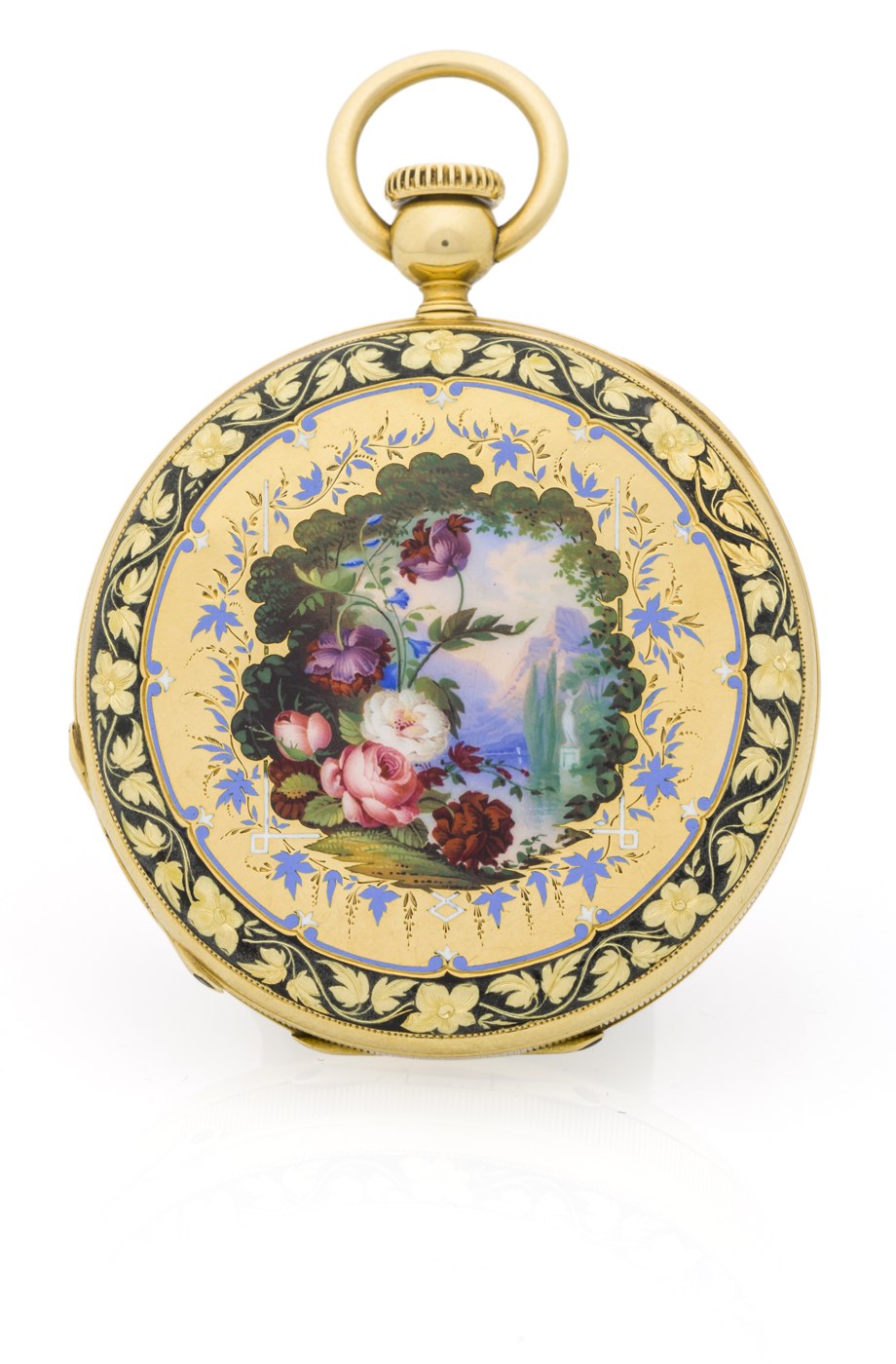
The exterior of the gold hunting-case watch, showing the multicoloured enamelled bouquet and lake scene, surrounded by gold foliage garland, with the reeded case-band visible.
The exterior of the gold hunting-case watch, showing the multicoloured enamelled bouquet and lake scene, surrounded by gold foliage garland, with the reeded case-band visible. — Antiquorum. Rights pending — permission not yet requested. Original source

Catalogue identity

Source
catalog.antiquorum.swiss
Category
Pocket watch · Hunting-case pocket watch
Maker / attribution
Constant Girard
Reference
Not recorded
Catalogue / lot identifier
218
Source-reported date
circa 1852-1856
Source-reported place
Switzerland
Source-reported serial
12 241

Source-reported attribution and specifications are not independent authentication. A listing does not establish present ownership, current display, availability or permission to reproduce.

Object description

Case and Enamel Decoration

The watch is housed in a five-body, round-shaped 'bassine et filets' 18K yellow gold case featuring a reeded case-band. The hinged front cover is decorated with a multicoloured enamelled coat of arms depicting a Central-Eastern European family crest on an ermine mantling, supported by two lions and surmounted by a Count crown. This assembly is set against a polished background and surrounded by a garland of foliage executed in ors paillonnés and ramolayé techniques, with sous fondant details.

The hinged case-back features a multicoloured enamelled bouquet of flowers presented before a lake landscape. This scene is contained within a frame of white and light blue champlevé enamel and taille-douce engraving on a polished background, matching the garland motif found on the front cover. The hinged gold cuvette is engraved with the retailer's name, 'Chs Suchy & Fils / Prague'.

Evidence for this section
  • “five-body, "bassine et filets" round-shaped; reeded case-band”
  • “the hinged cover with multicoloured enamelled coat of arms”
  • “The painting on enamel scene can be attributed to the Genevan workshop of Gaspard Lamunière”

Movement and Construction

The movement is a frosted gilt brass bridge calibre equipped with nineteen rubies, a straight-line equilibrated lever escapement, and a compensated balance with gold poising screws. It features a blued steel Breguet hairspring, a polished steel endplate, and an index regulator. The watch incorporates an early keyless-winding and setting system, eliminating the need for a separate key.

It is potentially the work of Antoine LeCoultre, whose 'à bascule' winding system was a prominent innovation of the period. The specific system implemented here is described as a development of LeCoultre’s earlier mechanisms.

Evidence for this section
  • “frosted gilt brass, bridge calibre with barrel, 19 rubies, straight-line equilibrated lever escapement”
  • “ébauche probably by LeCoultre (Le Sentier, Vallée de Joux)”

Dial and Provenance

The dial is made of white enamel and features black painted radial Roman numerals, complemented by blued steel 'Fantasy' hands. The watch was designed for the Central-Eastern-European market during the era of the Austro-Hungarian Empire. The manufacturer is identified as Constant Girard, who later established the Girard-Perregaux House.

Records indicate the watch is numbered on the plate under the dial. The auction house classifies the condition as 'Very good' for the dial, though the movement is noted as requiring repair. The enamel work is associated with the workshop of Gaspard Lamunière, a noted Genevan painter of the era.

Evidence for this section
  • “White enamel, with black painted radial Roman numerals. Blued steel Fantasy hands”
  • “made the Central-Eastern-European market (at the time Austro-Hungarian Empire)”
  • “numbered on the plate under the dial”

Open research questions

  • Confirm the specific Central-Eastern European family coat of arms depicted on the cover.
  • Verify the specific development phase of the keyless-winding mechanism utilized in this calibre.

Source evidence

Recorded claims and source quotations for Constant Girard 18K Yellow Gold and Enamel Hunting-Case Pocket Watch
FieldSource-reported valueSource quotation
MakerConstant Girard“Constant Girard, La Chaux-de-Fonds (the future founder of the Girard- Perregaux House)”
RetailerCharles Suchy & Fils“retailed by Charles Suchy & Fils, Prague.”
Serial Number12 241“No. 12 241”
Case Material18K yellow gold“18K yellow gold and enamel, hunting-case”
Movement TypeBridge calibre“frosted gilt brass, bridge calibre with barrel, 19 rubies”
Diameter50 mm“DIAM. 50 MM.”
EscapementStraight-line equilibrated lever“straight-line equilibrated lever escapement”
Datecirca 1852-1856“circa 1852-1856”

Visible details

  • Case features a multicoloured enamel bouquet and lake landscape
  • Dial displays black painted Roman numerals with blued steel hands
  • Features early keyless-winding and setting mechanism

Research qualifications

  • Movement ébauche is only probably attributed to Antoine LeCoultre
  • Enamel scene is only attributed to the workshop of Gaspard Lamunière

Photograph identity and source facts were screened before import; rights clearance remains pending.

Terms in this record

Glossary explanations for terms named in this object’s record.