
Skip to content
The Encyclopedia of Horology

Pocket watch · Clock watch

Clock-watch with alarm and calendar

Partially verified

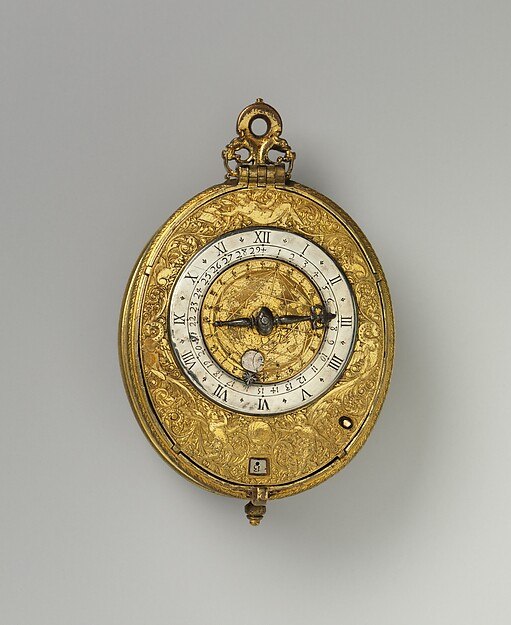
This clock-watch with alarm and calendar is attributed to the maker Nicolas Forfaict, who was active in Paris between circa 1580 and 1615. The object measures approximately 2 1/8 inches by 1 3/8 inches (5.4 by 3.5 cm). The construction incorporates multiple metals; the movement is composed of gilded brass and steel, with some steel components blued. The external case and dial are constructed from brass and silvered brass, with silver elements and a steel hand. The movement is visible when the case is opened, displaying openwork bridges and train wheels. The dial features a chapter ring with numerals, and internal circular scales related to the calendar and alarm functions. The overall design features decorative engraving across the exterior case surfaces, including a suspension loop at the top. The object is held in the European Sculpture and Decorative Arts department at The Metropolitan Museum of Art.

Side view of the clock-watch showing the movement assembly and the openwork bridge, with the case in an open position.
Side view of the clock-watch showing the movement assembly and the openwork bridge, with the case in an open position. — The Metropolitan Museum of Art, New York. Rights pending — permission not yet requested. Original source

Catalogue identity

Source
orbiscollectibles.com
Category
Pocket watch · Clock watch
Maker / attribution
Nicolas Forfaict
Reference
Not recorded
Catalogue / lot identifier
17.190.1607
Source-reported date
ca. 1600–1610
Source-reported place
French, Paris

Source-reported attribution and specifications are not independent authentication. A listing does not establish present ownership, current display, availability or permission to reproduce.

Object description

Construction and Materials

The clock-watch is constructed primarily from a combination of gilded brass and steel for the movement, with parts of the steel specifically finished in blue. The dial and the outer case are fashioned from brass, which has been silvered in sections, and incorporated with silver components. The primary indicator hand is made of steel.

The movement assembly features intricate openwork bridges that allow a view of the internal train wheels. When the case is open, the movement is revealed to be a compact structure secured within the decorative metal housing. The external dimensions of the watch are recorded as 2 1/8 by 1 3/8 inches.

Evidence for this section
  • “Movement: gilded breass and steel, partly blued; case and dial: brass, silvered brass, silver; hand: steel”
  • “2 1/8 x 1 3/8 in. (5.4 x 3.5 cm)”

Dial and Functions

The face of the clock-watch features a central dial plate, extensively engraved with scrollwork and figures. A chapter ring with standard numerals is present, along with additional inner scales required for the calendar and alarm complications. A single steel pointer facilitates reading the time and the secondary calendar or alarm functions.

The decorative engraving extends across the entirety of the exterior surface of the case, consistent with the construction of early seventeenth-century Parisian clock-watches.

Evidence for this section
  • “Clock-watch with alarm and calendar”
  • “hand: steel”

Provenance and Documentation

The object is held in the collection of The Metropolitan Museum of Art under accession number 17.190.1607. It was acquired as part of the gift from J. Pierpont Morgan in 1917. The museum documents the maker as Nicolas Forfaict, a French clockmaker active in Paris from 1580 until 1615.

The current record classifies the object as a clock-watch with alarm and calendar. The museum identifies the object as part of the European Sculpture and Decorative Arts collection, with the attribution to Forfaict and the date range established based on the museum's internal records.

Evidence for this section
  • “The Metropolitan Museum of Art holds this object as 17.190.1607”
  • “Watchmaker: Nicolas Forfaict (French, Paris, ca. 1580–1615)”
  • “Gift of J. Pierpont Morgan, 1917”

Open research questions

  • Does the movement contain a specific signature or mark identifying Nicolas Forfaict?
  • What are the precise mechanical steps required to set and engage the alarm complication?

Source evidence

Recorded claims and source quotations for Clock-watch with alarm and calendar
FieldSource-reported valueSource quotation
MakerNicolas Forfaict“Watchmaker: Nicolas Forfaict (French, Paris, ca. 1580–1615)”
Dateca. 1600–1610“ca. 1600–1610”
Dimensions2 1/8 x 1 3/8 in. (5.4 x 3.5 cm)“2 1/8 x 1 3/8 in. (5.4 x 3.5 cm)”
Movement Materialsgilded brass and steel, partly blued“Movement: gilded breass and steel, partly blued”
Case and Dial Materialsbrass, silvered brass, silver“case and dial: brass, silvered brass, silver”
Hand Materialsteel“hand: steel”
Holding InstitutionThe Metropolitan Museum of Art“The Metropolitan Museum of Art holds this object as 17.190.1607”
Accession Number17.190.1607“17.190.1607”

Visible details

  • Openwork bridge over the movement
  • Engraved scrollwork on the outer case and dial plate
  • Calendar display integrated into the main dial face
  • Steel hand with pointer indication

Research qualifications

  • Maker attribution to Nicolas Forfaict is based on historical records, not necessarily a signed stamp on this specific object.
  • The exact functional operational status of the alarm and calendar mechanisms remains unverified.

Photograph identity and source facts were screened before import; rights clearance remains pending.

Consulted source

Clock-watch with alarm and calendar

Reviewed 2026-11-02 · Record d0cece612b

Terms in this record

Glossary explanations for terms named in this object’s record.