
Skip to content
The Encyclopedia of Horology

Pocket watch · Clock watch

Clock watch

Partially verified

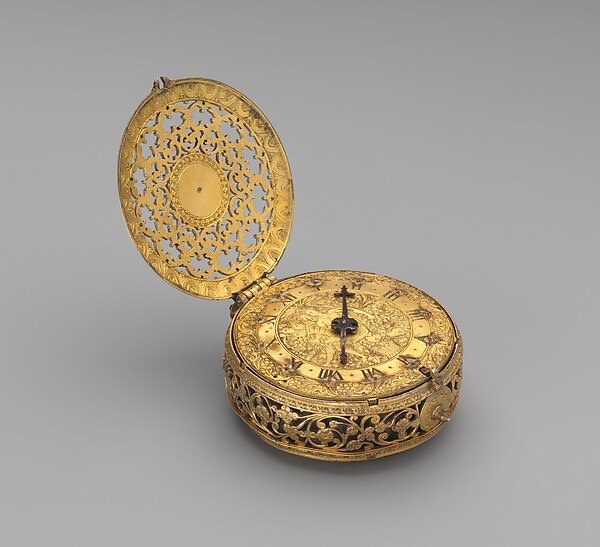
This clock watch is a horological instrument attributed to the Flemish maker Michael Nouwen, who was active in London between approximately 1600 and 1610. The object is held by The Metropolitan Museum of Art. It features a circular construction with a diameter of 2 inches. The watch case and dial are crafted from gilded brass, with a blued steel hand mounted on the dial. The internal movement is composed of gilded brass and iron. The object is designed with a pierced, ornate outer cover that allows the time to be viewed while the cover remains closed, revealing the Roman numerals engraved on the dial surface underneath. The case back and the cover are decorated with dense, foliate scrollwork engravings. The movement remains documented by the museum as a clock watch dating from the early seventeenth century period.

The clock watch shown with the hinged cover open to reveal the engraved gilded brass dial.
The clock watch shown with the hinged cover open to reveal the engraved gilded brass dial. — The Metropolitan Museum of Art, Gift of J. Pierpont Morgan, 1917. Rights pending — permission not yet requested. Original source

Catalogue identity

Source
orbiscollectibles.com
Category
Pocket watch · Clock watch
Maker / attribution
Michael Nouwen
Reference
Not recorded
Catalogue / lot identifier
17.190.1549
Source-reported date
ca. 1600–1610
Source-reported place
British

Source-reported attribution and specifications are not independent authentication. A listing does not establish present ownership, current display, availability or permission to reproduce.

Object description

Case and Dial Construction

The watch features a circular gilded brass case designed with an integral hinged cover. This cover is decorated with a complex, pierced foliate design that enables the viewer to see the chapter ring beneath it even when the watch is closed. The dial itself is also made of gilded brass and is engraved with a sequence of Roman numerals marking the hours.

A single blued steel hand is centrally mounted to display the time. The perimeter of the case, as well as the surfaces of both the hinged cover and the back, are finished with intricate scrollwork engravings that cover the gilded brass surfaces.

The overall diameter of the watch case measures 2 inches, while the internal back plate has a recorded diameter of 1 5/8 inches.

Evidence for this section
  • “Case: gilded brass; Dial: gilded brass with a blued steel hand”
  • “Diameter (watch case): 2 in. (5.1 cm) Diameter (back plate): 1 5/8 in. (4.1 cm).”

Movement and Attribution

The movement of the clock watch is constructed from a combination of gilded brass and iron. The piece is attributed to the Flemish maker Michael Nouwen, also referred to as Nouen. Nouwen was an active clockmaker in London during the early seventeenth century, with his documented period of activity spanning approximately 1600 to 1610, preceding his death in 1613.

Attribution remains linked to the record provided by The Metropolitan Museum of Art. The movement is understood to be consistent with the technical production of this era, though specific escapement details are not provided within the museum's summary documentation.

Evidence for this section
  • “Movement by Michael Nouwen, or Nouen (Flemish, active London, ca. 1600–10, died 1613)”
  • “Movement: gilded brass and iron.”

Provenance and Documentation

The object is currently held within the European Sculpture and Decorative Arts department at The Metropolitan Museum of Art in New York. It was acquired by the institution as part of a gift from J. Pierpont Morgan in 1917, receiving the accession number 17.190.1549.

The record is categorized as a clock watch. While the museum documentation identifies the piece by its maker, date, and physical dimensions, the museum notes that these details represent this specific object and acknowledges that further independent verification against broader horological references might be required to confirm the object's classification within the wider context of seventeenth-century clockmaking.

Evidence for this section
  • “The Metropolitan Museum of Art holds this object as 17.190.1549”
  • “Gift of J. Pierpont Morgan, 1917”

Open research questions

  • What specific escapement mechanism is utilized within this movement?
  • Are there known surviving examples by Michael Nouwen with matching engraved scrollwork motifs?

Source evidence

Recorded claims and source quotations for Clock watch
FieldSource-reported valueSource quotation
MakerMichael Nouwen, or Nouen“Movement by Michael Nouwen, or Nouen (Flemish, active London, ca. 1600–10, died 1613)”
Dateca. 1600–1610“dated ca. 1600–1610”
Mediumgilded brass and iron“Case: gilded brass; Dial: gilded brass with a blued steel hand; Movement: gilded brass and iron”
Diameter2 inches (5.1 cm)“Diameter (watch case): 2 in. (5.1 cm)”
Museum Number17.190.1549“Museum object number 17.190.1549”
CultureBritish, London“Culture British, London”

Visible details

  • Pierced, foliate openwork on the watch cover
  • Roman numerals on the chapter ring
  • Blued steel hand mounted to the dial center
  • Engraved, floral-patterned case and cover

Research qualifications

  • The attribution to Michael Nouwen is specified as an identification rather than a signed certainty in the metadata
  • The extent to which this specimen represents a broader type remains unverified

Photograph identity and source facts were screened before import; rights clearance remains pending.

Consulted source

Clock watch

Reviewed 2026-11-02 · Record c795e5d1ea

Terms in this record

Glossary explanations for terms named in this object’s record.