
Skip to content
The Encyclopedia of Horology

Pocket watch · Pocket watch

Charles Clay Gold and Rock Crystal Watch

Partially verified

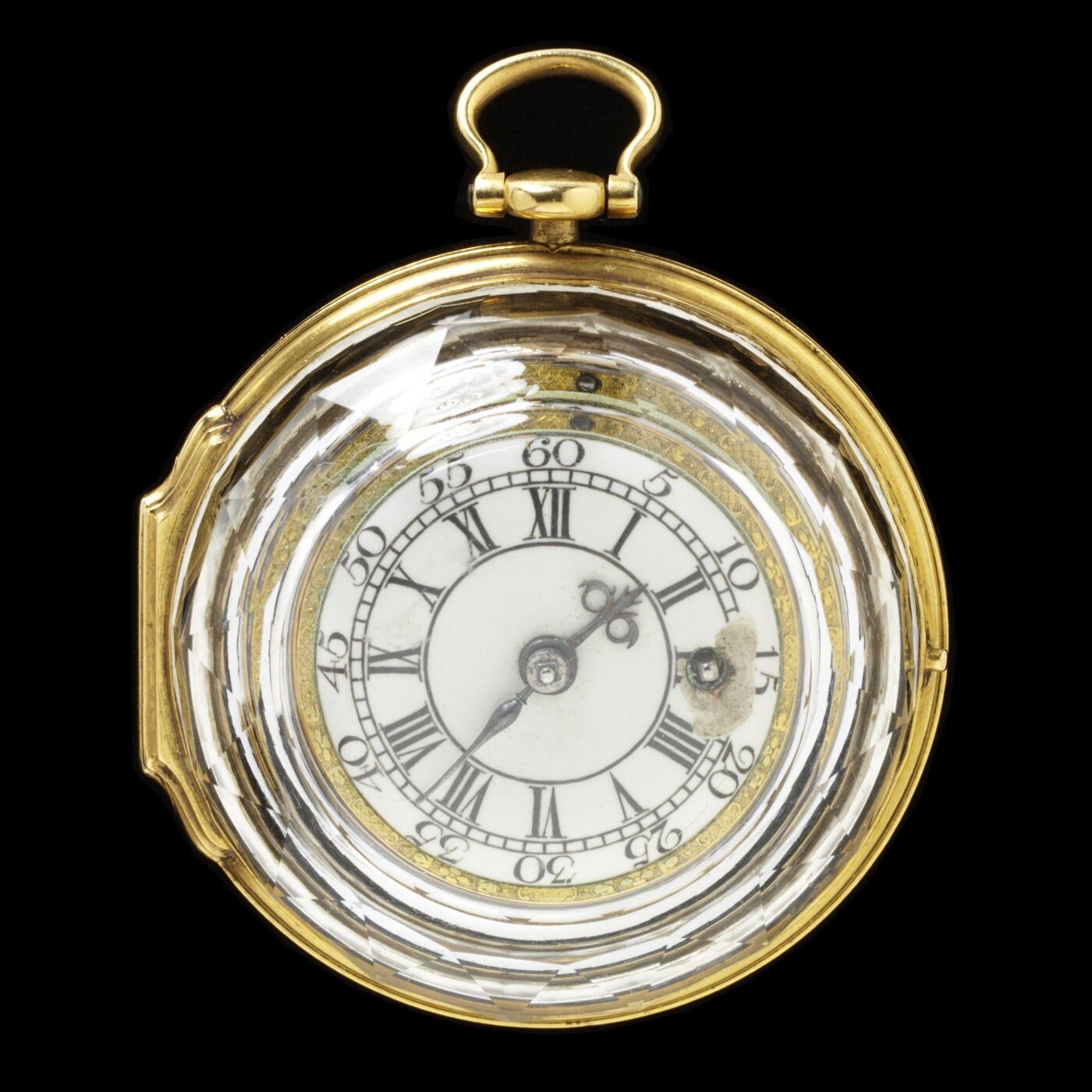
This watch is constructed from gold and rock crystal, dating to approximately 1730-1739. It is signed "Cha: Clay, London, 1197" on the movement. Charles Clay, who originated from Emley, Yorkshire, operated a shop south of St Mary-Le Strand, London, from 1720. He was appointed Clockmaker to His Majesty's Board of Works by 1723, a role he maintained until at least 1737. Known for his work on musical machines and clocks, Clay also gained prominence for a 1716 petition for a patent for a repeating and musical watch, a process that involved a significant legal dispute with the Clockmakers' Company. The object is held in the collection of the Victoria and Albert Museum under accession number 4299-1857.

Front view of the gold and crystal watch with the dial exposed.
Front view of the gold and crystal watch with the dial exposed. — Victoria and Albert Museum, London. Rights pending — permission not yet requested. Original source

Catalogue identity

Source
collections.vam.ac.uk
Category
Pocket watch · Pocket watch
Maker / attribution
Charles Clay
Reference
Not recorded
Catalogue / lot identifier
4299-1857
Source-reported date
ca. 1730-1739
Source-reported place
England
Source-reported serial
1197

Source-reported attribution and specifications are not independent authentication. A listing does not establish present ownership, current display, availability or permission to reproduce.

Object description

Construction and Design

The watch exhibits a specialized design characterized by the use of rock crystal in its case, paired with gold. The dial is enamel, displaying a chapter ring with Roman numerals for the hours and an outer track with Arabic numerals denoting five-minute intervals. The dial configuration includes a central hand assembly visible in the provided imagery.

The movement is housed within the gold and crystal case and features intricate gilded metalwork.

Evidence for this section
  • “Gold and crystal watch, signed 'Cha: Clay, London, 1197'”

Maker and Background

Charles Clay was a professional clockmaker active in London during the early 18th century. He was originally from Emley, near Huddersfield, and established his business south of St Mary-Le Strand in 1720. His career was marked by his position as Clockmaker to His Majesty's Board of Works, a role he held from 1723 until at least 1737.

Clay's professional activities were documented by his attempts to secure a patent for a repeating and musical watch in 1716. Although he received initial support from the Attorney General, his efforts were contested by the Clockmakers' Company and Daniel Quare. Clay is also noted for his work on complex musical machines, a passion that, according to his obituary in 1740, culminated in his order to destroy his unfinished musical machine shortly before his death.

Evidence for this section
  • “Charles Clay was a machine watch maker who, according to his will dated 18 January 1739, came originally from Emley, near Huddersfield, West Riding, Yorkshire.”
  • “by 1723 was appointed Clockmaker to His Majesty's Board of Works, a position he held until at least 1737.”

Provenance and Comparisons

The watch is documented under the V&A museum collection with the accession number 4299-1857.

The comparison piece, which also featured a rock crystal case, provides context for the production series of Clay's watches.

Evidence for this section
  • “A similar watch by Clay, movement number 1201, with rock crystal case, was sold by Antiquorum, Hong Kong, 17 June 1994, lot 321.”

Open research questions

  • What is the specific type of escapement used in the 1197 movement?
  • Does the rock crystal case show evidence of specific cutting or faceting techniques common to the 1730s?

Source evidence

Recorded claims and source quotations for Charles Clay Gold and Rock Crystal Watch
FieldSource-reported valueSource quotation
MakerCharles Clay“Maker: Clay, Charles (watchmaker)”
Dateca. 1730-1739“Date: ca. 1730-1739”
Place of originEngland“Place of origin: England (made)”
Accession number4299-1857“Accession number: 4299-1857”
Dimensions4.9 cm x 4.6 cm x 2.3 cm“Height: 4.9 cm; Width: 4.6 cm; Depth: 2.3 cm”
InscriptionsCha: Clay, London, 1197“'Cha: Clay, London, 1197'”

Visible details

  • Rock crystal case construction
  • Movement signed 'Cha: Clay, London, 1197'
  • White enamel dial with Roman numerals
  • Gilded foliate scrollwork on the movement

Research qualifications

  • Exact dating relies on the circa attribution provided by the museum source
  • The specific functional state of the movement remains unverified by provided records

Photograph identity and source facts were screened before import; rights clearance remains pending.

Consulted source

Watch

Reviewed 2026-10-26 · Record d0584269f0

Terms in this record

Glossary explanations for terms named in this object’s record.