
Skip to content
The Encyclopedia of Horology

Pocket watch · Split-seconds chronograph pocket watch with diablotine

Charles Ami Lecoultre Diablotine 1/4 Jump Split Seconds Chronograph Pocket Watch

Partially verified

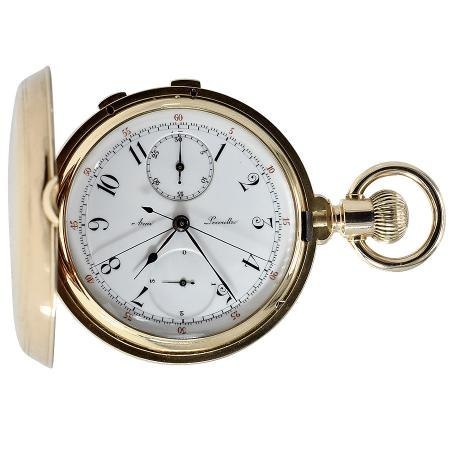
This antique pocket watch is an 18kt yellow gold hunter-cased timepiece crafted by Swiss watchmaker Charles Ami Lecoultre, dating according to the source to circa 1887. The 55 mm watch incorporates a split-seconds chronograph mechanism alongside a diablotine complication, featuring a subsidiary dial that reportedly advances in quarter-second increments while the chronograph operates. The white dial displays Arabic numeral hour markers, two vertically arranged sub-dials, central chronograph hands, and a signature reading 'C. Ami Lecoultre'. The seller reports that both the dial and movement are signed and bear an 1887 patent date.

Dial and open front hunter case view of the Charles Ami Lecoultre diablotine split-seconds chronograph pocket watch
Dial and open front hunter case view of the Charles Ami Lecoultre diablotine split-seconds chronograph pocket watch — Renaissance Antiques. Rights pending — permission not yet requested. Original source

Catalogue identity

Source
www.renaissanceantiques.com
Category
Pocket watch · Split-seconds chronograph pocket watch with diablotine
Maker / attribution
Charles Ami Lecoultre
Reference
Not recorded
Catalogue / lot identifier
EJEN 1 P
Source-reported date
Circa 1887
Country
Switzerland

Source-reported attribution and specifications are not independent authentication. A listing does not establish present ownership, current display, availability or permission to reproduce.

Object description

Dial Configuration and Display

The timepiece features a white dial detailed with black Arabic numeral hour markers, an outer railway track, and red five-minute or seconds numerals along the perimeter. Running across the central horizontal axis is the signature reading 'C. Ami Lecoultre'.

Two subsidiary dials are arranged vertically at the 12 and 6 o'clock positions. The vendor describes the bottom subsidiary dial as the diablotine register, which jumps forward every quarter-second when the chronograph is running.

Evidence for this section
  • “White dial with black Arabic numerals, outer railway track, and red five-minute/seconds numerals”
  • “Signed 'C. Ami Lecoultre' across the central dial horizontal axis”
  • “Two subsidiary dials positioned vertically at 12 and 6 o'clock”
  • “This rare and difficult to execute complication refers to the bottom subsidiary dial which jumps forward every quarter of a second when the chronograph, or stopwatch, is in motion.”

Case Construction

The watch is housed in an 18kt yellow gold hunter case reported to measure 55 mm across. Photographic evidence shows the front cover hinged open to the left.

A large fluted onion crown and attached bow are mounted at the 3 o'clock position, accompanied by an adjacent chronograph control pusher positioned along the case band.

Evidence for this section
  • “18kt yellow gold hunter case measuring 55mm across.”
  • “Yellow gold hunter case shown with the front cover open to the left”
  • “Large fluted onion crown with attached bow positioned at 3 o'clock, with chronograph pusher nearby on the band”

Mechanism and Source Limitations

According to the seller, the movement incorporates a split-seconds chronograph alongside a 'diablotine' or 1/4 jump seconds complication, in which the lower subsidiary hand advances in quarter-second intervals while the chronograph is engaged. The seller also reports that the movement bears the Ami Lecoultre signature and an 1887 patent date.

These mechanical features, internal movement signatures, patent markings, and cuvette hallmarks are not visible in the available imagery, which depicts only the dial and open front case. Consequently, mechanical attributes, caliber architecture, and the circa 1887 dating reflect seller statements rather than direct visual observation.

Evidence for this section
  • “This highly complicated timepiece features the remarkable “ diablotine” or 1/4 seconds jump movement”
  • “The dial and movement bear the Ami Lecoultre signature, and the patent date of 1887.”
  • “Circa 1887”

Open research questions

  • What specific patent number and text are inscribed on the movement corresponding to the reported 1887 patent date?
  • What are the hallmarks, serial numbers, or maker marks stamped on the inner cuvette and case back?
  • What is the underlying base caliber architecture and layout of the split-seconds and jump-seconds components under the cuvette?

Source evidence

Recorded claims and source quotations for Charles Ami Lecoultre Diablotine 1/4 Jump Split Seconds Chronograph Pocket Watch
FieldSource-reported valueSource quotation
Case Material18kt yellow gold“18kt yellow gold hunter case measuring 55mm across.”
Case Diameter55 mm“measuring 55mm across.”
ComplicationsSplit-seconds chronograph and diablotine 1/4 jump seconds“This highly complicated timepiece features the remarkable “ diablotine” or 1/4 seconds jump movement”
Patent Date1887“patent date of 1887.”
SKUEJEN 1 P“SKU: EJEN 1 P”

Visible details

  • Yellow gold hunter case shown with the front cover open to the left
  • White dial with black Arabic numerals, outer railway track, and red five-minute/seconds numerals
  • Two subsidiary dials positioned vertically at 12 and 6 o'clock
  • Signed 'C. Ami Lecoultre' across the central dial horizontal axis
  • Large fluted onion crown with attached bow positioned at 3 o'clock, with chronograph pusher nearby on the band

Research qualifications

  • Movement is not visible in the provided image; movement signatures and 1887 patent mark are source-reported
  • Cuvette and case markings are not visible

Photograph identity and source facts were screened before import; rights clearance remains pending.

Terms in this record

Glossary explanations for terms named in this object’s record.