
Skip to content
The Encyclopedia of Horology

Clock · Traveling purse watch

Cartier Montre Autel de Sac purse watch

Partially verified

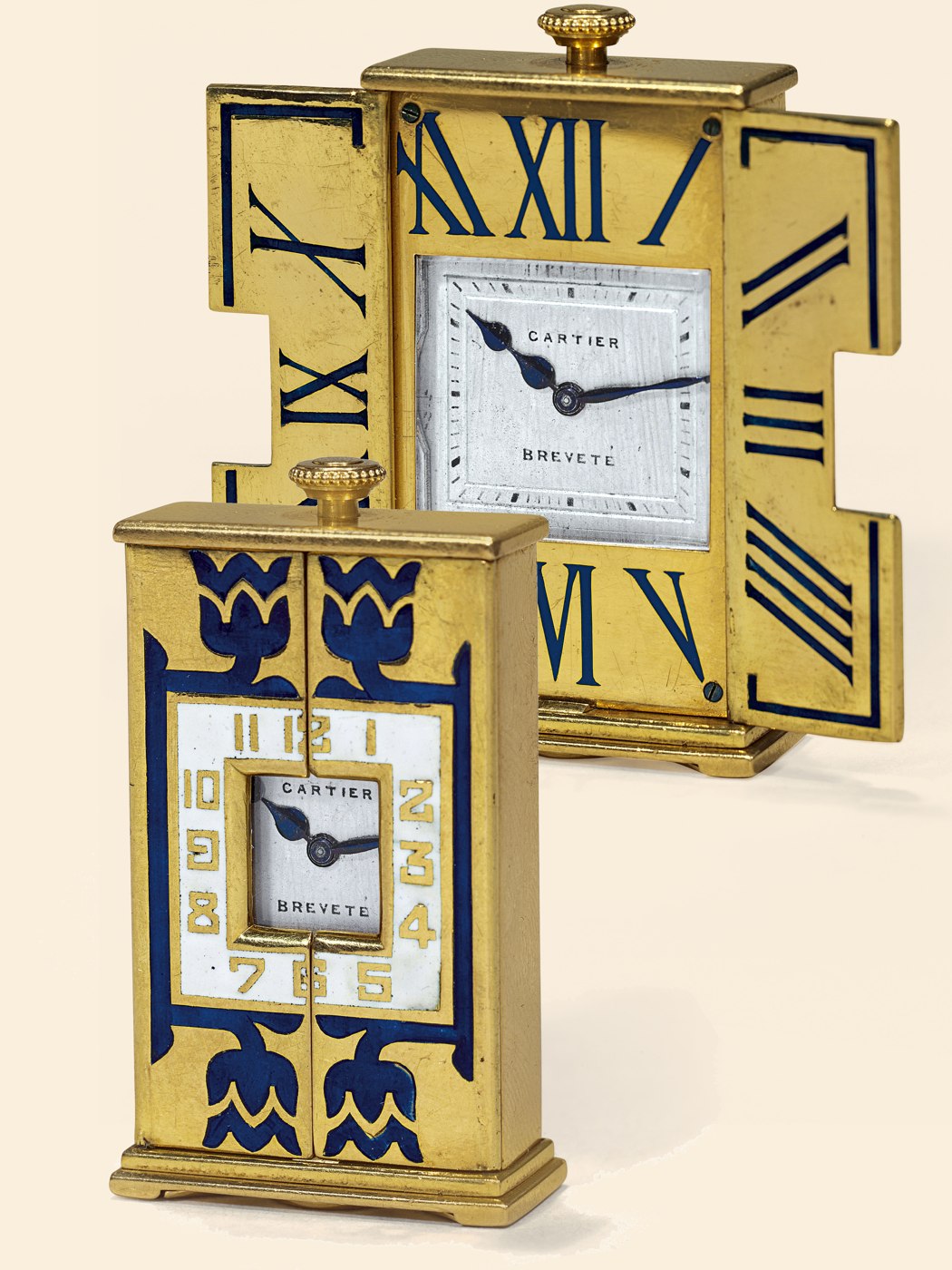
This Cartier 'Montre Autel de Sac' is a keyless traveling purse watch from approximately 1928. Constructed from 18K yellow gold, the rectangular case features champlevé enamel with stylized tulip decoration. The object functions as both a portable timepiece for a handbag and a table clock, supported by a pivoting base stand. When the hinged front shutters are closed, a white enamel chapter ring with Arabic numerals is visible; opening the shutters reveals a three-section radial Roman numeral chapter ring and a silvered engine-turned dial. The movement is a 15-jewel 8 1/2''' calibre with fausses côtes decoration, a straight-line lever escapement, and a cut bimetallic compensation balance with a Breguet balance spring.

The Cartier 'Montre Autel de Sac' shown both in its closed state (foreground) and with the shutters open (background).
The Cartier 'Montre Autel de Sac' shown both in its closed state (foreground) and with the shutters open (background). — Antiquorum. Rights pending — permission not yet requested. Original source

Catalogue identity

Source
catalog.antiquorum.swiss
Category
Clock · Traveling purse watch
Maker / attribution
Cartier
Reference
Not recorded
Catalogue / lot identifier
417
Source-reported date
circa 1928
Source-reported place
France
Source-reported serial
9308/2196

Source-reported attribution and specifications are not independent authentication. A listing does not establish present ownership, current display, availability or permission to reproduce.

Object description

Case and Exterior Design

The case of this Montre Autel de Sac is crafted from 18K yellow gold in a rectangular format, finished with polished surfaces. A primary feature of the exterior is the blue champlevé enamel decoration rendered in a stylized tulip pattern, which contributes to the piece's aesthetic.

The front of the watch comprises hinged shutters. When the case is closed, the user views an external white enamel chapter ring displaying Arabic numerals. Upon opening these shutters, the internal dial layout is revealed. This transition between two distinct display modes, using a folding mechanism, is described in the documentation as 'à cadran déployant' or 'à volets'.

Evidence for this section
  • “Rectangular gold, polished with blue champlevé enameled Art Deco stylized tulip decoration”
  • “pivoting base stand”
  • “Hinged shutters on the front revealing the three-section polished radial Roman chapter ring”
  • “small purse watch à volets was designed by Cartier”

Movement and Technical Specifications

The timepiece is powered by a 15-jewel, rhodium-plated movement measuring 8 1/2''' in diameter. The movement finish is characterized by 'fausses côtes' decorative striping. The regulation and timekeeping are managed through a straight-line lever escapement paired with a cut bimetallic compensation balance, designed to mitigate the effects of temperature variations on the hairspring.

Precision in the regulation of the balance is supported by the inclusion of a Breguet balance spring. The movement powers the blued steel 'double spade' hands, which display the time on the internal silvered engine-turned dial.

Evidence for this section
  • “15 jewels, straight-line lever escapement, cut bimetallic compensation balance, Breguet balance spring”
  • “Overhaul recommended, at buyer's expense”

Provenance and Documentation

The watch is identified by the serial number 9308/2196. The documentation provided by the auction house includes a brief attribution of the item's creation to circa 1928. The object's design, specifically the use of hinged volets, is linked to broader Cartier production, and the provenance is corroborated by its inclusion in a reference publication.

A similar iteration of this watch model is referenced in the book 'Le Temps de Cartier' by Jader Barracca, Giampiero Negretti, and Franco Nencini. The record provides standard condition gradings, identifying minor oxidation on the dial and the original state of the hands, supporting the object's authenticity as a period Cartier production.

Evidence for this section
  • “Made circa 1928”
  • “HANDS Original”

Open research questions

  • Are there archival records at Cartier confirming the specific production date for serial number 9308/2196?
  • How many variants of the 'Montre Autel de Sac' tulip-enamel design were manufactured during the late 1920s?

Source evidence

Recorded claims and source quotations for Cartier Montre Autel de Sac purse watch
FieldSource-reported valueSource quotation
MakerCartier“Cartier, Paris”
Serial Number9308/2196“No. 9308/2196”
Material18K yellow gold and champlevé enamel“18K yellow gold and champlevé enamel”
Dimensions41 x 26 x 11 mm“Dim. 41 x 26 x 11 mm”
Jewels15“15 jewels”
EscapementStraight-line lever“straight-line lever escapement”

Visible details

  • Case displays blue champlevé enamel in a stylized tulip motif.
  • Dial features blued steel double spade hands.
  • The watch utilizes a pivoting base stand for display as a table clock.
  • Front shutters fold outwards to reveal the primary dial.

Research qualifications

  • The auction house recommends an overhaul for the movement.
  • The auction description reports slight oxidation on the dial.

Photograph identity and source facts were screened before import; rights clearance remains pending.

Terms in this record

Glossary explanations for terms named in this object’s record.