
Skip to content
The Encyclopedia of Horology

Clock · Carriage clock

Carriage Clock by Wurtel

Partially verified

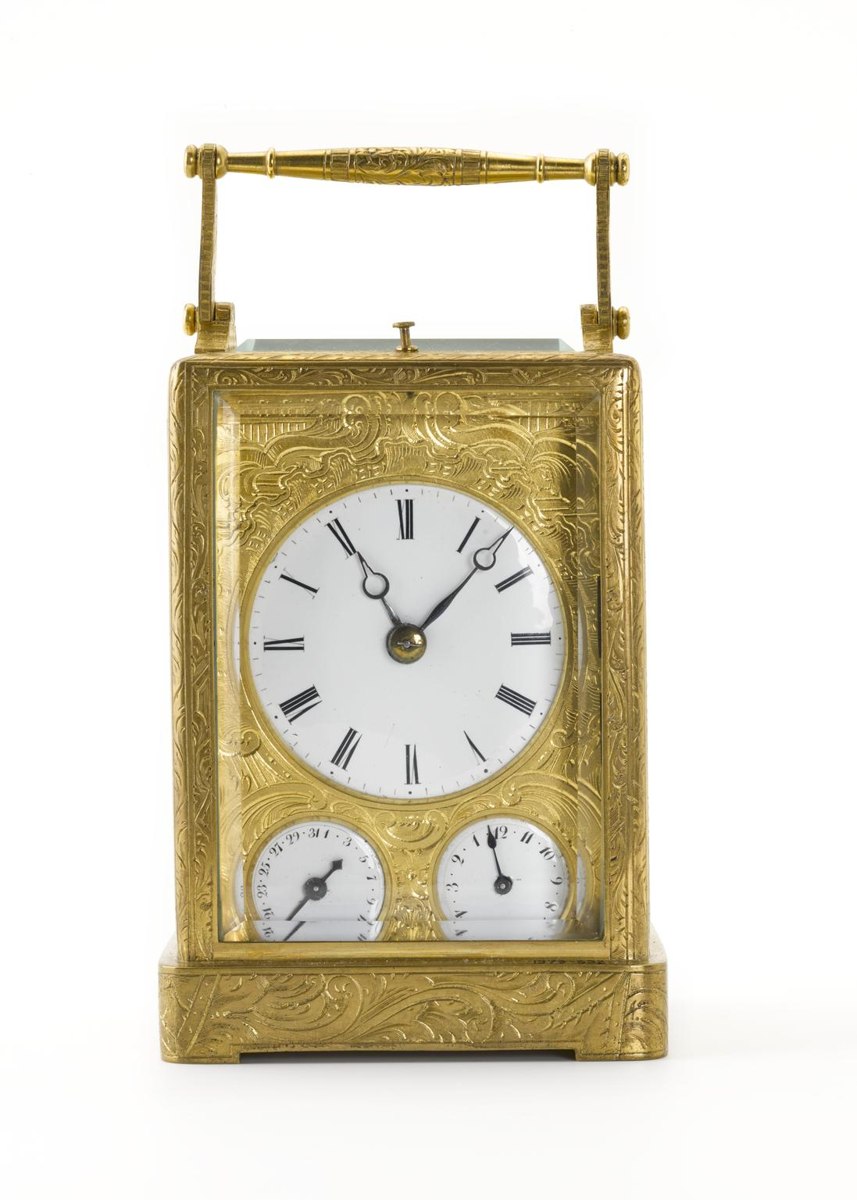
This ornate gilt carriage clock is attributed to Wurtel and dated to circa 1845 in Paris, France. Preserved in the Science Museum Group collection, the clock is housed in an elaborately engraved rectangular case with an overhead hinged handle and glass panels. The engraved gilded dial mask encloses a main white enamel chapter ring displaying Roman numerals, along with two subsidiary white enamel dials below. The museum records indicate that the clock features hour and half-hour striking, an alarm, and a calendar mechanism.

Front view of the gilt engraved carriage clock by Wurtel showing the primary dial and two subsidiary dials
Front view of the gilt engraved carriage clock by Wurtel showing the primary dial and two subsidiary dials — Science Museum Group. Rights pending — permission not yet requested. Original source

Catalogue identity

Source
collection.sciencemuseumgroup.org.uk
Category
Clock · Carriage clock
Maker / attribution
Wurtel
Reference
co1028
Catalogue / lot identifier
Source URL identifies the listing
Source-reported date
c. 1845
Country
France

Source-reported attribution and specifications are not independent authentication. A listing does not establish present ownership, current display, availability or permission to reproduce.

Object description

Case Construction

The clock is housed in a gilt rectangular case featuring scrolling foliate engraving on the front, base, and handle. The top handle is hinged and features turned and engraved detailing.

The case incorporates glass panels. A push-piece button is visible on the upper glass plate, described in the records as a repeat or strike button.

Evidence for this section
  • “Engraved gilt rectangular case decorated with scrolling foliate engraving across the front, base, and handle.”
  • “Hinged top handle with turned and engraved details.”
  • “Top repeat or strike button visible on the upper glass plate.”

Dial Configuration

The face consists of an engraved gilded mask surrounding a white enamel dial with black Roman numerals and open-tipped Breguet-style hands.

There are two lower subsidiary enamel dials; one is calibrated 1 to 31 for the calendar function, and the second is calibrated 1 to 12 for the alarm.

Evidence for this section
  • “Main white enamel dial featuring black Roman hour numerals and open-tipped Breguet-style hands.”
  • “Two lower subsidiary enamel dials, one calibrated 1 to 31 for date and the other calibrated 1 to 12.”

Attribution and Recorded Functions

The item is attributed to Wurtel of Paris, France, with a recorded date of circa 1845. Museum records state the clock features hour and half-hour striking, an alarm, and a calendar mechanism.

Internal components, including the movement and escapement, are not visible in the available documentation.

Evidence for this section
  • “Carriage clock by Wurtel”
  • “Paris, France”
  • “c. 1845”
  • “with hour and half hour striking, alarm and calendar.”

Open research questions

  • What specific internal movement type is utilized in this clock?
  • Are there any visible maker signatures on the dial or movement plates?
  • What is the functional condition of the alarm and calendar mechanisms?

Source evidence

Recorded claims and source quotations for Carriage Clock by Wurtel
FieldSource-reported valueSource quotation
MakerWurtel“Carriage clock by Wurtel”
Date of Manufacturec. 1845“c. 1845”
Place of ManufactureParis, France“Paris, France”
FunctionsHour and half hour striking, alarm and calendar“with hour and half hour striking, alarm and calendar.”
Datec. 1845“c. 1845”
OriginParis, France“Paris, France”

Visible details

  • Engraved gilt rectangular case decorated with scrolling foliate engraving across the front, base, and handle.
  • Hinged top handle with turned and engraved details.
  • Main white enamel dial featuring black Roman hour numerals and open-tipped Breguet-style hands.
  • Two lower subsidiary enamel dials, one calibrated 1 to 31 for date and the other calibrated 1 to 12.
  • Top repeat or strike button visible on the upper glass plate.

Research qualifications

  • Internal movement, escapement mechanism, and rear case layout are not visible in the supplied photograph.
  • Mechanical complications are recorded from source documentation rather than directly inspected.

Photograph identity and source facts were screened before import; rights clearance remains pending.

Consulted source

Carriage clock by Wurtel | Science Museum Group Collection

Reviewed 2026-10-22 · Record c13f2e87c3

Terms in this record

Glossary explanations for terms named in this object’s record.