
Skip to content
The Encyclopedia of Horology

Clock · Atomic clock

Caesium Atomic Clock (Essen-Parry)

Partially verified

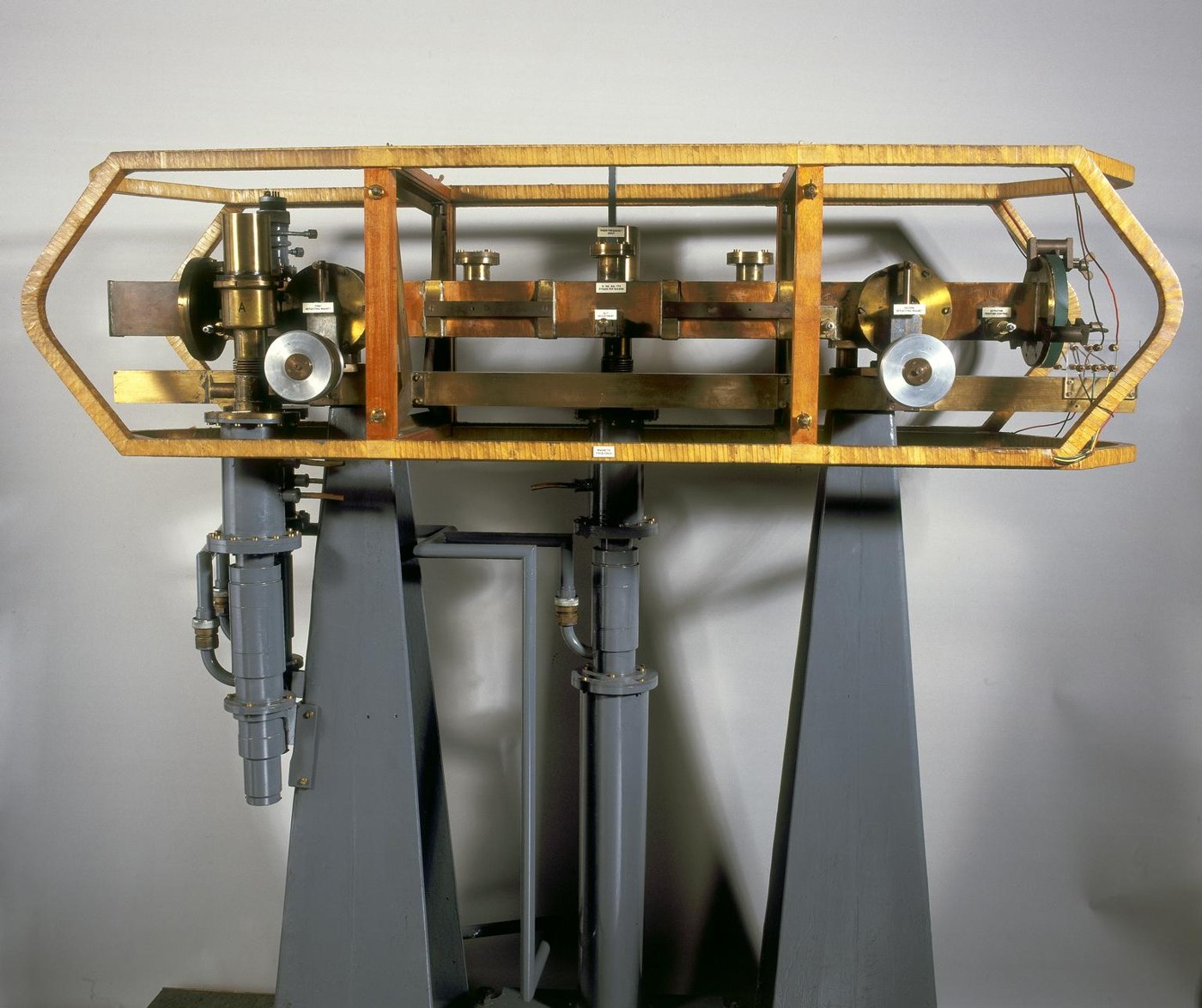
The Caesium Atomic Clock, constructed in 1955 by Louis Essen and J.V.L. Parry at the National Physical Laboratory in Teddington, England, is recognized as the first successful implementation of an atomic timekeeping device. Measuring 1685 mm by 607 mm by 1732 mm and weighing 463 kg, the instrument operates by measuring the change of state in caesium atoms to establish time standards. The device demonstrated an accuracy of one second in 300 years, significantly surpassing the precision of contemporary quartz crystal and mechanical pendulum clocks. Its development facilitated the transition of time definition from astronomical observations to atomic measurements. The apparatus features an exposed horizontal metallic structure supported by substantial grey-painted vertical stands, with various scientific components and magnetic housings integrated into the frame.

Side view of the 1955 Caesium Atomic Clock, showing the horizontal beam and support structures.
Side view of the 1955 Caesium Atomic Clock, showing the horizontal beam and support structures. — National Physical Laboratory. Rights pending — permission not yet requested. Original source

Catalogue identity

Source
collection.sciencemuseumgroup.org.uk
Category
Clock · Atomic clock
Maker / attribution
National Physical Laboratory
Reference
Not recorded
Catalogue / lot identifier
1962-59
Source-reported date
1955
Source-reported place
United Kingdom

Source-reported attribution and specifications are not independent authentication. A listing does not establish present ownership, current display, availability or permission to reproduce.

Object description

Construction and Design

The Caesium Atomic Clock is designed as a large-scale, floor-standing scientific apparatus. It comprises a primary, elongated horizontal beam containing the atomic beam vacuum system, encased within an open-frame timber structure. This wooden housing provides support and protection for the metallic scientific instruments aligned along the longitudinal axis.

The entire assembly is mounted upon two substantial, grey-painted metal pedestals, which elevate the beam to a height of approximately 1.7 meters. The components, including various brass housings, magnets, and vacuum-related cylinders, are arranged along the central horizontal beam, connected by a network of electrical wiring terminating at external connection boards on one end of the structure.

Evidence for this section
  • “overall: 1685 mm x 607 mm x 1732 mm, 463 kg”
  • “It was built by L Essen and J V L Parry at the National Physical Laboratory in England in 1955.”

Timekeeping Mechanism

This clock operates by utilizing the internal atomic properties of caesium. Specifically, it measures time through the detection of changes in the state of caesium atoms as they traverse the vacuum chamber. This mechanism represented a departure from traditional mechanical timekeeping, which relied on the physical oscillation of pendulums or quartz crystals.

By utilizing atomic transitions, the clock achieved a degree of precision approximately 30 times greater than quartz crystal clocks and 300 times greater than mechanical pendulum clocks. This shift allowed for the detection of minor irregularities in the Earth's rotation, ultimately leading to the redefinition of the second based on atomic measurement rather than astronomical events.

Evidence for this section
  • “It measured time by means of a change of state in atoms of caesium”
  • “30 times better than the quartz crystal clocks introduced in the 1930s and 300 times better than the most accurate pendulum clocks”

Provenance and Significance

The object is held by the Science Museum Group with the accession number 1962-59. It serves as the primary artifact documenting the invention of atomic timekeeping. The clock was developed in 1955 by Louis Essen and J.V.L. Parry at the National Physical Laboratory in Teddington.

While subsequent atomic clocks have reached accuracy levels of one second in a million years, the Essen-Parry clock provided the initial empirical proof for the viability of atomic-based chronometry.

Evidence for this section
  • “This clock is the first successful atomic clock.”
  • “The latest atomic clocks are accurate to about one second in a million years.”

Open research questions

  • What is the specific purpose of the wooden frame structure relative to the internal vacuum beam?
  • Are the electrical connections visible in the photos original to the 1955 setup or later modifications for display?

Source evidence

Recorded claims and source quotations for Caesium Atomic Clock (Essen-Parry)
FieldSource-reported valueSource quotation
MakerLouis Essen and J.V.L. Parry at the National Physical Laboratory“Caesium atomic clock made by Louis Essen and J.V.L. Parry at the National Physical Laboratory”
Weight463 kg“463 kg”
Accuracyone second in 300 years“accurate to a second in 300 years”
LocationTeddington, London“National Physical Laboratory, Teddington, London”
Accession number1962-59“1962-59”

Visible details

  • Large-scale horizontal metallic beam assembly
  • Exposed wooden framework structure
  • Grey painted support plinths
  • Multi-wired connections at the end of the beam

Research qualifications

  • The exact technical function of the various magnets and chambers on the beam is not explicitly detailed in the source.
  • The operational status of the internal vacuum or atomic source components is not stated.

Photograph identity and source facts were screened before import; rights clearance remains pending.

Consulted source

Caesium Atomic Clock, 1955.

Reviewed 2026-10-26 · Record 53c70d0e22

Terms in this record

Glossary explanations for terms named in this object’s record.