
Skip to content
The Encyclopedia of Horology

Clock · Table clock

Buschman Minerva German Horizontal Table Clock

Partially verified

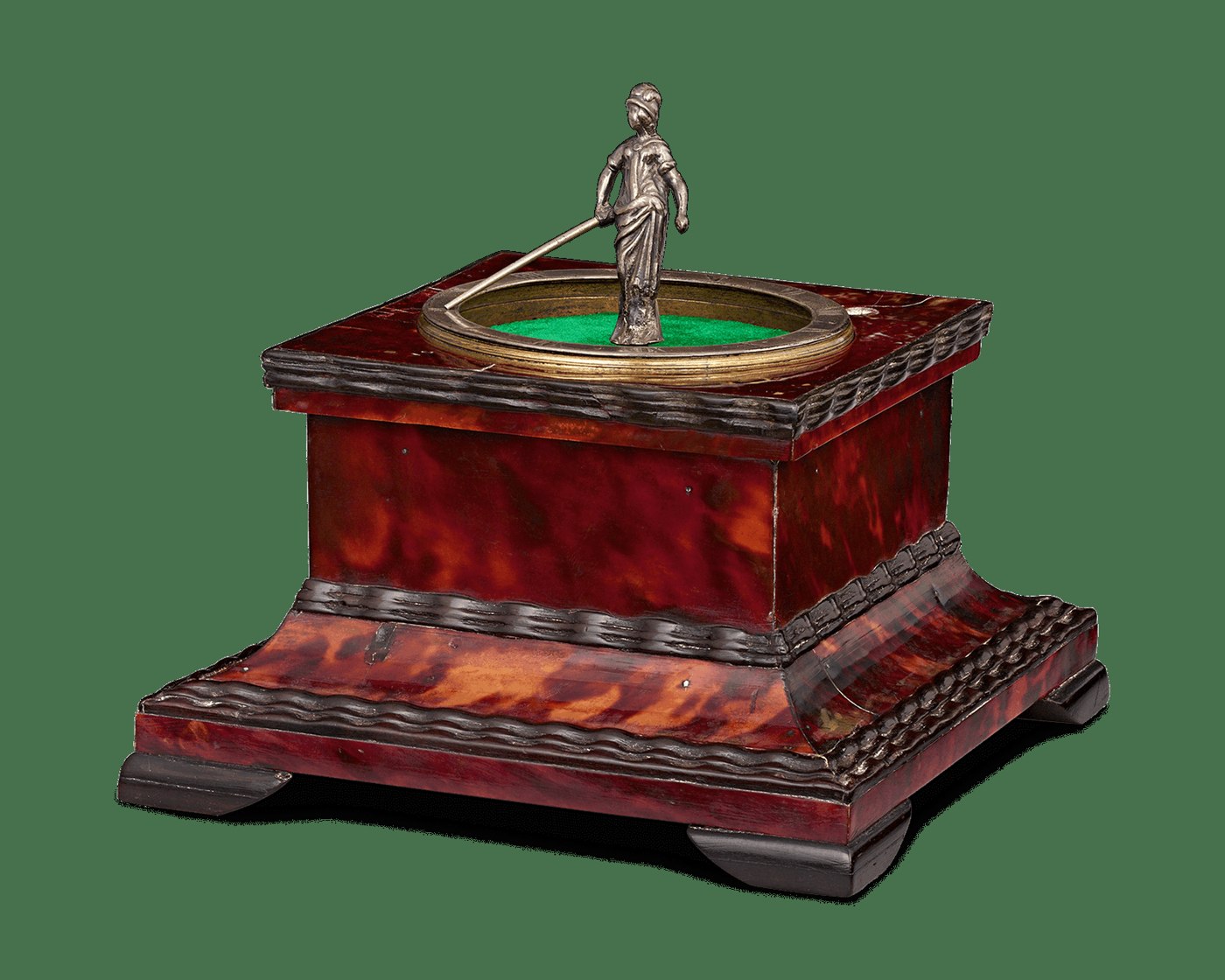
This horizontal tabletop clock is attributed to Johannes Buschman the Younger, dating to circa 1650 and originating from Augsburg, Germany. The timekeeping mechanism is housed within a moulded ebony and turtleshell casing with a mottled red finish. The movement incorporates a fusée and chain system with a verge escapement and balance with hogs-bristle regulation. A silver figure representing Minerva acts as a centerpiece for the Roman numeral-engraved chapter ring, using a staff to indicate the hour. A rotating sun motif, positioned beneath the figure on a green velvet base, functions as a minute indicator. The design includes a gilded backplate, which is pierced and engraved with a floral motif and bears the maker's signature. The object measures 5 5/8 inches in width, 5 5/8 inches in depth, and 5 inches in height, reflective of mid-17th-century household clock production.

The Buschman Minerva German horizontal table clock showing the silver figure and chapter ring.
The Buschman Minerva German horizontal table clock showing the silver figure and chapter ring. — M.S. Rau. Rights pending — permission not yet requested. Original source

Catalogue identity

Source
rauantiques.com
Category
Clock · Table clock
Maker / attribution
Johannes Buschman the Younger
Reference
Not recorded
Catalogue / lot identifier
Source URL identifies the listing
Source-reported date
circa 1650
Source-reported place
Germany

Source-reported attribution and specifications are not independent authentication. A listing does not establish present ownership, current display, availability or permission to reproduce.

Object description

Case and Dial Construction

The clock is presented in a horizontal format with a base composed of moulded ebony and turtleshell veneer. The exterior features a mottled red aesthetic consistent with the ornate decorative preferences of its era. The top surface supports a central silver figure of the Roman goddess Minerva, who is rendered standing upon a green velvet field within the dial area.

The dial is defined by a metal chapter ring engraved with Roman numerals. Time is indicated by Minerva, who holds an authoritative military staff pointing toward the current hour on the ring. Beneath her feet, a separate sun-shaped element rotates to provide a minute indication, adding a level of mechanical complexity to the display.

Evidence for this section
  • “A finely moulded ebony and turtleshell casing veneered in a mottled red hue holds the clock’s fusée and chain movement”
  • “A silver figure of Minerva, Roman goddess of war and wisdom, centers the Roman numeral-engraved chapter ring, indicating the time by pointing to the hour with an authoritative military staff as the sun rotates below her feet to indicate the minute.”

Movement and Mechanics

The mechanism utilizes a fusée and chain arrangement to equalize the force delivered from the mainspring. Regulation of the timekeeping is achieved through a verge escapement paired with a balance wheel system incorporating hogs-bristle regulation.

The mechanical assembly is mounted against a gilded backplate, which serves as a decorative component as well as a housing for the movement. This backplate is hand-pierced and engraved with floral motifs, and it serves as the location for the maker's signature, providing identification of the clock as a work of Johannes Buschman.

Evidence for this section
  • “holds the clock’s fusée and chain movement with verge escapement and balance with hogs-bristle regulation.”
  • “The incredible design is finished by a gilded backplate intricately pierced and engraved with a floral motif and the signature of Johannes Buschman.”

Signatures and Attribution

The clock is attributed to Johannes Buschman the Younger, a member of a known family of clockmakers from Augsburg, Germany. The attribution is supported by the signature found on the gilded backplate of the timepiece. The engraving explicitly identifies the maker and the location of manufacture.

The object is presented as part of the mid-17th-century tradition of Augsburg clockmaking, during which artisans produced complex, luxury spring-driven mechanisms for elite patrons. Similar examples of German table clocks from this timeframe are held in museum collections including the British Museum, the Metropolitan Museum of Art, and The Frick Collection.

Evidence for this section
  • “Created by Johannes Buschman the Younger”
  • “Gilded backplate engraved with signature, “Johannes Buschman, Aug:””

Open research questions

  • Verification of the specific metallurgical composition of the Minerva figure
  • Assessment of the original nature of the green velvet base material

Source evidence

Recorded claims and source quotations for Buschman Minerva German Horizontal Table Clock
FieldSource-reported valueSource quotation
MakerJohannes Buschman the Younger“Created by Johannes Buschman the Younger”
Datecirca 1650“Circa 1650, Augsburg, Germany”
LocationAugsburg, Germany“Augsburg, Germany”
Dimensions5 5/8" wide x 5 5/8" deep x 5" high“5 5/8" wide x 5 5/8" deep x 5" high”
Case materialsEbony, turtleshell“A finely moulded ebony and turtleshell casing veneered in a mottled red hue”
Movement featuresFusée and chain, verge escapement, hogs-bristle regulation“fusée and chain movement with verge escapement and balance with hogs-bristle regulation”
SignatureJohannes Buschman, Aug:“Gilded backplate engraved with signature, “Johannes Buschman, Aug:””

Visible details

  • Silver figure of Minerva holding a staff
  • Roman numeral chapter ring with sun indicator
  • Mottled red turtleshell veneer over casing
  • Pierced and engraved floral backplate

Research qualifications

  • Specific provenance history not provided
  • Individual mechanical performance not reported

Photograph identity and source facts were screened before import; rights clearance remains pending.

Consulted source

ساعت رومیزی افقی مینروا؛ بوشمان

Reviewed 2026-11-02 · Record abafedd2eb

Terms in this record

Glossary explanations for terms named in this object’s record.