
Skip to content
The Encyclopedia of Horology

Clock · Lantern clock

Brass lantern clock

Partially verified

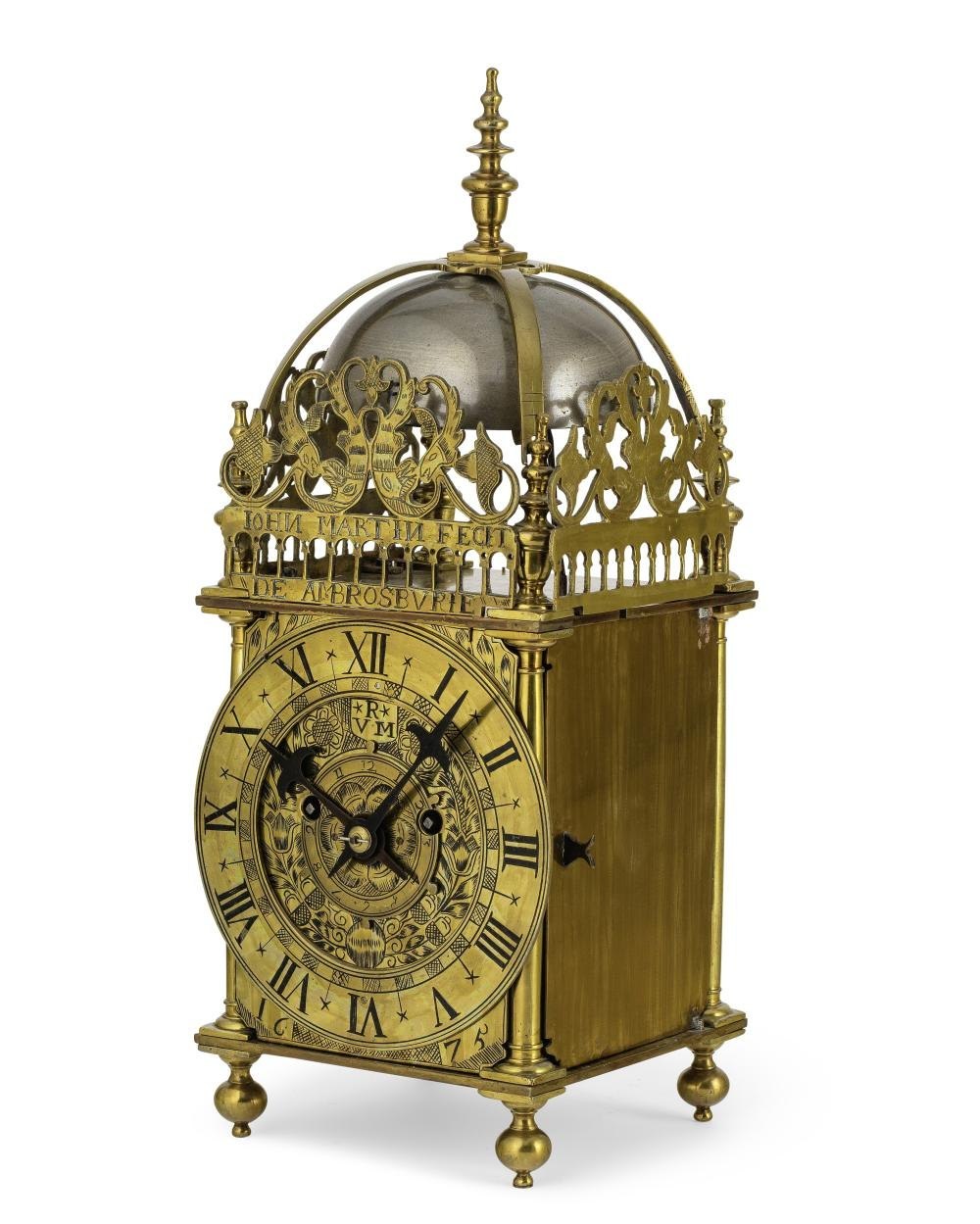
This brass lantern clock stands approximately 40 centimeters tall and acts as a historical assembly, featuring a 19th-century movement within a case styled after 17th-century designs. Supported by four turned pillars and ball feet, the case includes a bell stand, bell, and corner finials. The 6.5-inch brass dial features Roman numerals, star half-hour markers, and an engraved date of 1675. The central area incorporates an alarm-setting dial with a Tudor rose motif, Arabic numerals, and floral engraving. A cartouche on the dial bears the initials RVM. The clock utilizes a double chain-driven fusee movement with an anchor escapement that strikes the hours on the bell. According to the auction description, the case plates, frets, side doors, backplate, hands, and top finial are modern replacements. The fret bears an inscription attributed to John Martin of Ambrosbury.

A brass lantern clock with a double chain-driven fusee movement, featuring a dial dated 1675 and a signed fret.
A brass lantern clock with a double chain-driven fusee movement, featuring a dial dated 1675 and a signed fret. — Bonhams, via Invaluable. Rights pending — permission not yet requested. Original source

Catalogue identity

Source
orbiscollectibles.com
Category
Clock · Lantern clock
Maker / attribution
John Martin
Reference
Not recorded
Catalogue / lot identifier
Source URL identifies the listing
Source-reported date
19th century
Source-reported place
Not established

Source-reported attribution and specifications are not independent authentication. A listing does not establish present ownership, current display, availability or permission to reproduce.

Object description

Case and Dial

The brass lantern clock is constructed with a height of approximately 40 centimeters, resting on four turned pillars and ball feet. The exterior design incorporates elements reminiscent of 17th-century horological styles. Surmounting the case are four corner finials, a bell stand, and a central bell. The top finial is noted as a later addition to the clock's assembly.

The 6.5-inch brass dial is centered by an alarm-setting dial featuring a Tudor rose motif and Arabic numerals, surrounded by floral engraving. The primary chapter ring displays Roman numerals with star half-hour markers. An engraved date of 1675 is visible on the dial, and a cartouche on the upper dial is marked with the initials RVM. The hands are identified by the source as modern replacements.

Evidence for this section
  • “Standing approximately 40 centimeters tall, the clock is supported by four turned pillars and ball feet.”
  • “6.5-inch brass dial marked with a Roman numeral chapter ring, star half-hour markers, and a date of 1675.”
  • “the listing notes that the case plates, frets, side doors, and backplate are modern replacements, with the hands and top finial also identified as later additions.”

Movement and Escapement

The clock functions through a double chain-driven fusee movement. The mechanism utilizes an anchor escapement and is configured to strike the hours on the central bell. The source identifies the movement as consistent with late 19th-century mechanisms.

While the movement possesses functional striking capabilities, it is part of a larger, mixed-era construction. The backplate and case plates containing this mechanism are specifically noted as modern replacements.

Evidence for this section
  • “The clock operates via a double chain-driven fusee movement with an anchor escapement that strikes the hours on the central bell.”
  • “While the movement is consistent with late 19th-century mechanisms”

Inscriptions and Provenance

The fret of the clock features an inscription indicating its manufacture by John Martin of Ambrosbury. The engraving is presented as: 'John Martin Fecit De Ambroseburie'.

The historical integrity of the piece is complicated by its composition. The auction house listing identifies the clock as an 'interesting historical assembly'. This characterization stems from the discrepancy between the 1675 date engraved on the dial and the 19th-century movement housed within the structure.

Evidence for this section
  • “The fret signed John Martin Fecit De Ambroseburie”
  • “This brass lantern clock is an interesting historical assembly, featuring a 19th-century construction that incorporates elements styled after 17th-century designs.”

Open research questions

  • What is the intended purpose of the RVM initials on the dial?
  • Is there any archival record of a clockmaker named John Martin in Ambrosbury during the 17th century?

Source evidence

Recorded claims and source quotations for Brass lantern clock
FieldSource-reported valueSource quotation
Height40 cm“Standing approximately 40 centimeters tall”
Dial size6.5 inches“6.5-inch brass dial”
Movement typeDouble chain-driven fusee“double chain-driven fusee movement”
EscapementAnchor“anchor escapement”
Maker inscriptionJohn Martin Fecit De Ambroseburie“The fret signed John Martin Fecit De Ambroseburie”
Modern elementsCase plates, frets, side doors, backplate, hands, and top finial“the listing notes that the case plates, frets, side doors, and backplate are modern replacements, with the hands and top finial also identified as later additions”

Visible details

  • Four turned pillars with ball feet supporting the case
  • Alarm-setting dial with central Tudor rose and floral engraving
  • Dial engraved with date 1675
  • Fret signed with the maker's name

Research qualifications

  • The source describes the object as a 'historical assembly' with many modern replacement parts.
  • The dating of 1675 is engraved on the dial but does not align with the 19th-century movement.
  • The attribution to John Martin is linked to an inscription on the fret.

Photograph identity and source facts were screened before import; rights clearance remains pending.

Consulted source

Brass lantern clock with late 19th century twin fusee movement

Reviewed 2026-11-02 · Record 1a59b41d27

Terms in this record

Glossary explanations for terms named in this object’s record.