
Skip to content
The Encyclopedia of Horology

Tool · Latin-inscribed astrolabe

Brass Astrolabe

Partially verified

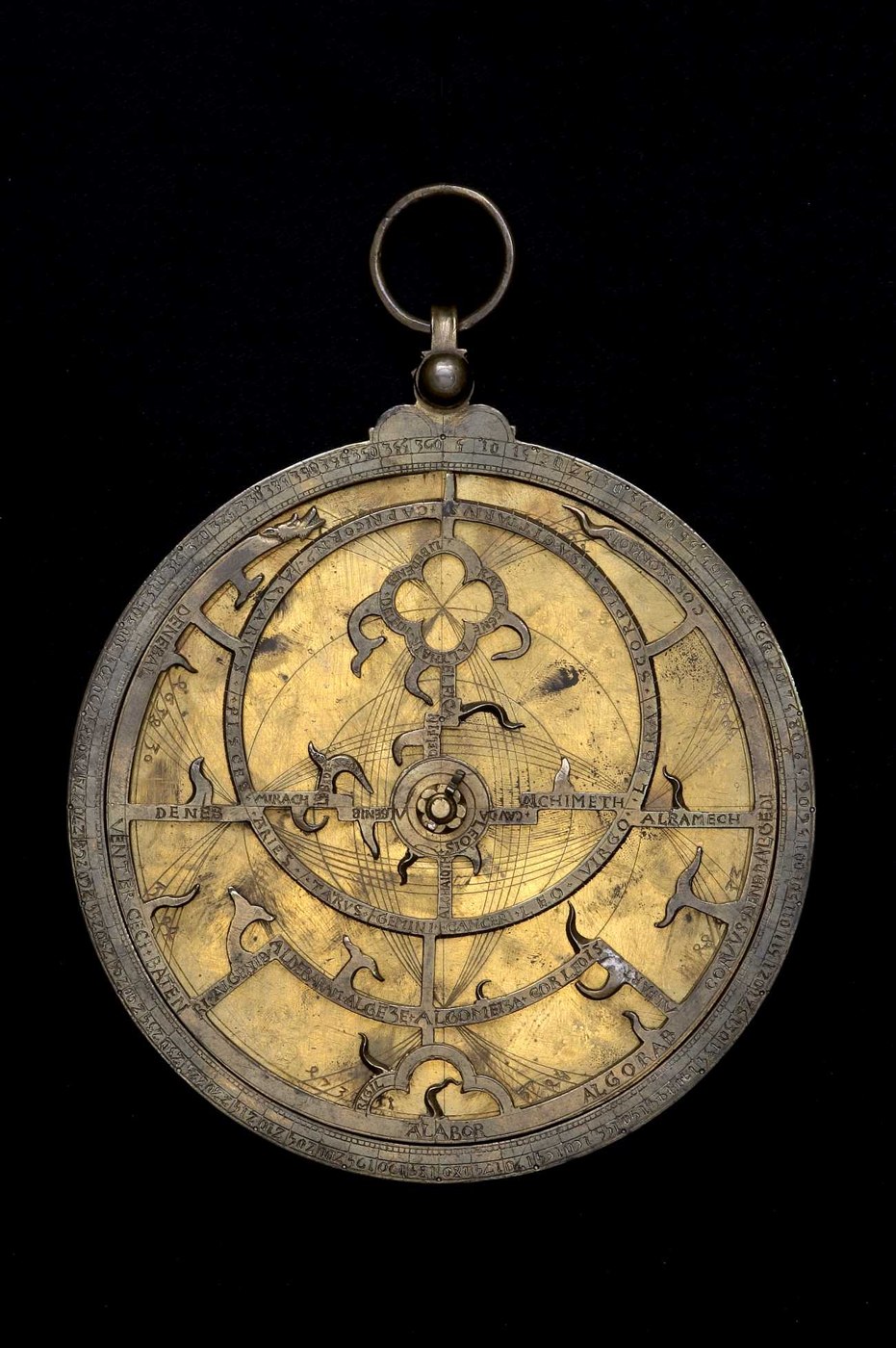
This 14th-century European brass astrolabe (inventory number 47615) is comprised of a mater with a riveted limb, a rete, four latitude plates, an alidade, and a rule. The rete, of a gothic quatrefoil design, includes 32 stars marked by flamant pointers and a zodiacal band. The Tropic of Capricorn on the rete is decorated with a zoomorphic dragon, oriented with its head to the left, which is noted as an unusual feature among similar items in the collection. The back of the mater is engraved with six scales: degree, zodiacal, calendar, lunar mansions, unequal hours, and a shadow square.

Astrolabe with rete and mater, showing the zoomorphic dragon on the Tropic of Capricorn.
Astrolabe with rete and mater, showing the zoomorphic dragon on the Tropic of Capricorn. — History of Science Museum, University of Oxford. Rights pending — permission not yet requested. Original source

Catalogue identity

Source
www.mhs.ox.ac.uk
Category
Tool · Latin-inscribed astrolabe
Maker / attribution
Not established
Reference
Not recorded
Catalogue / lot identifier
1957-84/175
Source-reported date
14th century
Source-reported place
Europe
Source-reported serial
47615

Source-reported attribution and specifications are not independent authentication. A listing does not establish present ownership, current display, availability or permission to reproduce.

Object description

Construction and Layout

The astrolabe is constructed primarily of brass and consists of a mater with a riveted limb and a series of plates. The mater features a three-lobed throne with an integrated base, to which a simple band ring and an omega-shaped shackle are attached via a large pin. The limb includes a degree scale ranging from 0 to 360 degrees, marked every five degrees.

The instrument includes four plates with latitudes ranging from 33° to 45°. The back of the mater is engraved with six distinct circular and arc-shaped scales, including zodiacal signs, a calendar, lunar mansions, unequal hours, and a shadow square, organized in concentric or eccentric arrangements.

Evidence for this section
  • “The mater and limb are of two pieces, riveted construction.”
  • “The throne is of the three-lobed type made of brass attached with integrated base”
  • “The back contains 6 scales of the following types: Degree; Zodiacal signs; Calendar; Lunar Mansions; Unequal hours; Shadow square.”

Rete and Alidade

The rete is designed in a gothic quatrefoil style and supports 32 stars, each indicated by a flamant pointer. The zodiacal band lists the twelve signs from Aries to Pisces. A notable feature is the zoomorphic decoration on the Tropic of Capricorn, which terminates in the head and tail of a dragon, with the head positioned on the left-hand end.

The alidade is double-ended and counter-changed, described as rigid with double sights. The accompanying rule is also original, and both components feature scales for unequal hours. The assembly is held together by a pin and wedge mechanism with a fitted spacer.

Evidence for this section
  • “The rete is of the gothic (quatrefoil) type.”
  • “the tropic of capricorn band ends in the head and tail of a dragon. this rete is unusual in that the head of the dragon is on the left-hand end.”
  • “Alidade Double-ended, counter-changed.”

Provenance and Documentation

The object is catalogued as inventory number 47615 in the History of Science Museum, University of Oxford. It was added to the collection in 1957 through a gift from J. A. Billmeir.

Records indicate that the object was purchased by Billmeir between 1955 and 1957 from Nicolas Landau, a dealer and collector based in Paris. The instrument's history is documented within the museum's astrolabe catalogue, which provides details regarding the star names on the rete, noting that while many names are clearly associated with modern equivalents, others are misplaced or ambiguous.

Evidence for this section
  • “Presented by J. A. Billmeir in 1957”
  • “Billmeir bought it from Nicolas Landau, a collector and dealer of Paris, during the period 1955-57.”
  • “Many of the star names are clearly misplaced, e.g., Vega is labelled Althair.”

Open research questions

  • What specific workshop or regional origins in 14th-century Europe might be associated with the gothic quatrefoil rete design?
  • Does the misplacement of star names, such as labelling Vega as Althair, suggest a specific copyist error or a historical shift in star nomenclature?

Source evidence

Recorded claims and source quotations for Brass Astrolabe
FieldSource-reported valueSource quotation
Inventory number47615“Inventory no. 47615”
MaterialBrass“Material Brass”
Date14th century“Date 14th century”
ConstructionTwo-piece mater and limb, riveted“The mater and limb are of two pieces, riveted construction.”
Throne typeThree-lobed“The throne is of the three-lobed type”
ProvenancePresented by J. A. Billmeir in 1957“Presented by J. A. Billmeir in 1957”
Acquisition sourceNicolas Landau“Billmeir bought it from Nicolas Landau, a collector and dealer of Paris”

Visible details

  • Three-lobed throne with omega-shaped shackle
  • Gothic style quatrefoil rete design
  • Zoomorphic dragon ornament on the Tropic of Capricorn
  • Double-ended, counter-changed alidade

Research qualifications

  • Many star names are noted as clearly misplaced
  • Some star pointers remain ambiguous regarding their modern identity

Photograph identity and source facts were screened before import; rights clearance remains pending.

Consulted source

Astrolabe, inventory 47615 (Europe, 14th century)

Reviewed 2026-10-26 · Record 3d4c5a1091

Terms in this record

Glossary explanations for terms named in this object’s record.