
Skip to content
The Encyclopedia of Horology

Tool · Latin-inscribed astrolabe

Brass Astrolabe

Partially verified

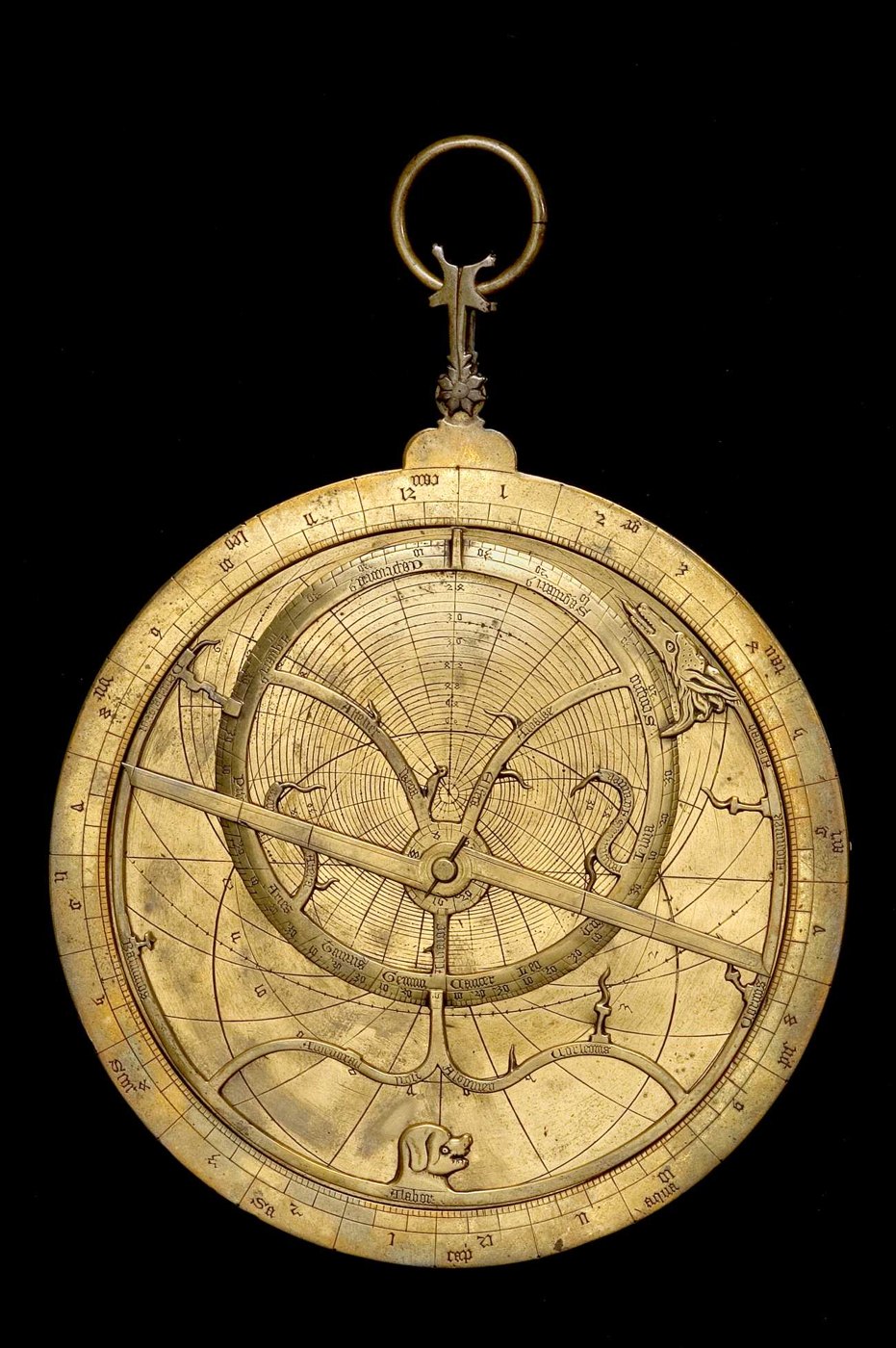
This brass astrolabe (inventory no. 49359) is attributed to England, circa 1370. The instrument features a Y-shaped (low) rete with 19 stars and zoomorphic pointers, including a bird for Vega, a dog's head for Sirius, and a dragon's head for Antares. The mater and limb are of one-piece construction. The back includes scales for zodiacal signs, altitude, calendar, and a shadow square, alongside an incomplete semi-circular scale. The throne is a simple brass type with an integrated base, featuring a simple round-section ring and a comet-shaped shackle. The instrument is equipped with a plate for latitude 51°0', a double-ended rule, and a counter-changed alidade. It was presented to the History of Science Museum by A. E. Gunther in 1986.

Front view of the brass astrolabe showing the Y-shaped rete and zoomorphic star pointers.
Front view of the brass astrolabe showing the Y-shaped rete and zoomorphic star pointers. — History of Science Museum, University of Oxford. Rights pending — permission not yet requested. Original source

Catalogue identity

Source
www.mhs.ox.ac.uk
Category
Tool · Latin-inscribed astrolabe
Maker / attribution
Not established
Reference
Not recorded
Catalogue / lot identifier
49359
Source-reported date
ca. 1370
Source-reported place
England (?)

Source-reported attribution and specifications are not independent authentication. A listing does not establish present ownership, current display, availability or permission to reproduce.

Object description

Construction and Layout

The astrolabe consists of a mater and limb of one-piece construction, with the notch for plate tabs positioned at the throne. The throne is of a simple design with an integrated base and holds a ring of round cross-section. The shackle exhibits a distinctive shape, modeled after a comet complete with a fiery head and a trailing tail.

The back of the instrument contains several concentric scales, including zodiacal signs, altitude, calendar, and a shadow square divided into four parts. An incomplete semi-circular scale is located in the upper two quadrants, which the source suggests may have been intended for an epact or other calendrical function.

Evidence for this section
  • “The mater and limb are of one-piece construction.”
  • “The shackle is designed to resemble a comet, with a fiery head and long tail.”
  • “The back contains 4 scales of the following types: Zodiacal signs; Altitude; Calendar; Shadow square.”
  • “In addition to the scales catalogued, there is an incomplete semi-circular scale in the upper two quadrants.”

The Rete and Astronomical Features

The rete is constructed in a low, Y-shape and serves as a mount for 19 stars, each marked with a flamant pointer. A key stylistic feature of this instrument is the presence of three zoomorphic star pointers: a small bird pointing to Vega, a dog's head for Sirius, and a dragon's head for Antares. The rete also features ecliptic and lunar cycle scales.

The zodiac scale on the rete is inscribed in a Latinized form, listing the signs from Aries through Pisces.

Evidence for this section
  • “The rete is of the y-shaped (low) type.”
  • “three zoomorphic features: vega is indicated by a bird-shaped star pointer. sirius is indicated by a star pointer shaped like a dog's head. a dragon's head points to antares”
  • “The rete is attached using a pin & wedge. The wedge is, in fact, a small brad.”

Provenance and Historical Context

The astrolabe formed part of the Gunther Collection, which was initially deposited on loan to the museum in 1940 by the executors of R. T. Gunther. The specific acquisition history of this item remains undocumented by R. T. Gunther himself. Notably, the instrument does not appear in his 1932 catalog, The Astrolabes of the World.

The instrument is grouped with 14th-century 'Chaucerian' astrolabes, sharing design similarities with the 'Painswick' astrolabe. These instruments are considered to represent the type of astrolabe that Geoffrey Chaucer intended to present to his son, Lewis, for his studies in Oxford.

Evidence for this section
  • “The Gunther Collection, initially deposited on loan in 1940 by the executors of R. T. Gunther (1869-1940), the Museum's founding Curator, was a very miscellaneous collection”
  • “It is not included in his book The Astrolabes of the World (1932).”
  • “This astrolabe belongs to a small group of instruments that are taken to represent the astrolabe that Geoffrey Chaucer intended to give to 'his son' Lewis”

Open research questions

  • What is the specific nature of the 'incomplete' semi-circular scale on the back of the instrument, and how does it relate to known epact systems of the 14th century?
  • Can the 'small brad' serving as a wedge be definitively dated to a specific restoration period?

Source evidence

Recorded claims and source quotations for Brass Astrolabe
FieldSource-reported valueSource quotation
Inventory number49359“Inventory no. 49359”
Dateca. 1370“Date ca. 1370”
Place of manufactureEngland (?)“Place England (?)”
MaterialBrass“Material Brass”
Rete star count19“The rete contains 19 stars.”
Latitude51°0'“There is one plate for latitude 51°0' .”
AcquisitionPresented by A. E. Gunther in 1986“Presented by A. E. Gunther in 1986”
Shackle designComet“The shackle is designed to resemble a comet, with a fiery head and long tail.”

Visible details

  • The shackle is uniquely designed to resemble a comet with a fiery head and long tail.
  • The rete includes zoomorphic pointers for Vega, Sirius, and Antares.
  • The alidade is double-ended and counter-changed.
  • The shadow square on the back is divided into four sections, each numbered to 12 fingers.

Research qualifications

  • The provenance of the instrument is not recorded by R. T. Gunther, and it is excluded from his 1932 publication 'The Astrolabes of the World'.
  • The small brad securing the rete is considered a likely replacement.

Photograph identity and source facts were screened before import; rights clearance remains pending.

Consulted source

Astrolabe, inventory 49359 (England (?), ca. 1370)

Reviewed 2026-10-26 · Record 0fb7048731

Terms in this record

Glossary explanations for terms named in this object’s record.