
Skip to content
The Encyclopedia of Horology

Clock · Bracket clock

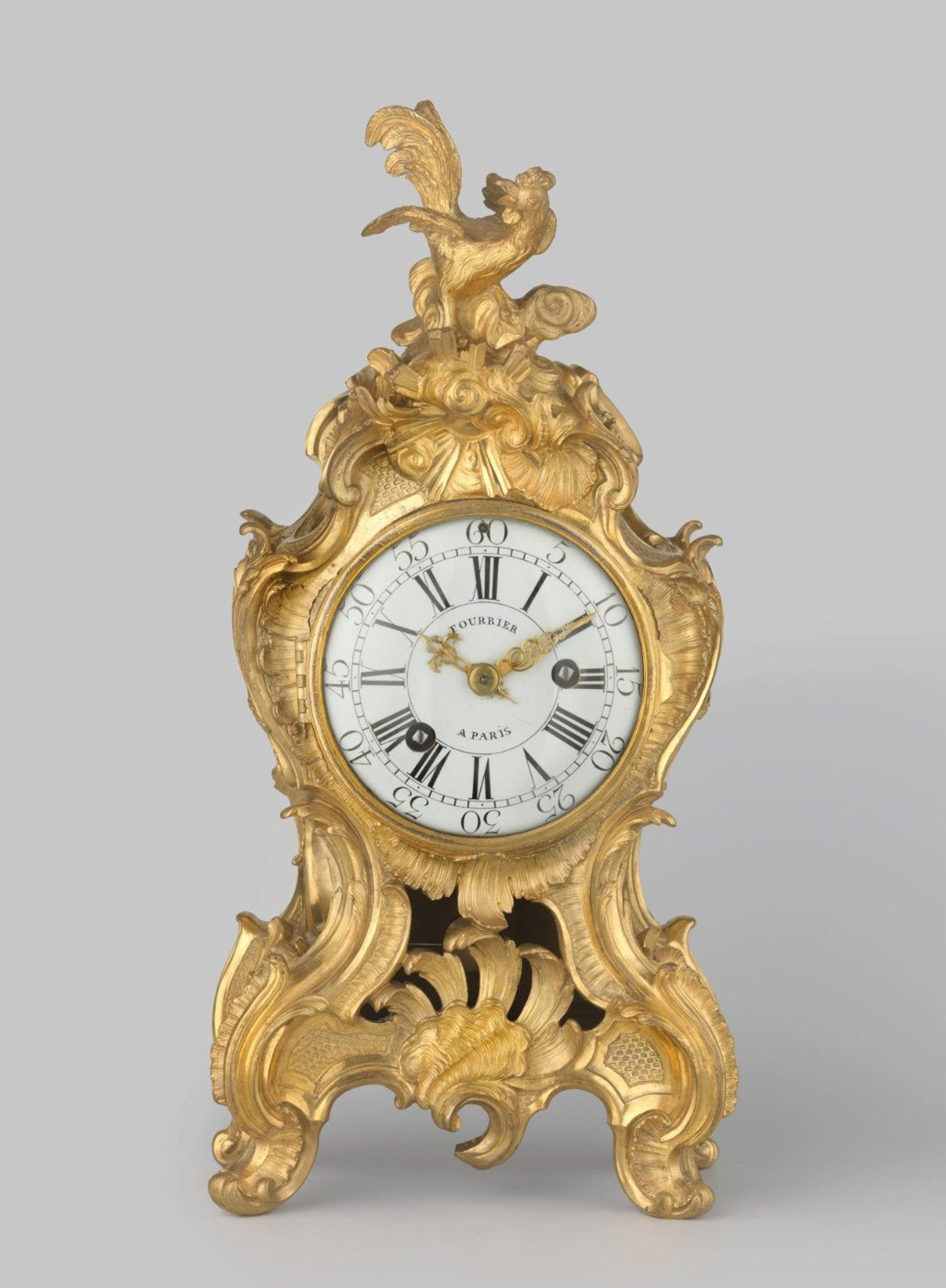
Bracket clock with gilt-bronze case

Partially verified

This bracket clock features a gilded and chased bronze case, attributed to the work of Jean Joseph de Saint-Germain. Produced in Paris between 1745 and 1749, the piece displays an asymmetrical, openwork rocaille design. The clock is supported by angular, C-shaped feet that transition into S-shaped leaf volutes holding the circular, white enameled dial. The top of the case is surmounted by a sculpted figure of a crowing cock set against a sunburst emanating from clouds. The movement was produced by the maker known as Fourrier, whose signature is found on the backplate and the dial. The enameled dial is signed by J. Boullé le jeune. The case is marked with the 'C Couronné' (crowned C), a tax stamp used on copper-based alloys in France between 1745 and 1749.

Bracket clock of gilded and chased bronze, Fourrier, c. 1745–1749.
Bracket clock of gilded and chased bronze, Fourrier, c. 1745–1749. — Rijksmuseum. Rights pending — permission not yet requested. Original source

Catalogue identity

Source
www.rijksmuseum.nl
Category
Clock · Bracket clock
Maker / attribution
Fourrier (movement), Jean Joseph de Saint-Germain (attributed case)
Reference
Not recorded
Catalogue / lot identifier
BK-NM-12289-1
Source-reported date
c. 1745 – c. 1749
Source-reported place
France

Source-reported attribution and specifications are not independent authentication. A listing does not establish present ownership, current display, availability or permission to reproduce.

Object description

Case Design and Construction

The clock case is executed in gilded and chased bronze. Its structure is based on a triangular form featuring openwork, asymmetrical rocaille motifs. The clock is supported on angular, C-shaped feet, which rise into S-shaped leaf volutes at the front, providing the mount for the circular dial. The crown of the clock is decorated with a sculpture of a crowing cock and a sunburst effect emerging from behind clouds.

The sides of the clock case feature openwork, diamond-shaped inserts. The overall physical dimensions of the object are 69 cm in height, 27.5 cm in width, and a depth of 15 cm. The case bears the 'C Couronné' mark, a government-mandated stamp for copper alloys in circulation during the mid-18th century.

Evidence for this section
  • “De console in de vorm van een gelijkzijdige driehoek vertoont opengewerkte, asymmetrische rocaille-motieven.”
  • “De zijkanten hebben opengewerkte ruitvormige vullingen.”
  • “Gestempeld met de gekroonde C, een belastingteken voor koper dat in gebruik was tussen 1745 en 1749.”

Signatures and Technical Inscriptions

The clock features several inscriptions confirming its components and attribution. The movement is signed by Fourrier on the backplate and the dial attachment plate. The enameled dial itself bears the signature 'FOURRIER A PARIS', while the reverse of the dial is signed by the enameler, J. Boullé le jeune.

Additional markings include the 'C Couronné' tax stamp found on the console and the bottom volute on the right side. An inscription identified as 'Richard (?) 785' is engraved on the spring, though this remains subject to the source's uncertainty regarding the specific name.

Evidence for this section
  • “signatuur, op de achterplaat, gegraveerd: ‘Fourrier AParis’”
  • “signatuur, op de achterzijde van de wijzerplaat, geëmailleerd: ‘.j.boullé l[e] jeune’”
  • “inscriptie, op de veer, ingegrift: ‘Richard (?) 785’”

Provenance and Documentation

The clock was acquired by the Rijksmuseum in 1912 with the support of the Vereniging Rembrandt. It is currently held in the public domain. The object is identified by the accession number BK-NM-12289-1 and is documented as part of the museum's collection in Amsterdam.

The manufacturing process is tied to Paris, with the case attributed to Jean Joseph de Saint-Germain and the movement attributed to the maker Fourrier, consistent with the dated stamp used between 1745 and 1749.

Evidence for this section
  • “Aankoop met steun van de Vereniging Rembrandt”
  • “aankoop 1912”
  • “toegeschreven aan Jean Joseph de Saint-Germain, Parijs”

Open research questions

  • What is the full identity of the 'Richard' recorded on the spring?
  • Can the movement maker 'Fourrier' be definitively linked to a specific horological workshop in 1740s Paris?

Source evidence

Recorded claims and source quotations for Bracket clock with gilt-bronze case
FieldSource-reported valueSource quotation
MakerFourrier“uurwerkmaker: Fourrier, Parijs”
Case attributionJean Joseph de Saint-Germain“toegeschreven aan Jean Joseph de Saint-Germain, Parijs”
Datec. 1745–1749“ca. 1745 - ca. 1749”
MaterialGilded bronze and enamel“verguld brons, email”
Height69 cm“hoogte 69 cm”
Tax markC Couronné“Gestempeld met de gekroonde C, een belastingteken voor koper dat in gebruik was tussen 1745 en 1749.”
Dial signatureFourrier A Paris“signatuur, op de wijzerplaat, geëmailleerd: ‘FOURRIER A PARIS’”

Visible details

  • Gilded bronze rocaille-style case with crowing cock finial
  • White enameled dial with black Roman hour numerals and Arabic five-minute markers
  • Asymmetrical openwork base with leaf volute decorations

Research qualifications

  • Movement maker Fourrier signature on the dial attachment plate is marked with a question mark in source
  • Spring inscription 'Richard (?)' contains a question mark in source

Photograph identity and source facts were screened before import; rights clearance remains pending.

Terms in this record

Glossary explanations for terms named in this object’s record.