
Skip to content
The Encyclopedia of Horology

Clock · Bracket clock

Bracket clock by James Markwick the Younger

Partially verified

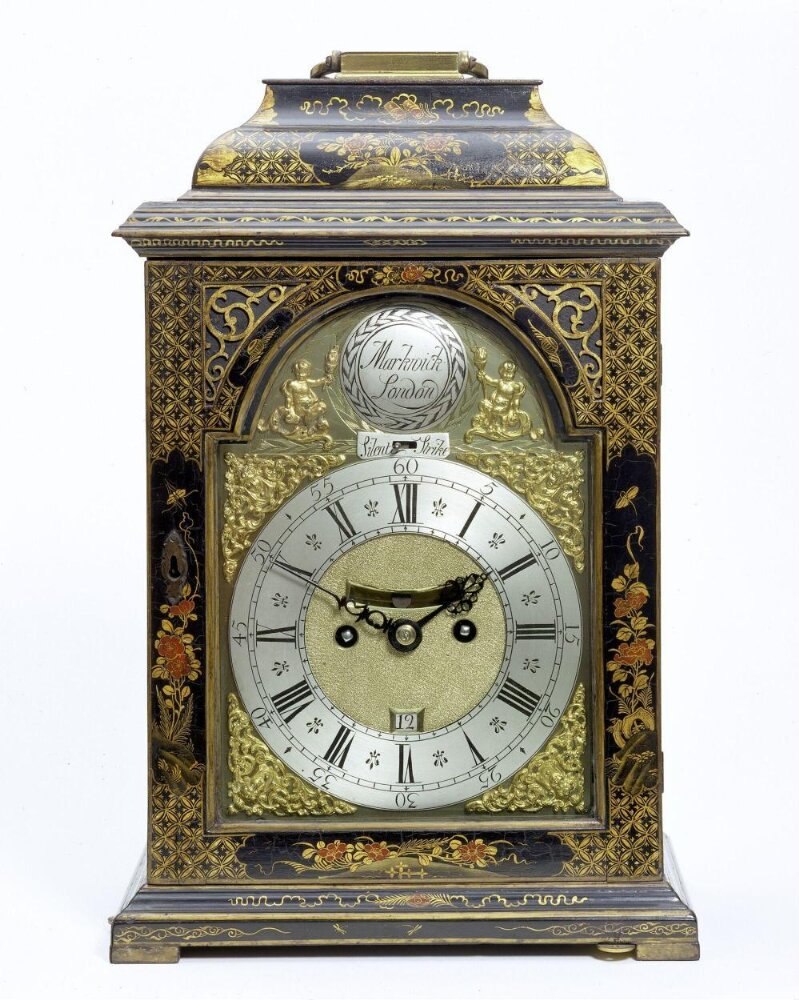
This bracket clock was produced in London circa 1730 by James Markwick the Younger. The timepiece is housed in a wooden case finished in a black ground with red and gold floral ornament and diaper patterns. The arched dial features a silvered hour-circle, hands of pierced steel, and a day-of-the-month aperture. Brass spandrel ornaments surrounding the dial are designed with masks and scrollwork. The clock includes pierced fretwork panels on the arched door and the sides. The back-plate is engraved with scrollwork, and the pendulum features an engraved floral design. A convex silvered disc on the dial is inscribed 'Markwick London', accompanied by brass cherub figures holding torches. The clock stands 45.6 cm high, 26.6 cm wide, and 17.2 cm deep. It was acquired by the museum as part of a bequest from Mr. William T. Johnson.

Front view of the bracket clock, showing the arched dial, pierced steel hands, silvered hour-circle, and the black-ground case with chinoiserie decoration.
Front view of the bracket clock, showing the arched dial, pierced steel hands, silvered hour-circle, and the black-ground case with chinoiserie decoration. — Victoria and Albert Museum, London. Rights pending — permission not yet requested. Original source

Catalogue identity

Source
collections.vam.ac.uk
Category
Clock · Bracket clock
Maker / attribution
James Markwick (the younger)
Reference
Not recorded
Catalogue / lot identifier
W.7:1 to 4-1944
Source-reported date
ca. 1730
Source-reported place
England

Source-reported attribution and specifications are not independent authentication. A listing does not establish present ownership, current display, availability or permission to reproduce.

Object description

Case and Dial Design

The bracket clock is constructed from wood and features a black-ground case decorated with red and gold floral motifs and diaper patterns. The design incorporates elements of the chinoiserie style, including depictions of cloudbands, rocks, flowers, and dragonflies flanking the dial. Brass mounts, including scrollwork and figures of cherubs bearing torches, are applied to the exterior.

The arched dial is mounted with brass spandrels cast in a pattern of masks and scrolls. Time is indicated by pierced steel hands against a silvered hour-circle. A subsidiary aperture for the day of the month is present on the lower portion of the dial, while a 'Silent/Strike' lever is located above the chapter ring. A convex silvered disc at the top of the arch is engraved with the maker's signature.

Evidence for this section
  • “The case is decorated with diaper patterns and floral ornament in red and gold on a black ground.”
  • “The arched dial has a silvered hour-circle, hands of pierced steel and a day-of-the-month aperture”
  • “On a convex silvered disc is engraved 'Tarkwick London' and on either side are cherubs holding torches of brass.”

Mechanical Details

The movement is housed within the wooden cabinet. The back-plate of the movement is embellished with engraved scrollwork. The clock's pendulum, which is a key feature of the movement's regulation, is also decorated with a floral engraving.

The construction incorporates pierced fretwork panels on the side and on the arched door, which serves to allow for sound projection and ventilation for the movement.

Evidence for this section
  • “The back-plate is engraved with scrollwork, and the pendulum is engraved with a floral design.”
  • “In the spandrels of the arched door and at the side below the top are panels of pierced fretwork decoration.”

Attribution and Provenance

The clock is attributed to James Markwick the Younger, who was admitted to the Freedom of the Clockmakers' Company in 1692 and attained the rank of Master in 1720. The signature on the dial identifies the maker and the location of production as London.

The object entered the collection through a bequest from Mr. William T. Johnson. The museum documentation indicates the clock was made in London, with production dated to approximately 1730.

Evidence for this section
  • “Made in London by James Markwick the Younger (active 1720); signed 'Markwick, London' on the arched dial”
  • “Bequeathed by Mr William T. Johnson”

Open research questions

  • Does the movement retain its original anchor escapement components?
  • Is there evidence of the clock having been modified to accommodate a different striking sequence?

Source evidence

Recorded claims and source quotations for Bracket clock by James Markwick the Younger
FieldSource-reported valueSource quotation
Accession numberW.7:1 to 4-1944“W.7:1 to 4-1944”
MakerJames Markwick the Younger“made by James Markwick the Younger”
Dateca. 1730“ca. 1730”
InscriptionMarkwick, London“'Markwick, London'”

Visible details

  • The dial features a 'Silent/Strike' selector lever.
  • The case displays chinoiserie motifs including cloudbands and dragonflies.
  • Pierced steel hands rotate over a silvered hour-circle.
  • A calendar aperture is positioned above the six o'clock numeral.

Research qualifications

  • The source suggests the clock might be associated with the Turkish market based on decorative features, but this is not definitively documented for this specific example.
  • The exact provenance prior to the bequest is not specified beyond the creator.

Photograph identity and source facts were screened before import; rights clearance remains pending.

Consulted source

Bracket clock, Markwick, James (the younger), London, ca. 1730

Reviewed 2026-11-02 · Record 5aa4bfa2a1

Terms in this record

Glossary explanations for terms named in this object’s record.