
Skip to content
The Encyclopedia of Horology

Clock · Bracket clock

Bracket clock by Charles Gretton

Partially verified

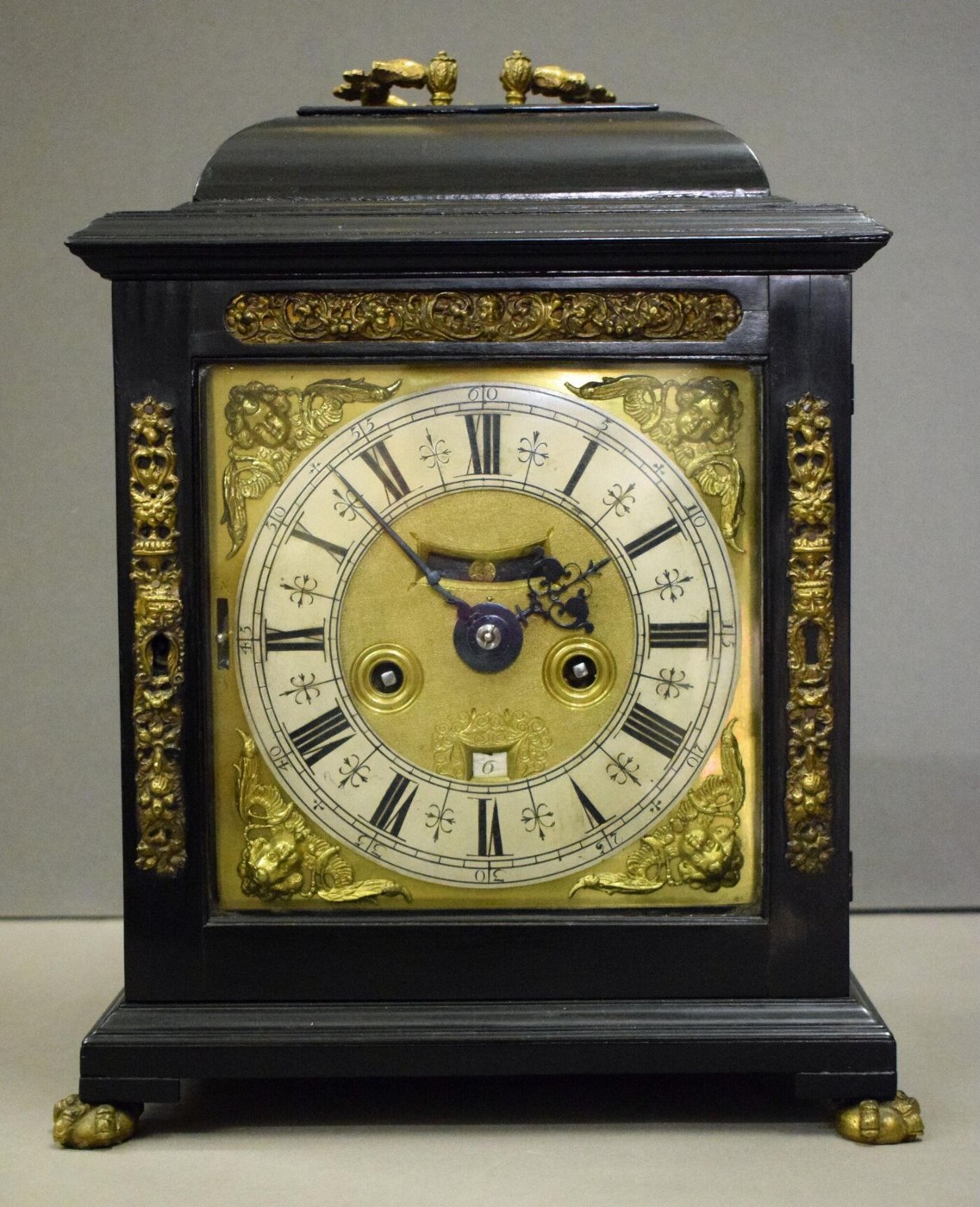
This bracket clock was produced in London circa 1680 by the maker Charles Gretton. Standing 58.4 cm in height, the clock features an ebonised pearwood case with a domed top and an integrated handle chased with foliage. The case sits upon brass paw feet and incorporates applied embossed ornaments on the door and inset panels at the sides. The brass dial is designed with an hour and minute circle, a central day of the month aperture, and two winding holes. It is flanked by chased cherubs' heads in the spandrels. The hour hand is pierced with a scrolled outline. The internal movement provides hour striking and a repeating function, and the back plate is engraved with scrolls and floral ornament. The object includes its original engraved brass winding key and a separate steel door key. It entered the museum collection in 1932 as a gift from Robert N. Shaw.

Front view of the bracket clock by Charles Gretton, showing the brass dial and cherub spandrels.
Front view of the bracket clock by Charles Gretton, showing the brass dial and cherub spandrels. — Victoria and Albert Museum, London. Rights pending — permission not yet requested. Original source

Catalogue identity

Source
collections.vam.ac.uk
Category
Clock · Bracket clock
Maker / attribution
Charles Gretton
Reference
Not recorded
Catalogue / lot identifier
W.23:1-1932
Source-reported date
ca. 1680
Source-reported place
London

Source-reported attribution and specifications are not independent authentication. A listing does not establish present ownership, current display, availability or permission to reproduce.

Object description

Case Construction

The bracket clock is housed in an ebonised pearwood case measuring 58.4 cm in height, 27.3 cm in width, and 19.4 cm in depth. The structure includes a domed top surmounted by a foliage-chased loop handle. The front door is detailed with applied embossed ornaments, complemented by two inset panels positioned at the sides above glass sections. The entire housing rests upon brass paw feet.

The exterior is designed with a mixture of dark-finished wood and decorative metal mounts. While internal museum records identify the wood as pearwood, historical correspondence from the time of acquisition occasionally referenced the case as ebony.

Evidence for this section
  • “Bracket clock in ebonised pearwood case.”
  • “The case has a domed top with a loop handle chased with foliage.”
  • “The door has applied embossed ornament and there are two similar panels inset at the sides above panels of glass.”
  • “The case rests on brass paw feet.”

Dial and Movement

The brass dial displays an hour and minute circle, accompanied by a day of the month aperture. The hour hand is distinct for its pierced, scrolled outline. The dial is visually anchored by chased cherubs' heads positioned in each of the four spandrels. The movement provides for both hour striking and a repeating function.

The internal mechanism is accessed via two winding holes on the dial. The back plate of the movement is decorated with engraved scrolls and floral ornament, and it bears the signature of the maker, Charles Gretton.

Evidence for this section
  • “The brass dial has an hour and minute circle, a day of the month aperture and two winding holes; the hour hand is pierced and of scrolled outline.”
  • “In the spandrels are chased chrubs' heads”
  • “There is an hour striking and repeating movement.”
  • “the back plate is engraved with scrolls and floral ornament and signed.”

Provenance and History

The clock was presented to the museum in 1932 by Robert N. Shaw.

Following its acquisition, the clock remained part of the collection and was later placed on long-term loan to the Privy Council Office between 1968 and 1998. The acquisition file includes detailed correspondence regarding the offer, which highlighted the maker's reputation as a master working from 'The Ship' in Fleet Street.

Evidence for this section
  • “Bracket clock, gift of Robert N Shaw”
  • “The Norman Shaw collection of clocks, which was very extensive, was sold at Christie's in 1913”
  • “On long loan to Privy Council Office from 1968 to 1998.”
  • “the other bracket clock is by Charles Gretton, an (eminent?) make of "The Ship", Fleet Street”

Open research questions

  • Does the current condition of the ebonised finish suggest later restoration or original application?
  • Are the movement serial number or specific hallmarking details available to confirm the circa 1680 dating?

Source evidence

Recorded claims and source quotations for Bracket clock by Charles Gretton
FieldSource-reported valueSource quotation
MakerCharles Gretton“made by Charles Gretton”
Dateca. 1680“ca. 1680”
Height58.4 cm“Height: 58.4 cm”
Case materialEbonised pearwood“Bracket clock in ebonised pearwood case.”
MovementHour striking and repeating“There is an hour striking and repeating movement.”
BackplateEngraved and signed“the back plate is engraved with scrolls and floral ornament and signed.”
ProvenanceRobert N. Shaw“Given by Robert N Shaw”

Visible details

  • Pierced hour hand with scrolled design
  • Chased cherub-head spandrels
  • Raised brass paw feet
  • Domed top with foliage-chased handle

Research qualifications

  • The source notes a potential conflict regarding the wood type, describing the case as ebonised pearwood while internal correspondence refers to an ebony case.
  • The exact extent of internal original components is not specified beyond the keys and movement signature.

Photograph identity and source facts were screened before import; rights clearance remains pending.

Consulted source

Clock

Reviewed 2026-10-26 · Record dcd28fae32

Terms in this record

Glossary explanations for terms named in this object’s record.