
Skip to content
The Encyclopedia of Horology

Clock · Bracket clock

B. Warwick Gothic Revival Bracket Clock

Partially verified

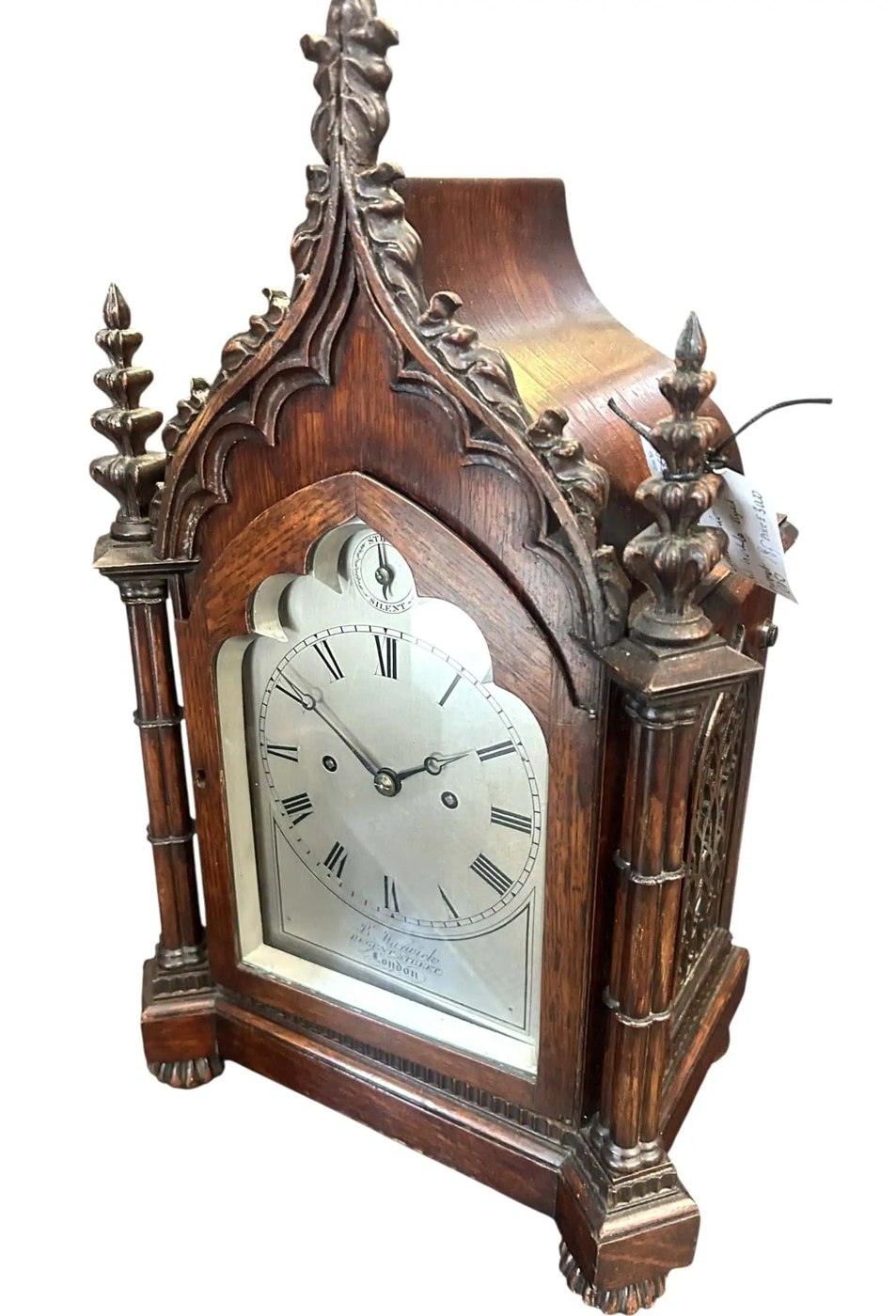
This 8-day bracket clock is attributed to the maker B. Warwick of Regent Street, London, dating to approximately 1870. The timepiece is housed in a solid oak case executed in a Gothic Revival style, featuring architectural elements such as pointed arches and carved details. Measuring 49cm in height, 30cm in width, and 20cm in depth, the clock incorporates an engraved silvered dial with Roman numerals and a Strike/Silent lever positioned at the 12 o'clock mark. The internal mechanism is a heavy brass 8-day double fusee movement, which operates a striking train on a cathedral gong. The clock comes with its pendulum and winding key. According to the auction report, the case displays original patina with minor historic wear, and the movement is currently functioning and striking as intended.

Front view of the B. Warwick Gothic Revival bracket clock, showing the silvered dial and architectural oak case.
Front view of the B. Warwick Gothic Revival bracket clock, showing the silvered dial and architectural oak case. — Vintage Clocks UK. Rights pending — permission not yet requested. Original source

Catalogue identity

Source
vintageclocks.uk
Category
Clock · Bracket clock
Maker / attribution
B. Warwick
Reference
Jn160
Catalogue / lot identifier
Jn160
Source-reported date
c.1870
Source-reported place
England

Source-reported attribution and specifications are not independent authentication. A listing does not establish present ownership, current display, availability or permission to reproduce.

Object description

Case and Dial

The clock is contained within a solid oak case designed in the Gothic Revival style. The exterior features architectural elements including pointed arch framing around the dial aperture and decorative finials at the top and corners.

The front of the clock features an engraved silvered dial displaying black Roman numerals. Positioned at the top of the dial, near the 12 o'clock position, is a Strike/Silent lever that allows the user to disengage the striking train. The dial is signed with the maker's name and location, B. Warwick, Regent Street, London.

Evidence for this section
  • “Housed in a magnificent solid oak Gothic Revival case”
  • “The face boasts a highly desirable engraved silvered dial featuring crisp black Roman numerals”
  • “dedicated Strike/Silent lever near the 12 o’clock position”

Movement and Functionality

The clock is powered by a heavy-plate brass 8-day double fusee mechanical movement. This configuration utilizes two distinct chain-driven fusees to provide power to the timekeeping and the striking trains independently.

The striking mechanism is configured to sound the full hour count on a cathedral gong. The auction description reports that the movement is complete and currently functional, noting that the strike/silent feature operates as expected.

Evidence for this section
  • “Behind the dial sits a spectacular, heavy-plate double fusee movement”
  • “Unlike single fusee clocks, a double fusee uses two separate chain-driven cones to independently power the timekeeping and the strike train”
  • “The premium 8-day double fusee movement is complete, running smoothly, and striking correctly on the gong”

Condition and Accessories

The auction description reports that the case is in antique condition, exhibiting a deep grain and original patina with minor, anticipated historic wear. The silvered dial is described as being in a crisp state with legible engravings and minimal tarnish.

The clock includes its original pendulum and winding key. The seller indicates that the strike/silent function is operational and the clock strikes correctly.

Evidence for this section
  • “The oak case has a rich, deep grain and an excellent original patina with only minor, expected historic wear.”
  • “The silvered dial is in beautiful, crisp condition”
  • “Includes the original heavy pendulum and winding key”

Open research questions

  • Was B. Warwick primarily a retailer or a manufacturing clockmaker in London?
  • Does the serial/SKU Jn160 relate to an internal maker's production log or an auction inventory system?

Source evidence

Recorded claims and source quotations for B. Warwick Gothic Revival Bracket Clock
FieldSource-reported valueSource quotation
MakerB. Warwick, Regent Street, London“Maker: B. Warwick, Regent Street, London”
Datec.1870“c.1870”
Case MaterialSolid oak“Case Material: Solid oak in a striking Architectural Gothic Revival style”
Dimensions49cm x 30cm x 20cm“Measures 49cm high, 30cm wide, 20cm deep”
Movement8-day double fusee“Movement: Heavy brass 8-day double fusee mechanical movement”
ComplicationHour striking with Strike/Silent“Hour striking on a cathedral gong with Strike/Silent feature”
SKUJn160“SKU: Jn160”

Visible details

  • Engraved silvered dial signed B. Warwick, Regent Street, London
  • Gothic Revival oak case with pointed arch detail
  • Strike/Silent lever indicator near the 12 o'clock position
  • Fretted side panels with geometric tracery

Research qualifications

  • Movement internal mechanisms not photographed
  • Exact nature of the B. Warwick business entity (maker vs retailer) not specified

Photograph identity and source facts were screened before import; rights clearance remains pending.

Terms in this record

Glossary explanations for terms named in this object’s record.