
Skip to content
The Encyclopedia of Horology

Clock · Figural mantel clock

Aurora Clock

Partially verified

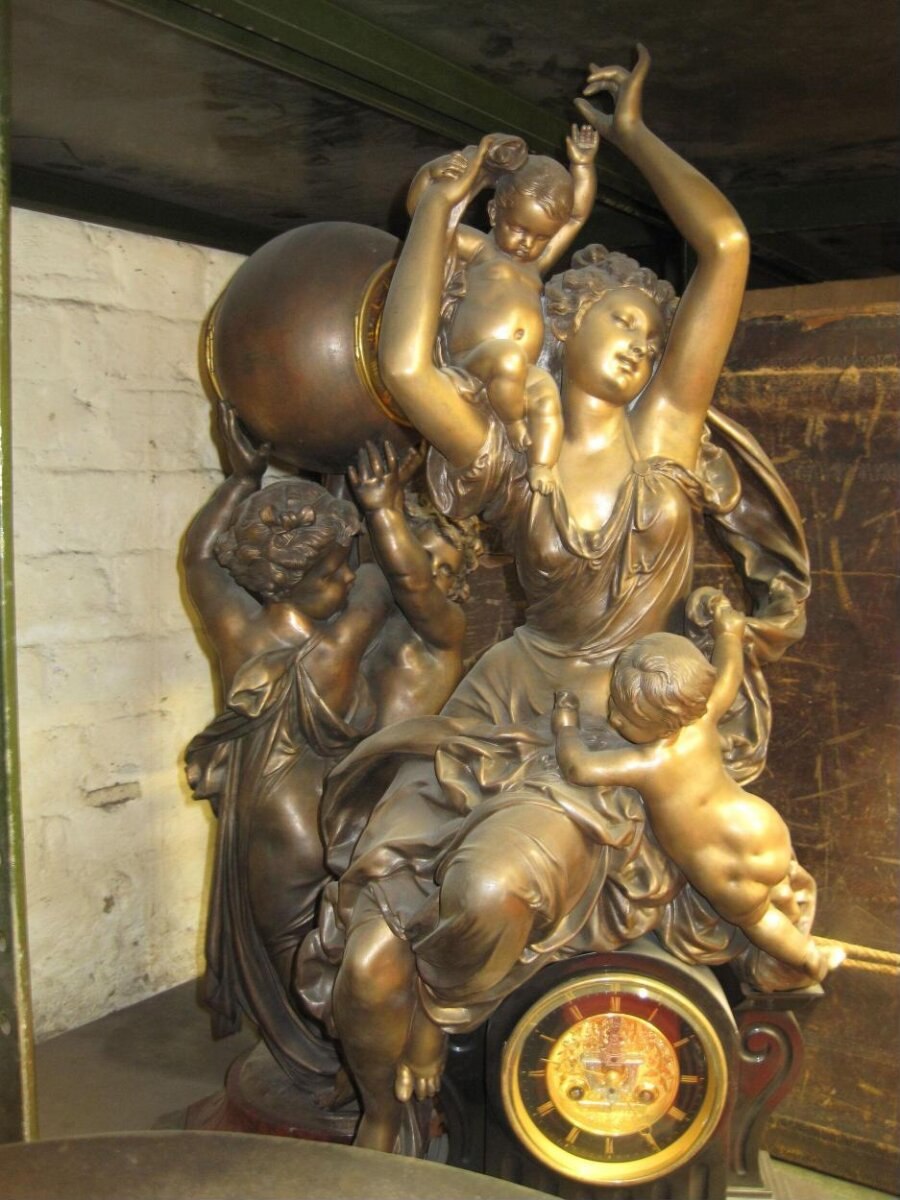
This figural mantel clock, acquired by the V&A in 1867 from the Paris International Exhibition, is constructed of imitation bronze and set upon a black marble base. Designed by Albert Carrier-Belleuse, the sculpture depicts a female figure representing Aurora seated on a clock, accompanied by three putti. One putto is held on Aurora's shoulder, while two standing putti on the left support a globe containing a concealed clock dial. The primary dial, located at the base, features an enamel chapter ring with Roman numerals and Breguet-type gilt hands. The movement is powered by two going barrels and incorporates a cylinder escapement. The backplate bears the maker's stamp of Japy Frères & Cie and the mark of Y.M. Thomas.

Full view of the Aurora figural clock showing the central female figure, the surrounding putti, the globe on the left, and the clock dial integrated into the base.
Full view of the Aurora figural clock showing the central female figure, the surrounding putti, the globe on the left, and the clock dial integrated into the base. — Victoria and Albert Museum. Rights pending — permission not yet requested. Original source

Catalogue identity

Source
collections.vam.ac.uk
Category
Clock · Figural mantel clock
Maker / attribution
Albert Carrier-Belleuse (designer)
Reference
Not recorded
Catalogue / lot identifier
764-1869
Source-reported date
1860s
Source-reported place
France
Source-reported serial
323 11

Source-reported attribution and specifications are not independent authentication. A listing does not establish present ownership, current display, availability or permission to reproduce.

Object description

Design and Sculpture

The clock features a sculptural group centered on a female figure representing Aurora. The figure is depicted seated, with a putto resting on her right shoulder while another clings to her drapery. A second pair of standing putti are positioned to her left, tasked with supporting a globe that contains a secondary, hidden clock dial. The composition is executed in a material described in museum records as imitation bronze.

The physical arrangement of the figures is anchored by a black marble base, which houses the primary clock mechanism. The sculpture was designed by Albert Carrier-Belleuse, a prominent figure in 19th-century decorative arts. The museum notes that the acquisition was made specifically to demonstrate the production standards of such decorative horological items at the time.

Evidence for this section
  • “Clock, comprising female figure representing Aurora, seated on a clock with two putti”
  • “Designed by M.A.Carrier later known as Carrier-Belleuse”
  • “bought by the V&A from the Paris Exhibiton of 1867 "as an example of cheapness of manufacture”

Dial and Mechanism

The main dial measures 12.4 cm in diameter and features a recessed center. A black-enamel chapter ring, 1.6 cm wide, displays Roman numerals for the hours and gilt strokes for the minutes. The Breguet-style hands are gilt. The central area of the dial is engraved with leafy sprays and scrolls, and it incorporates a rectangular cartouche identifying the exhibition and maker, dated 1867.

The brass movement is powered by two going barrels and utilizes a cylinder escapement. An outside count-wheel system handles the striking, which is configured to permit a single stroke at the half-hours. The bell is mounted externally on the back plate. The regulator assembly is positioned above the clock, with an index moving across an R to A scale.

Evidence for this section
  • “The black-enamel chapter-ring 1.6 cm broad with an outer minute ring”
  • “The gilt hands are of the Breguet type.”
  • “Going train with cylinder escapement, small steel escape wheel”
  • “Striking train of locking-plate type, the outside count-wheel permitting also a single stroke at the half-hours.”

Signatures and Marks

The movement backplate provides specific manufacturer details via stamped marks. It bears the mark of Japy Frères & Cie, including a crown and a star emblem resembling a Maltese cross. Additionally, it features the stamp 'Y.M.THOMAS BTE S.G.D.G.', which is repeated twice alongside the punched sequence '323 11'.

The dial cartouche confirms the manufacture and provenance, specifically referencing the 1867 Paris Universal Exhibition and a maker identified as Boy. This indicates the object was produced specifically for, or at least featured during, this international event.

Evidence for this section
  • “Also stamped in a small sunk well 'JAPY FRERES & CIE'”
  • “The backplate is twice stamped 'Y.M.THOMAS BTE S.G.D.G.' in an oval with the punched number 323 and 11.”
  • “signed in a rectangular horizontal cartouche with the legend 'EXPOSITION UNIVERSELLE BOY FT A PARIS'”

Open research questions

  • What is the specific nature and composition of the 'imitation bronze' used in this clock's construction?
  • What is the specific working relationship between Japy Frères and the individual clockmaker 'Boy' referenced on the dial?

Source evidence

Recorded claims and source quotations for Aurora Clock
FieldSource-reported valueSource quotation
Movement InscriptionY.M.THOMAS BTE S.G.D.G.“The backplate is twice stamped 'Y.M.THOMAS BTE S.G.D.G.' in an oval with the punched number 323 and 11.”
Dial InscriptionEXPOSITION UNIVERSELLE BOY FT A PARIS 1867“signed in a rectangular horizontal cartouche with the legend 'EXPOSITION UNIVERSELLE BOY FT A PARIS' with the date '1867' below the cartouche.”
DesignAlbert Carrier-Belleuse“designed by Carrier-Belleuse, before 1867”
ProvenanceParis International Exhibition 1867“Bought at the Paris International Exhibition, 1867, for £12-0s-0d as an example of cheapness of manufacture.”

Visible details

  • The clock dial is positioned at the base of the figural sculpture.
  • Two putti are shown supporting a separate globe to the left.
  • The primary dial features Breguet-type hands.
  • The sculpture is mounted on a black marble base.

Research qualifications

  • The exact extent of the role of the clockmaker 'Boy' in the manufacture is not fully specified beyond the cartouche inscription.
  • The precise nature of the material termed 'imitation bronze' in the museum records is not technically detailed.

Photograph identity and source facts were screened before import; rights clearance remains pending.

Consulted source

Clock — Aurora, Paris, 1860s

Reviewed 2026-11-02 · Record 1e75e4c52b

Terms in this record

Glossary explanations for terms named in this object’s record.