
Skip to content
The Encyclopedia of Horology

Clock · Table clock

Astronomical table clock

Partially verified

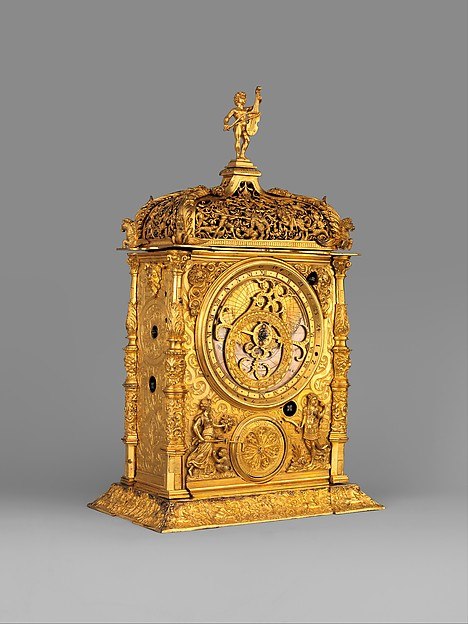
This astronomical table clock, dated 1568, is attributed to the German clockmaker Jeremias Metzger. Featuring a spring-driven iron movement, the clock is encased in gilded brass with a base depicting triumphal processions and a dome adorned with openwork foliage and animal-hunting figures. The construction follows the 'Metzger-type' design, which utilizes three separate wheel trains: a central train for the primary time-telling and astrolabe functions, and two flanking trains for striking the hours and quarters. Following its original construction, the clock was later modified to incorporate a balance spring, reflecting the influence of Christiaan Huygens’ 1675 publication. The piece entered the Metropolitan Museum of Art collection in 1917 as a gift from J. Pierpont Morgan.

Front view of the astronomical table clock, showing the astrolabe dial and subsidiary planetary indicators.
Front view of the astronomical table clock, showing the astrolabe dial and subsidiary planetary indicators. — The Metropolitan Museum of Art. Rights pending — permission not yet requested. Original source

Catalogue identity

Source
www.metmuseum.org
Category
Clock · Table clock
Maker / attribution
Jeremias Metzger
Reference
Not recorded
Catalogue / lot identifier
17.190.634a–d
Source-reported date
1568
Source-reported place
Germany

Source-reported attribution and specifications are not independent authentication. A listing does not establish present ownership, current display, availability or permission to reproduce.

Object description

Movement and Construction

The clock features a spring-driven iron movement constructed with two rectangular plates connected at the corners by iron pillars. This framework supports three distinct trains of wheels. The central train operates the time-telling dial and the astrolabe located on the exterior long sides of the clock. The arbor for this train is positioned perpendicular to these dials, with the central axis projecting through the casing to facilitate the mounting of hands.

Flanking the central train are two additional trains set at right angles. These are dedicated to the striking mechanism, actuating hammers that strike two bells mounted on a top plate. One bell tracks the hours, while the other marks the quarter-hours. A subsidiary count wheel was included to improve the reliability of the twenty-four-hour striking function, though this feature is reported as currently inoperative.

Evidence for this section
  • “the clock has a spring-driven movement, consisting of two rectangular plates that are held in place at the four corners by iron pillars, a structure that supports three trains of wheels.”
  • “These trains primarily operate the hammers that strike two bells on stands that are attached to a plate at the top of the clock, one for hours and one for quarters.”

Case and Ornamentation

The rectangular brass case is designed with applied colonettes at the corners, resting upon a base ornamented with cast reliefs of triumphal processions. An openwork dome sits atop the case, decorated with foliage and figures of hunters pursuing bear and ducks. Winged horse figures are positioned at the junctions where the dome meets the body.

Several of the decorative elements, such as the figures on the dome and base, appear to be products of serial casting, with some components matching those found on other known Metzger-type clocks. Historical research suggests that the ornamentation was influenced by contemporary engravings, specifically by artists such as Virgil Solis and Hans Sebald Beham, whose prints served as source material for the figural reliefs and decorative motifs.

Evidence for this section
  • “the case of the Museum’s clock is rectangular, with applied colonettes at the corners, which are set upon a base ornamented with cast reliefs depicting triumphal processions and supporting an openwork dome with interlaced foliage inhabited by figures variously engaged in hunting bear and ducks.”
  • “The applied figures on the cases of the Metzger clocks in the Kunsthistorisches Museum and Waddesdon Manor, as well as the Behaim clock, are prime examples of serial casting from the same models.”

Modification and Provenance

The original circular balance was updated with a balance spring, and the dial layout was adjusted to reflect new timing standards. The original Italian-hour chapter ring was replaced, and markings for minutes were added to the outer ring. The calendar plates were also altered to include saints' names and a Dutch reference, suggesting the work was performed in the Netherlands.

The clock’s history includes ownership by Charles Stein, who sold it in Paris in 1886, and subsequently Frédéric Spitzer. During its time in Paris, a replacement finial was supplied by Alfred André. The clock was acquired by J. Pierpont Morgan, who eventually gifted the object to the Metropolitan Museum of Art in 1917. Today, the object is noted for its missing hands and the loss of the original movable shutters used for daylight and night-hour indication.

Evidence for this section
  • “the original circular balance was fitted with a balance spring, probably not long after the invention by the Dutch mathematician Christiaan Huygens (1629–1695) was published in 1675.”
  • “A new finial for the dome was supplied in Paris by Alfred André (1839–1919) at some time between 1886 and 1893.”
  • “The clock is now missing most of its hands and the movable shutters adjusting the length of the days and nights.”

Open research questions

  • What is the definitive link between Jeremias Metzger and the specific Austrian patron associated with Caspar Behaim?
  • Are there remaining traces of the original movable shutter mechanism in the internal gear train?

Source evidence

Recorded claims and source quotations for Astronomical table clock
FieldSource-reported valueSource quotation
MakerJeremias Metzger“Jeremias Metzger, Maker”
MediumGilded brass and iron“Case and dials: gilded brass; Movement: iron”
Dimensions36.2 x 21.6 x 14.6 cm“14 1/4 × 8 1/2 × 5 3/4 in. (36.2 × 21.6 × 14.6 cm)”
Accession number17.190.634a–d“17.190.634a–d”
Striking mechanismHour and quarter-hour strike“These trains primarily operate the hammers that strike two bells on stands that are attached to a plate at the top of the clock, one for hours and one for quarters.”
ProvenanceFrédéric Spitzer, Charles Stein, J. Pierpont Morgan“The clock had earlier belonged to Frédéric Spitzer in Paris (1893), who may have added the André finial. Before Spitzer the clock belonged to Charles Stein”

Visible details

  • Applied colonettes at the corners of the rectangular case
  • Cast relief base depicting triumphal processions
  • Revolving astrolabe rete showing positions of fourteen stars
  • Figures of winged horses at the corners of the dome

Research qualifications

  • Originality of minute-tracking marks on the chapter ring is unverified
  • Exact maker of the case remains uncertain

Photograph identity and source facts were screened before import; rights clearance remains pending.

Consulted source

Astronomical table clock

Reviewed 2026-10-26 · Record d7e3204afc

Terms in this record

Glossary explanations for terms named in this object’s record.