
Skip to content
The Encyclopedia of Horology

Tool · Flemish astronomical ring dial

Astronomical Ring Dial

Partially verified

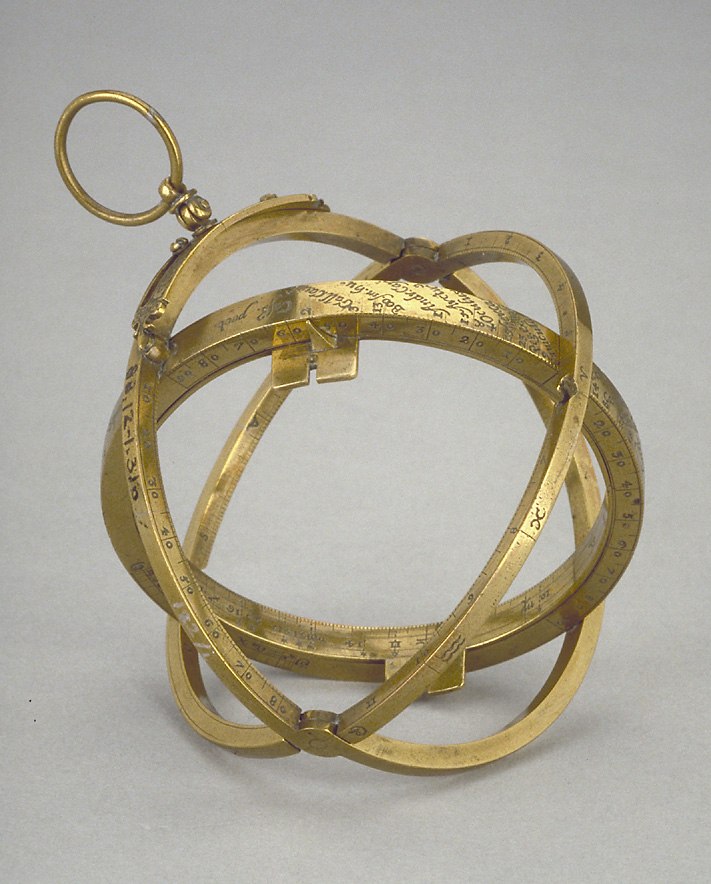
This astronomical ring dial, measuring 70 mm in diameter, is constructed from gilt brass and is unsigned. It comprises three rings: a meridian ring, an equatorial ring, and a third ring pivoted to the polar points, which is fitted with an internal sliding ring featuring a pair of sights. The meridian ring features a degree scale, while the equatorial ring contains a 12-hour scale and an internal calendrical scale. The sliding ring is equipped with indices that move over degree and zodiacal scales to adjust for solar declination, and includes an ecliptical scale with star positions. The exterior of the third ring displays abbreviated names and numbers for 25 stars. The instrument is adjustable for latitude using a swivelling ring attached to a decorated arc on the outer ring. It was bequeathed to the British Museum by Octavius Morgan in 1888.

Astronomical Ring Dial in gilt brass with engraved scales and star identifiers.
Astronomical Ring Dial in gilt brass with engraved scales and star identifiers. — © British Museum, London. Rights pending — permission not yet requested. Original source

Catalogue identity

Source
www.mhs.ox.ac.uk
Category
Tool · Flemish astronomical ring dial
Maker / attribution
Unknown (Attributed to Flemish)
Reference
Not recorded
Catalogue / lot identifier
MLA 1888,12-1.316
Source-reported date
Late 16th century
Source-reported place
Flemish

Source-reported attribution and specifications are not independent authentication. A listing does not establish present ownership, current display, availability or permission to reproduce.

Object description

Structural Composition

The instrument is composed of three primary rings, including a meridian ring, an equatorial ring, and a polar ring. It features a mechanism for latitude adjustment, where an arc attached to the outer meridian ring allows movement between 42 1/2 and 59 degrees along a degree scale.

A suspension ring is fixed to the decorated arc to hold the instrument. When the rings are unfolded, the equatorial ring is perpendicular to the meridian ring. A third ring, pivoted to the polar points of the meridian, houses an internal sliding ring equipped with sights.

Evidence for this section
  • “The instrument consists of three rings, two of which can be set perpendicular to each other, while the third one can move around freely.”
  • “The arc itself is attached to the outer ring in such a way that it can move between 421/2? and 59? along the degree scale in order to set the instrument to the appropriate latitude.”

Scales and Astronomical Features

The meridian ring includes a double degree scale marked from 0 to 90. The equatorial ring incorporates both 12-hour scales and an internal calendrical scale identifying months by their initials. Zodiacal symbols are engraved on the exterior of the equatorial ring.

The third ring is designed for solar observations using sights that align with zodiacal and degree scales. Its sliding ring features an ecliptical scale and identifies the positions of 25 stars, listed by name and number on the exterior of the ring.

Evidence for this section
  • “The inside bears a calendrical scale with the names of the months indicated by their first letters”
  • “The outside of the third ring is marked with the same numbers and the abbreviated names of these stars in the following sequence”

Provenance and Documentation

The item was acquired by the British Museum through the bequest of Octavius Morgan in 1888. It is currently held in the Department of Medieval and Later Antiquities.

The instrument is documented in a published catalogue of scientific instruments where it is identified by its specific inventory number and attributed to a Flemish maker working near 1600.

Evidence for this section
  • “The instrument was bequeathed by Octavius Morgan in 1888 and is described in F. A. B. Ward, A Catalogue of European Scientific Instruments in the Department of Medieval and Later Antiquities of the British Museum (London, 1981), p. 65, no. 182.”
  • “the style suggests that it was made by a Flemish maker around 1600.”

Open research questions

  • What is the specific functionality of the star catalog numbering sequence starting with 2 Cass Pect?
  • Are there similar Flemish ring dials from this period that could provide further clarity on the unsigned maker?

Source evidence

Recorded claims and source quotations for Astronomical Ring Dial
FieldSource-reported valueSource quotation
MaterialGilt brass“Gilt brass”
Diameter70 mm“70 mm in diameter”
Maker attributionFlemish maker“the style suggests that it was made by a Flemish maker”
Registration numberMLA 1888,12-1.316“Registration no. MLA 1888,12-1.316”
ProvenienceBequeathed by Octavius Morgan“The instrument was bequeathed by Octavius Morgan in 1888”
Equinox dates15 March and 10 September“The equinoxes are at 15 March and 10 September.”
Latitude adjustment42 1/2 degrees to 59 degrees“move between 421/2? and 59? along the degree scale”

Visible details

  • Three-ring construction
  • Gilt brass finish
  • Suspension ring attached to a decorated arc
  • Internal sights and sliding ring

Research qualifications

  • Unsigned and undated, maker is attributed based on style
  • Exact date of manufacture is approximate

Photograph identity and source facts were screened before import; rights clearance remains pending.

Consulted source

Astronomical Ring Dial

Reviewed 2026-10-26 · Record 552a98da56

Terms in this record

Glossary explanations for terms named in this object’s record.