
Skip to content
The Encyclopedia of Horology

Tool · Flemish astronomical ring dial

Astronomical Ring Dial by Gualterus Arsenius

Partially verified

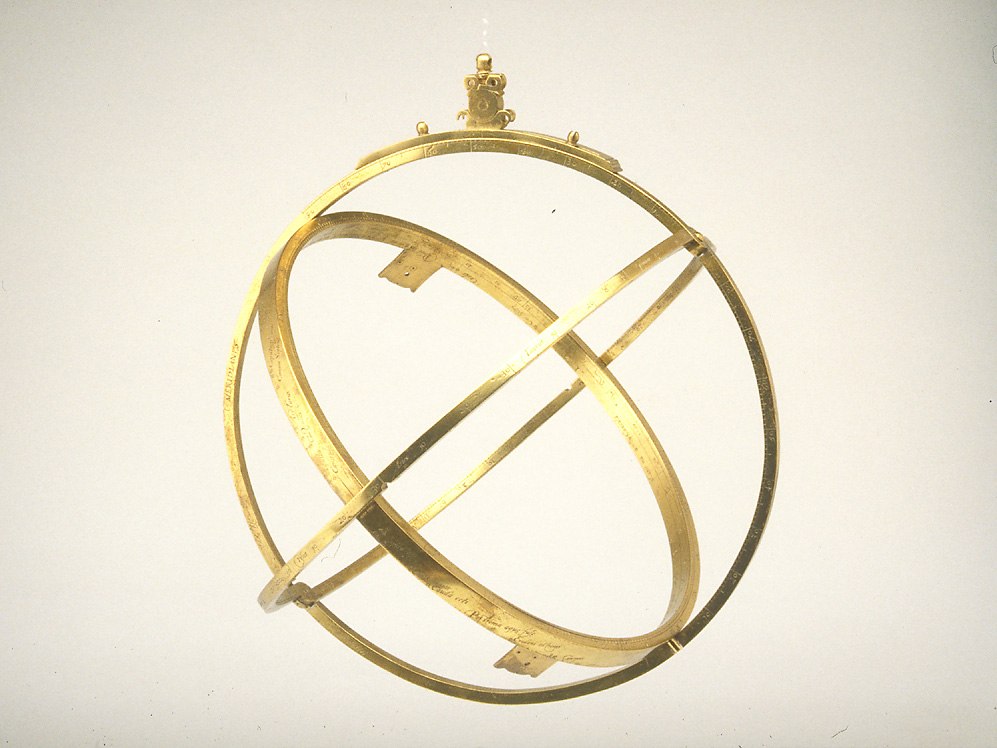
This astronomical ring dial, dated 1572, was constructed by Gualterus Arsenius in Louvain. The instrument is crafted from gilt brass and measures 262 mm in diameter. It comprises three hinged circular brass rings: a fixed meridian ring, an equatorial ring perpendicular to the meridian, and a third mobile ring that rotates inside. The meridian ring features a latitude scale ranging from 90 to 0 to 90 degrees. The equatorial ring includes a zodiacal and calendrical scale, as well as markings for 'Umbra recta' and 'Umbra versa'. The mobile meridian ring contains a pair of sighting holes for taking bearings of specific stars. The instrument is suspended via a swivelling ring attached to a throne, which is mounted on the fixed meridian ring. The object is signed by the maker on the meridian ring with the Latin inscription 'G.A. nepos Gemme Fris Louan fecit anno 1572'.

Astronomical ring dial by Gualterus Arsenius, 1572, viewed from an oblique angle showing the three-ring assembly.
Astronomical ring dial by Gualterus Arsenius, 1572, viewed from an oblique angle showing the three-ring assembly. — Museum Boerhaave, Leiden. Rights pending — permission not yet requested. Original source

Catalogue identity

Source
www.mhs.ox.ac.uk
Category
Tool · Flemish astronomical ring dial
Maker / attribution
Gualterus Arsenius
Reference
Not recorded
Catalogue / lot identifier
9163
Source-reported date
1572
Source-reported place
Louvain

Source-reported attribution and specifications are not independent authentication. A listing does not establish present ownership, current display, availability or permission to reproduce.

Object description

Construction and Mechanics

The instrument is composed of three hinged circular brass rings that allow for various astronomical calculations. The arrangement includes a fixed meridian ring and an equatorial ring set perpendicular to one another. A third, mobile ring rotates within the structure. When not in use, the assembly is designed to be folded flat.

Suspension is provided by a swivelling ring connected to a throne, which is fixed to the meridian ring. The meridian ring displays a latitude scale and is inscribed with 'MERIDIANVS', 'Polus arcticus', and 'Polus antarcticus'. The mobile inner ring incorporates a set of adjustable sighting holes for taking stellar bearings.

Evidence for this section
  • “The instrument consists of three hinged circular brass rings”
  • “The instrument is suspended from a swivelling ring attached to the throne that in turn is screwed to the fixed meridian ring.”
  • “Inside the mobile meridian ring there is a ring with a pair of sighting holes which can be adjusted for taking the bearing of one of the above mentioned stars.”

Inscriptions and Markings

The instrument bears numerous inscriptions detailing its function and origin. The equatorial ring features a combined zodiacal and calendrical scale, along with the text 'Aequinoctialis', 'Aequator', 'Umbra recta', and 'Umbra versa'.

The meridian ring includes a signature and date at the bottom, identifying the maker as the nephew of Gemma Frisius. Additionally, both the outer rim and the equatorial ring are decorated with eight-pointed star symbols and the names of thirty distinct stars, including 'Canopus', 'Arcturus', and 'Lyra'.

Evidence for this section
  • “The bottom of the meridian ring is signed 'G.A. nepos Gemme Fris? Louan? fecit anno 1572'”
  • “The outer rim and the perpendicularly mounted equatorial ring both contain eight-pointed star symbols and the names of the following thirty stars”

Provenance and Documentation

The object is held by the Museum Boerhaave in Leiden, inventory number 9163. It has been on loan from the Leiden Observatory since 1931. Prior to its formal acquisition, the instrument remained undocumented.

The item was rediscovered around 1868 within the attic of the Leiden University Library. Its existence is referenced in scholarly literature concerning 16th-century scientific instruments.

Evidence for this section
  • “The instrument (previously catalogued as Obs A 2) has been on loan from the Leiden Observatory since 1931.”
  • “Of its previous history, before it was found around 1868 in the attic of the Leiden University Library, nothing is known.”

Open research questions

  • What specific astronomical functions did the 'Umbra recta' and 'Umbra versa' scales serve on this particular model?
  • Could the missing flat case be reconstructed based on comparable instruments from the Louvain school?

Source evidence

Recorded claims and source quotations for Astronomical Ring Dial by Gualterus Arsenius
FieldSource-reported valueSource quotation
MakerGualterus Arsenius“Signed by Gualterus Arsenius”
Date1572“Dated 1572”
LocationLouvain“Louvain”
MaterialGilt brass“Gilt brass”
Diameter262 mm“262 mm in diameter”
Inventory Number9163“Inventory number: 9163”

Visible details

  • Instrument features a blank throne.
  • Meridian ring marked with Polus arcticus and Polus antarcticus.
  • Outer rim and equatorial ring inscribed with names of thirty stars.
  • Equatorial ring inscribed with 'Aequinoctialis' and 'Aequator'.

Research qualifications

  • Original flat storage case is no longer present.
  • History prior to the discovery of the instrument in 1868 remains unknown.

Photograph identity and source facts were screened before import; rights clearance remains pending.

Consulted source

Astronomical Ring Dial

Reviewed 2026-10-26 · Record 1878e87378

Terms in this record

Glossary explanations for terms named in this object’s record.