
Skip to content
The Encyclopedia of Horology

Tool · Flemish astronomical ring dial

Astronomical Ring Dial

Partially verified

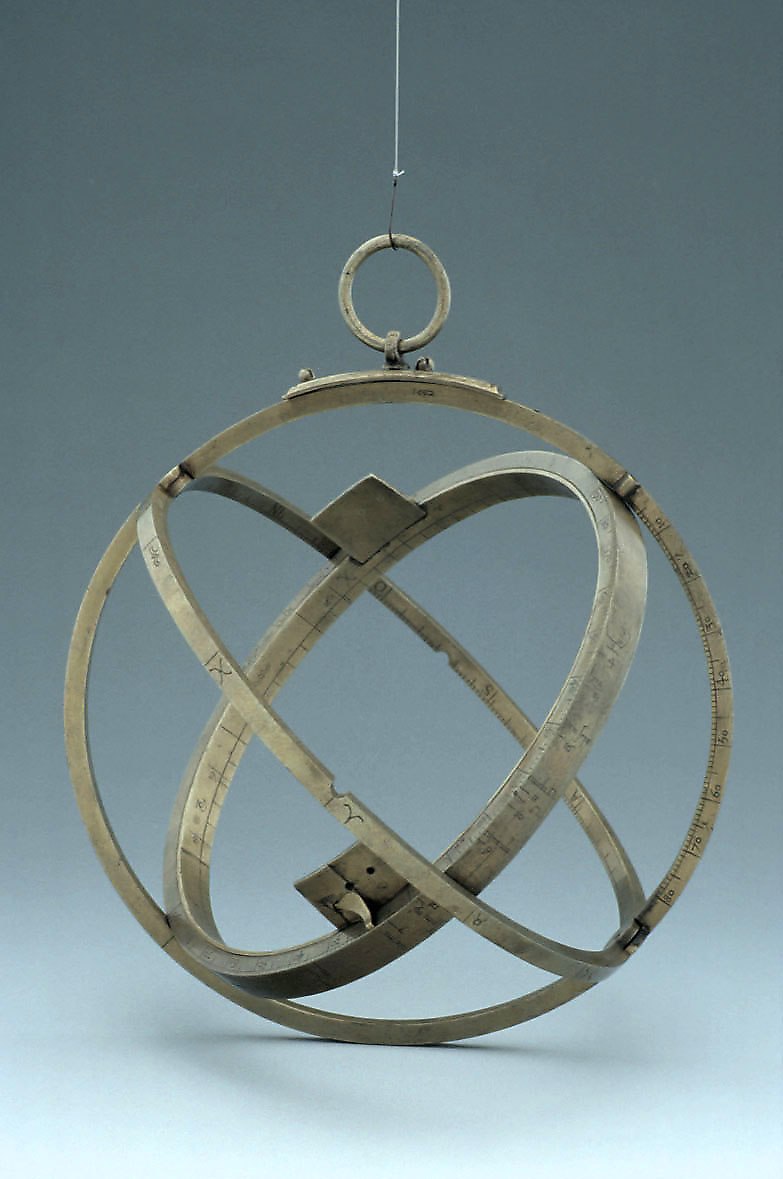
This astronomical ring dial, currently held by the Museum of the History of Science in Oxford, is an 182 mm diameter brass instrument. Although the piece is unsigned, it is attributed to Johannes Motter, active in Louvain during the mid-16th century, based on comparative analysis with signed and attributed examples in Brussels and Florence. The instrument conforms to the design described by Gemma Frisius, featuring folding meridian, equator, and declination rings, alongside a sliding inner ring equipped with sights. The dial is complex, incorporating latitude scales, polar distance quadrants, hour scales, shadow squares, and zodiacal calendars. Notably, the instrument includes the date '1602' engraved on the meridian ring; however, this marking appears in a style inconsistent with the rest of the object, suggesting it was added by a later owner long after the instrument's original construction.

The astronomical ring dial showing the meridian, equator, and declination rings, with the suspension ring at the top.
The astronomical ring dial showing the meridian, equator, and declination rings, with the suspension ring at the top. — Museum of the History of Science, Oxford. Rights pending — permission not yet requested. Original source

Catalogue identity

Source
www.mhs.ox.ac.uk
Category
Tool · Flemish astronomical ring dial
Maker / attribution
Johannes Motter
Reference
Not recorded
Catalogue / lot identifier
35171
Source-reported date
Mid 16th century
Source-reported place
Louvain

Source-reported attribution and specifications are not independent authentication. A listing does not establish present ownership, current display, availability or permission to reproduce.

Object description

Construction and Design

The astronomical ring dial is a brass instrument measuring 182 mm in diameter. Its architecture consists of a folding meridian ring, an equatorial ring, and a declination ring. This configuration follows the specific form documented by Gemma Frisius. The meridian ring serves as the frame, featuring a latitude scale divided from 0 to 90 and a quadrant for polar distance. The suspension plate, which attaches to the meridian ring, contains slots specifically designed to facilitate fine adjustments to the latitude setting.

The equatorial and declination rings are mounted within this structure, providing the primary mechanisms for solar timekeeping. The equatorial ring includes dual-faced hour scales, a shadow square, and a zodiacal calendar distributed across its outer and inner rims. The declination ring is similarly functional, carrying its own zodiacal and hour scales, and the outer rim is marked with the specific declination of twenty numbered stars to assist in celestial calculations.

Evidence for this section
  • “The instrument is in the form described by Gemma Frisius, with folding meridian, equator, and declination rings and a sliding inner ring with sights.”
  • “The meridian ring has a scale of latitude 0 to 90, divided to 10, 5 and 1, and numbered by 10.”
  • “The equatorial ring carries on one face a semicircle of hours 0 to 12 numbered by 1, with each hour subdivided to 20 and 4 minutes.”

Attribution and Dating

The instrument remains unsigned, yet it is attributed to the Louvain instrument maker Johannes Motter. This conclusion stems from comparisons with a known signed instrument by Motter in Brussels and another unsigned example in Florence. Examination of the engraving indicates that the style of these specific numerals differs significantly from the rest of the instrument's inscriptions.

The discrepancy in engraving technique supports the conclusion that the date was not inscribed by the original maker. It is therefore interpreted as a later addition by an owner rather than an indication of the instrument's initial creation. By disregarding this later mark, the constructional characteristics remain consistent with the mid-16th-century output associated with Motter's work in Louvain.

Evidence for this section
  • “Although unsigned, this astronomical ring dial has been attributed to Johannes Motter by comparison with a similar instrument signed by Motter now in Brussels.”
  • “However, the numerals of the 1602 date are engraved in a style distinct from the rest of the instrument, and therefore may have been added by a later owner.”

Functionality and Provenance

The sliding inner ring, which is slotted into the declination ring, contains sights with pairs of pinholes. These allow the user to align the instrument with celestial bodies. The internal rim of this sliding ring is calibrated with a zodiac scale and positions for twenty specific stars. This allows the user to perform conversions between the right ascension of stars and solar time, providing a multi-functional approach to navigation and timekeeping.

The instrument holds a documented history within the Lewis Evans Collection, which forms part of the holdings of the Museum of the History of Science in Oxford. The item is catalogued under inventory number 35171, representing its formal accession into the museum's collection of scientific instruments.

Evidence for this section
  • “The sliding ring slotted into the declination ring carries two sights, each with a pair of pinholes.”
  • “The inside rim carries a zodiac scale, with each sign represented by its symbol and divided to 5?, with single degree divisions along the edge.”
  • “Provenance: Lewis Evans Collection F. 42.”

Open research questions

  • What specific observational data confirms the instrument's accuracy for solar timekeeping relative to the stars identified on the declination ring?
  • Can petrographic or metallurgical analysis of the brass composition provide further evidence to solidify the mid-16th-century dating?

Source evidence

Recorded claims and source quotations for Astronomical Ring Dial
FieldSource-reported valueSource quotation
Inventory number35171“Inventory number: 35171”
Diameter182 mm“182 mm in diameter”
AttributionJohannes Motter“Attributed to Johannes Motter”
DateMid 16th century“Mid 16th century”
ProvenanceLewis Evans Collection“Provenance: Lewis Evans Collection F. 42.”
Added date1602“the date '1602', executed in a different hand from the rest of the instrument's engraving”

Visible details

  • The instrument is constructed from brass.
  • It features folding meridian, equator, and declination rings.
  • The sliding inner ring is equipped with a pair of pinhole sights.
  • The meridian ring includes a scale for latitude from 0 to 90 degrees.

Research qualifications

  • The attribution to Johannes Motter is based on stylistic comparison rather than a signature.
  • The '1602' date appears to be a later addition not reflective of the object's original manufacture date.

Photograph identity and source facts were screened before import; rights clearance remains pending.

Consulted source

Astronomical Ring Dial

Reviewed 2026-10-26 · Record 0bb098bffe

Terms in this record

Glossary explanations for terms named in this object’s record.